Introduction
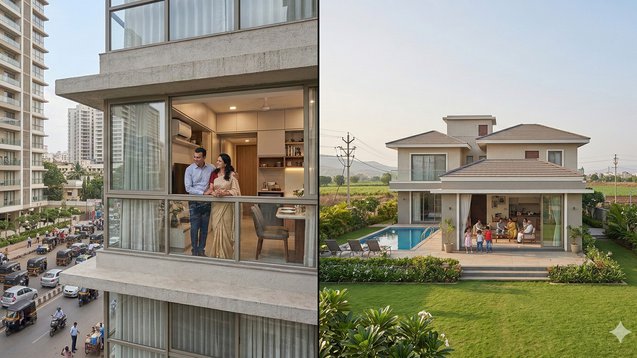
The two properties which you discover lie within your financial limit. The first property offers a small apartment located in a central area which provides you access to your job and nearby educational institutions and medical facilities and coffee shops and public transportation. The second property contains a large house located on the city outskirts which provides multiple large bedrooms and extended balconies and potentially additional spaces. The price? Almost the same. This situation represents the most frequent confusion which people face in the real estate industry. Which aspect should you select between location and space? Which aspect should you judge between daily convenience and square footage? Which aspect should you choose between immediate comfort and future growth? The answer to this question does not exist as a standard solution. Your preferred choice will depend on the combination of your daily activities and savings objectives and future plans. The process of making a decision based on emotional factors needs you to understand the available options.
The value of a prime location
The existence of prime locations provides easy access to essential services because they have developed infrastructure which connects them to multiple transportation options. The distance to businesses has decreased. The distance to educational institutions and medical facilities is short. The entertainment venues and retail stores together with essential services can be reached within walking distance. People who live in central areas experience shorter travel periods. The improvement brings a major advantage which enhances the overall life experience. People who spend less time driving experience more family time while achieving better work-life harmony and decreasing their transportation costs. The value of prime properties maintains its worth throughout time. Even if appreciation is moderate, demand remains consistent because location is always a key driver in real estate. The potential for rental income typically reaches higher levels. The main disadvantage of prime locations is that they require people to accept smaller living spaces and reduced parking facilities and increased upkeep expenses. Your family requires space which you must choose between convenient access or restricted mobility.
The appeal of a bigger home farther away
People who want to move between their current home and a distant home in a developing area usually find a larger space to provide immediate comfort. The design of the space creates a feeling of openness through its larger bedroom areas and its continuous living space and its extensive balcony space and its enhanced airflow system. Families with children may value additional space for study areas, play zones, or work-from-home setups. The process of storing items becomes simpler. The experience allows guests to spend the night in comfort. The area becomes more private. The developing outskirts contain modern buildings which feature contemporary designs and low traffic levels. The spacious layout of this house gives buyers better everyday comfort than a small upscale apartment which exists in prime real estate.
The main result creates delayed travel periods which restrict access to nearby facilities. The distance between schools and hospitals and shopping centers requires additional travel time. The daily process of commuting becomes an exhausting experience for both body and mind.
Commuting: the hidden cost
Distance measurement requires more than just kilometers because it encompasses both time and energy requirements. The extra time which results from choosing a remote property creates a direct impact on daily commuting. The total time which needs to be spent during the year will result in hundreds of hours dedicated to traffic. This situation impacts both work efficiency and physical well-being and time spent with family members. The total cost of transportation expenses will increase through rising fuel prices and vehicle upkeep costs and toll expenses and public transportation ticket prices. When you compare properties you need to determine both the purchase cost and the total costs which will occur during commuting throughout the entire period of property ownership. A smaller residence located in a desirable location provides greater lifestyle advantages than a larger residence situated in a more remote location.
Long-term appreciation and resale value
The future value of the property depends on its location to determine its resale market worth. The geographical area remains the most important factor which drives property value growth. Prime properties typically show stable demand, even during slower market cycles. Central access to properties remains the top preference for both buyers and tenants. The value of remote properties located in developing regions increases with infrastructure development because their appreciation potential reaches higher levels. Commercial hubs and highways and metro lines have the potential to convert remote areas into valuable districts through their future development. The process of growth remains uncertain because it may not proceed as expected. Buyers must research government plans, connectivity projects, and market trends before assuming appreciation. Your decision should prioritize locations which exhibit stability because your future resale plans require rental income.
Family needs and life stage
Your current life stage plays a crucial role in deciding. Young professionals who prioritize career growth and convenience often benefit from prime locations. The ability to work and network becomes easier with shorter commutes. Families that expand their home requirements because of growing children need study areas and play zones and privacy spaces. The city center distance becomes less important for families who have one or both parents working from home. Families with elderly members will choose prime locations because those areas provide easy access to healthcare services. Your daily routine should guide your choice more than market trends.
Lifestyle priorities: space vs accessibility
People choose between two lifestyle options which exist as space requirements and accessibility needs. The question which requires your attention asks you to determine which aspect of your life will bring you more happiness the upcoming day because of space restrictions or travel delays. Some families adjust easily to compact living if everything they need is nearby. The need for open space and privacy becomes essential because smaller homes make others feel tense about their living situation. Neither preference is wrong. The key is honest self-evaluation. A spacious home loses its charm if daily travel becomes exhausting. A prime apartment becomes restrictive through its narrow space which makes people feel stuck in every area of the apartment. People experience comfort according to their individual needs. Your family should establish its own definition for comfort.
Financial considerations and EMI pressure
The bigger distant property gives better value because it provides more benefits than the smaller property. The loan repayments need to stay within your budget limits. The total expenses for prime properties require higher payments per square foot, but their total savings through maintenance and commuting costs will decrease this expense difference. The first choice should suit your financial limits and the second option needs to remain within your budget. The property should match your financial capabilities which you established for your entire life. The need for stability requires us to choose this option instead of trying to achieve maximum space.
The ability to adapt in future
People should plan their future needs for the next five to ten years. Will your job location remain stable? Are you aware of upcoming infrastructure improvements that will occur around the remote property? Do you believe your family will need additional space as they expand? A prime location offers better long-term flexibility for professionals who need to travel between cities for their work. A larger house will provide benefits when two conditions exist: remote work becomes permanent and infrastructure development expands to remote areas. Future planning reduces regret.
Emotional and mental well-being
Daily life is structured through standard activities which include school drop-offs and grocery shopping and doctor appointments and office travel. Daily activities face less resistance because of convenient solutions. Daily traffic problems decrease through the use of space.
All emotional elements require your accurate assessment. The shorter travel time provides mental comfort which exceeds the value of having an additional bedroom. The presence of open spaces leads to better family relationships in certain situations. Select the surroundings which help you achieve inner tranquility.
Conclusion
A choice between smaller prime properties and larger remote properties requires evaluation of personal values rather than assessment of property value. Prime locations provide easy access to locations which lead to high resale value and reduced travel duration. Remote properties offer residents extensive room and comfortable living areas which tend to be less expensive than their urban counterparts. There is no universally correct answer. The right choice depends on your commute, family needs, financial comfort, and long-term vision. People need to approach situations with a practical mindset. People should analyze how their decisions will affect their lives throughout the day. People should focus on their upcoming ten years instead of only their upcoming twelve months. The ideal property needs to meet your personal requirements while providing your family space to grow without causing them added stress.
FAQs
1. Is location more important than size in real estate?
The value of a location establishes permanent value which exceeds all other factors, yet people need their space requirements to reach optimal balance. The right balance depends on personal lifestyle needs.
2. Do distant properties increase their market value over time?
Properties can increase their value through appreciation when their infrastructure development proceeds at a fast pace. People need to conduct research to understand which factors affect property value appreciation since this process does not operate as a guaranteed outcome.
3. How should I evaluate commute impact?
People should determine their daily traveling expenses and work-life balance effects before they select their distant property.
4. Is a smaller prime property better for resale?
Yes, because prime location properties maintain constant demand which makes smaller prime properties more valuable for resale.
5. What if my budget allows only one option comfortably?
People should select the option which maintains their financial situation at its current level without causing them anxiety.
6. Can remote work make distant properties more practical?
Distant properties become more useful for people who need to travel, because their larger homes provide better living conditions when they work from home.
Read more about property matters with our specialists and browse the latest property listings on Property Aaj. Download the app from the Play Store and App Store now for easy buying, selling, and renting!