Vastu for Children’s Room, Do’s & Don’ts
Introduction:
The design process for a house needs to focus on the children's room because this area requires special consideration for its significance. The space functions as a sleeping area for kids yet serves multiple purposes. Children use this area to study and play while developing their future identities through their imaginative activities. In India, parents prioritize establishing the ideal atmosphere for their kids because they believe Vastu Shastra provides guidance on this matter. The truth is that modern housing in cities such as Mumbai and Bangalore as well as Delhi NCR cannot achieve complete Vastu design because of spatial limitations and apartment design constraints. Space limitations combined with predetermined building patterns and small residential units force people to utilize existing materials. The actual inquiry centers on whether you can create an environment that achieves equilibrium while maintaining positive energy and practical usability for your kid. Nashik and Indore allow families to use their available space according to their preferences. The independent houses in Tier 3 towns provide homeowners with greater authority over their properties. The primary concept across these different segments remains consistent because a properly designed space will help children stay focused and maintain a positive emotional state while supporting their overall health. This blog presents Vastu guidelines which Indian homes should use to create children’s rooms. It will show readers how to implement practical Vastu procedures.
The Importance of Vastu Design in a Child's Bedroom Space
Children display greater environmental sensitivity than adults do. Environmental factors control their habits and their ability to concentrate and their sleep behaviour. Vastu exists as a system which helps people maintain equilibrium but it does not provide magical solutions for attaining better academic success and improved conduct. The established equilibrium creates a positive environment which helps people develop their skills. A room which receives sufficient natural light and has effective airflow and neatly arranged furniture creates an environment which people find attractive. A child prefers to study and read and think creatively when present in that environment. The design of narrow spaces in Tier 1 cities which contain multiple families will benefit from any layout changes which lead to better results. The larger spaces in Tier 2 and Tier 3 cities enable residents to practice Vastu principles more effectively. Homebuyers who use Property Aaj (https://www.propertyaaj.com) to search for properties now prefer homes which include "study space" and "natural light" and "ventilation" because these features match with Vastu principles. People should use Vastu as a guide which helps them make spaces better suited for children instead of seeing it as an obligatory checklist.
Ideal Direction for Children’s Room
The first question that people ask most frequently requires them to show which location they want to use for the children's room. Vastu prescribes the western and north-western directions as the best options for establishing children's sleeping areas. The two directions support three essential life skills which children need to develop during their early life stages. Most apartments in Tier 1 cities lack room placement options because builders create all building designs. Their final design. The solution requires you to concentrate on making the most of your existing facilities. The room design needs proper lighting and ventilation together with furniture placement to reach its full potential. Parents in Tier 2 and Tier 3 cities prefer to use Vastu guidelines for room assignments because those areas offer more independent home and larger flat options. The main point shows that while direction provides assistance to people, it does not serve as their only resource. The actual needs for a space require both functional aspects and comfortable design elements.
The study area is the essential space which a child needs for his or her room.
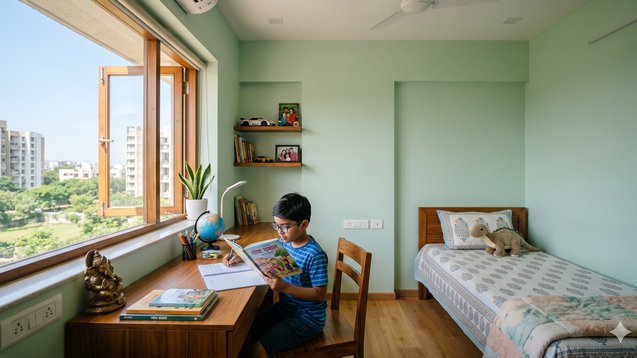
According to Vastu guidelines, the study table should face east or north while the child needs to study in those directions. The practice is believed to enhance both memory skills and concentration abilities. The practice has both practical and belief-based foundations. East-facing setups provide gentle morning light which creates comfortable viewing conditions. North-facing setups maintain their lighting balance throughout the entire daylight period. A study corner with bright light next to a window helps a Pune student with his board exam preparation. The study area in smaller homes serves as a combined space which occupies both the bedroom and the living room in Tier 1 cities. The desk position needs special attention when the study space is not large enough to accommodate a complete desk setup. A Property Aaj website (https://www.propertyaaj.com) now displays study-friendly layouts as a primary requirement which parents use to evaluate their properties. The design of the study area provides both comfort and effectiveness for students who need to study during their daily learning schedule.
Bed Placement and Sleeping Direction
Sleep functions as an essential element for both physical and mental growth in children. Vastu recommends that children should sleep with their head directed towards either the south or east. This practice is said to enhance sleep quality and emotional well-being. The bed should not be positioned directly below a beam or across from the door entrance. The two bed positions create an atmosphere that creates both discomfort and distractions. Space limitations in compact homes restrict residents' choices in cities that include Mumbai and Bangalore. The bed can be moved by a small distance which brings visible improvement to the situation. Better alignment becomes possible in Tier 2 and Tier 3 cities because bedroom space requirements have increased. Parents tend to ignore this element since they prioritize décor over layout design. Proper bed placement provides more comfort through its effect on sleep than through its visual appeal.
Lighting, Ventilation, and Natural Energy
The presence of natural light and airflow functions as the primary element which overrides all Vastu regulations. A bright, airy room automatically feels more positive. The system eliminates the requirement of artificial lights while maintaining the child's active and alert state. East or north-facing windows are ideal, but even if your home doesn't have them, you can maximize available light. People should use light-coloured walls together with window cleaning and curtain elimination to maintain proper indoor airflow through fans and ventilation systems. Buildings in Tier 1 cities face challenges with natural light because of their tightly constructed designs. In Tier 2 and Tier 3 cities, better spacing often allows more sunlight. The Property Aaj website (https://www.propertyaaj.com) displays listings which showcase "well-ventilated rooms" that create both Vastu-compliant and practical residential spaces. Modern design elements and traditional wisdom systems share complete agreement regarding this particular aspect.
Colours and Décor, Creating the Right Mood
Children's rooms use bright colours together with fun design elements. But balance is key. Vastu recommends soft, soothing colours like light green, blue, or pastel shades. These colours establish a peaceful atmosphere which helps people to concentrate better. People should avoid using extremely dark or aggressive colours because those shades will create an overwhelming effect which lasts throughout time. The décor should include only essential elements which convey special meaning. Excessive items result in visual disorder which makes it difficult for people to concentrate. A clean study area with a simple bookshelf and few toys demonstrates better effectiveness than an overcrowded room. Minimalist design has become essential for Tier 1 cities because of their limited available space. The space in Tier 2 and Tier 3 cities allows for more decorative items in larger rooms yet people must still maintain their space arrangement. A well-designed room should feel cheerful but not chaotic.
Dos for Children's Room as per Vastu
We will look at some things that really work in our homes. The room should be clean. It should be organised. If the room is messy it can make the children feel bad. They will not be able to study well. The room should have light. It is best if it is light. The table where the children study should be in the east or north part of the room. The room should have air. We can use windows or fans for this. We should use colours for the walls and the furniture. There should be some space where the children can play. This is especially important for children. Parents who are looking for homes on Property Aaj often think these things are more important, than following all the Vastu rules.. That is a good way to do things.
Don’ts for Children’s Room as per Vastu
Now, let’s look at what to avoid.
The study table should not face a wall that has no visual interruption between them.
The room should not contain excessive furniture and decorative items.
The bed space should not have mirrors that are placed directly opposite to it.
People should not forget about ventilation because closed spaces create health problems which decrease their ability to concentrate. The design should not include dark or dull colours. The design errors become more frequent in smaller homes because their limited space creates design challenges. Design errors become avoidable through effective space planning. The room needs to maintain its practical function beyond its visual design.
Real Estate Perspective: Why This Matters to Buyers
You might wonder how does this relate to real estate? The answer lies in buyer psychology. Families prefer homes that have well-designed children's rooms which provide good lighting and study areas and proper ventilation. In Tier 2 and Tier 3 cities, Vastu-friendly layouts become important because they help family buyers make their purchasing decisions. In Tier 1 cities, people prefer practical solutions but study spaces and natural light create additional benefits. The Property Aaj website (https://www.propertyaaj.com) shows that listings with particular features attract more attention from potential buyers. You can improve your property's attractiveness and resale value by building a child-friendly room even if Vastu guidelines are not part of your design process.
Conclusion: Balance Over Perfection
A child’s room needs design work which requires environmental design work rather than Vastu design work to achieve perfect results. A space that is well-lit, organised, and comfortable will always support a child’s growth better than a poorly planned “perfect” layout. Vastu provides guidance for you. The system helps you choose better locations and light sources together with design elements. The system should not limit your choices. The basic rules about residence design apply to both small Mumbai apartments and large Tier 2 city homes because people should design their homes to create comfortable spaces which serve their practical needs while maintaining proper balance. The combination of your child’s established habits together with his or her discipline and the home environment will determine his or her development more than the orientation of your home. Property Aaj (https://www.propertyaaj.com) allows you to search for homes which provide superior layouts and spaces suitable for children throughout India.
FAQs
1. Which direction is best for a children’s room?
The west or northwest direction is considered ideal. The west and northwest direction needs to be used as the second option when proper lighting and ventilation and layout creation fail to meet needs.
2. What is the best direction for a study table?
The study table should face east or north as its optimal direction. The study area will become more effective when natural light flows into the space which helps students concentrate.
3. What colours are suitable for children’s rooms?
The recommended soft colours for children’s rooms include light green and blue and pastel shades because they establish a peaceful and positive atmosphere.
4. Can Vastu really improve a child’s performance?
Vastu does not enhance performance but it establishes an environment that assists people in maintaining their focus and disciplinary practices.
5. Is Vastu important in small apartments?
The answer is yes with flexible implementation. Small changes to furniture arrangement and lighting design can produce significant results.
6. What is the biggest mistake parents make in children’s rooms?
Parents make the mistake of putting too much furniture and décor into the space with their multiple items. A room needs to maintain a clutter-free organized state to achieve maximum efficiency.