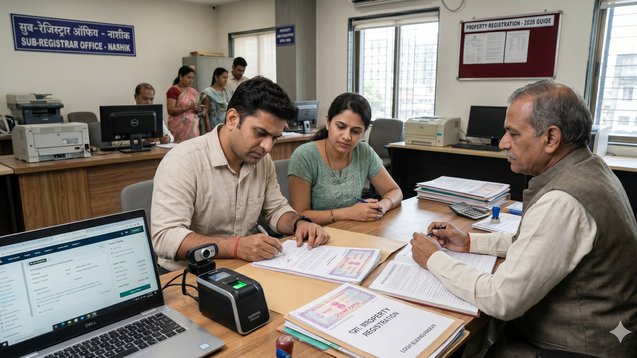
Registry Process Explained Step-by-Step (2026 Guide)
Buying a property in India requires more than just completing the purchase agreement and making the payment. The real moment of ownership happens during the registry process. This process establishes your legal ownership of the property because it records your name in official government documents. Skip or mishandle this step, and even a fully paid property can become a legal headache. Digitization has streamlined the registry process in multiple states by 2026. The actual situation on the ground continues to show significant differences between locations. Online appointments and e-stamping have improved efficiency in Tier 1 cities such as Mumbai and Bengaluru and Delhi. The process in Tier 2 cities such as Nashik and Jaipur and Tier 3 towns still requires manual operations combined with local agent assistance which leads to extended waiting periods.
What happens during the property registration process?
What documents are required? How much does it cost?
The most important question requires an answer about how to eliminate errors. This guide presents the complete registry procedure in a practical format that users can easily follow through each of its stages. This guide will assist you in confidently navigating the entire process of buying your first home or investing in a plot throughout India.
What Is Property Registration and Why It Matters
The process of property registration establishes a legal framework which enables the government to record property transactions through the Registration Act. The process establishes your ownership rights through legal documentation. The ownership of a property cannot be established through a signed contract and complete payment until the property registration process is completed. Sounds surprising? But it’s true. The banking and construction industries in Tier 1 cities require customers to follow property registration processes which they establish to qualify for home financing. Some buyers in Tier 2 and Tier 3 cities use informal contracts to avoid stamp duty expenses, but this practice creates high risks that result in legal conflicts. The government maintains your registered property information in official records which enables you to establish ownership rights and conduct property transactions in the future. The Property Aaj platform provides information about legally verified properties, but buyers must complete the registration process to take responsibility for their property ownership.
Step 1: Finalizing the Sale Agreement
Before you register your property the buyer and the seller will sign a Sale Agreement. The Sale Agreement is a document that talks about the Sale Agreement terms like the price you pay when you pay and when you get the property. The Sale Agreement is like a plan for the Sale Agreement. In cities the Sale Agreement is very detailed and checked by lawyers.. In smaller cities the Sale Agreement might be simple and not very clear. So buyers of the Sale Agreement need to be careful. For example, let's say you are buying a flat in an area. The Sale Agreement says you will get the flat "within 6 months". It does not say what happens if it is late. That is a problem with the Sale Agreement. You should make sure that the Sale Agreement has:
All the financial terms of the Sale Agreement clearly written
The correct carpet area of the property in the Sale Agreement
The timeline for the Sale Agreement is clear
When you sign the Sale Agreement it becomes the basis, for the Sale Deed when you register the property and the Sale Agreement.
Step 2: Check The Property Title. Do Legal Checks
Before you register the property you need to make sure it is legally okay. This means you have to check some things like:
Title Deed
Encumbrance Certificate
RERA registration if it is needed
Land use approvals
In cities people usually do legal checks.. In smaller cities some buyers do not do this to save time or money. This is where the problems start. For example someone who buys a property in a town might find out later that the land was used for farming and not for houses. The best thing to do is to get a property lawyer to help you. Even if you found the property on Property Aaj it is still an idea to do your own legal check. This way you can be completely sure that everything is okay, with the property. Get a property lawyer involved. You will have complete peace of mind with your Property Aaj purchase.
Step 3: Stamp Duty Calculation and Payment
Stamp duty is a tax you pay to the state government to make the property purchase official. This tax varies from state to state in India.
Maharashtra: You pay around 5 to 7 percent.
Karnataka: The stamp duty is between 5 to 6 percent.
Delhi: It ranges from 4 to 6 percent. Women buyers get a lower rate.
states: The rates are often lower or more flexible.
To calculate stamp duty the government looks at two things: the agreement value of the property and the government circle rate. The circle rate is the price at which a property can be registered. In cities like Mumbai and Delhi the circle rate is close to the market price. In towns there is a big difference between the circle rate and the market price. Some people used to underreport the property price to pay stamp duty but this is decreasing because of strict rules. You can pay stamp duty in two ways:
E-stamping: This is common, in cities.
Physical stamp paper: This is still used in areas.
Always keep the receipt safely. You will need it when you register the property.
Step 4: Drafting the Sale Deed
The Sale Deed is an important document. It helps transfer ownership from the seller to the buyer in a way. This document has:
Buyer and seller details
Property description
Transaction value
Payment confirmation
Possession clause
In cities lawyers or builders usually write Sale Deeds. In towns local deed writers often do it. Here’s a problem. Small mistakes in the Sale Deed can cause big problems later. For example wrong property boundaries or spelling mistakes, in names can delay registration. Create legal issues. It is always an idea to review the Sale Deed carefully or get it checked before proceeding with the Sale Deed.
Step 5: Booking Appointment at Sub-Registrar Office
When you have all your documents ready and you have paid the stamp duty you need to book an appointment at the Sub-Registrar Office. You can do this online in cities like Mumbai or Bengaluru. This way you can choose a time that suits you. You do not have to wait in long lines. In towns people still just go to the office without an appointment but you never know how long you will have to wait. On the day of your appointment at the Sub-Registrar Office:
Buyer, seller and two witnesses must be there
You must bring the documents with you
You must also bring your identity proofs
It is very important to be on time. If you miss your time slot in a city like Mumbai or Bengaluru you might have to wait for days to get another appointment. So it is an idea to plan ahead when you are booking an appointment at the Sub-Registrar Office. This can save you a lot of trouble.
Step 6: Biometric Verification and Document Submission
The Sub-Registrar Office functions as the official starting point of the process. You will complete three steps which involve:
Biometric verification which requires fingerprinting and photographic identification
Document verification
Final confirmation of details
The process in Tier 1 cities operates through digital systems which result in faster processing times. The process in Tier 2 and Tier 3 offices requires more time because staff needs to perform manual document assessments.
The registrar ensures:
All documents are valid
Stamp duty is paid
Parties are genuine
The Sale Deed receives registration after the party reaches the required level of satisfaction. This moment establishes your ownership as legally binding.
Post-registration, mutation & record alteration.
The registered title is not the end of the property transaction; mutation is an equally vital phase. With mutation, local municipalities or revenue departments will update their property records with the new owner's name. Why is this important?
Property tax bills can be sent under your name.
Ownership will be correctly reflected in future resales.
Reselling will be easier (future ownership records will be accurate).
Mutation can occur via an electronic application for cities/towns; however, in smaller towns, mutation must be done by a manual process. If you fail to complete a mutation, you may run into problems later on, either through resale or inheritance.
Step 7: Registration Fees and Final Signing
The registration fee, which amounts to approximately 1% of property value, serves as an additional expense that must be paid together with stamp duty. After verification:
Both parties sign the Sale Deed
Witnesses sign
Registrar approves the transaction
The process now includes digital signatures and scanned documents in multiple states. All processes in smaller towns continue to use traditional paper documentation. The deal becomes official once all parties sign the document and receive their approval.
Step 8: Obtaining the Registered Sale Deed
Following registration, you will obtain a registered Sale Deed. Many Tier 1 cities now provide a digital copy of your registered Sale Deed within several days and only require the original (physical) document from the Tier 2 and Tier 3 areas. The registered Sale Deed will serve as proof of ownership for the buyer (and the seller). Make sure that you have several originals (the number can change, so verify) and store them in a safe place, because if you lose the original, you will have to go through complications, but you will be able to get a certified copy of the lost/deleted Sale Deed from the county office where the deed was registered. Property Aaj allows its customers to browse properties online using verified properties. Many Property Aaj customers complete this process quicker than others because their initial registrations of the properties have been streamlined.
Mutation & Record Change after Registration
Registration is not the last step, but mutation is equally important to the ongoing process. Mutation is the method of updating the local government records (local municipality or revenue sites) with your name for property. Why is it so important to me?
our property tax bill will arrive in your name.
Proof of Ownership will be updated (to you).
Resale of the property will be much easier for you to complete at a later date. In cities, reconciliation can be completed online; however, in smaller municipalities, they may require a physical application to complete. Not completing mutation may create problems down the road, especially when the property is sold or willed.
Common Mistakes Buyers Should Avoid
Today a lot of people who are buying properties make mistakes that can be avoided when they are registering their properties. Some of the mistakes that buyers make include:
Underreporting the value of the property
Ignoring the verification of documents
Not checking if the stamp duty calculations are correct
Skipping the mutation process
Relying entirely on property agents
In cities like Tier 1 cities buyers often make mistakes that cost them money. In cities like Tier 2 and Tier 3 areas buyers often make mistakes that have to do with the law. A good way to avoid these mistakes is to have an approach, which means you need to know about the law and about money. Using websites like Property Aaj can make it easier for you to find a property. You have to be careful when you are registering your Property Aaj purchase to make sure your investment in Property Aaj is really safe.
Conclusion: Registration Is Where Ownership Becomes Real
Property buying involves emotional factors while registration needs technical execution. Both aspects hold equal value in the process. You may fall in love with a home during your first visit. But the home becomes yours after you complete the registration process according to legal requirements. The core process of property buying in India stays constant across all locations from metropolitan areas to developing Tier 2 cities and small towns. Take your time. Double-check documents. Understand the costs. And don’t hesitate to seek professional help. Property registration creates ownership rights which bring confidence, security and peace of mind. Every property investment needs to deliver these results according to standard business practices.
FAQs
1. How long does the property registration process take in India?
Registration in Tier 1 cities requires only one day for completion when all necessary documents are prepared. In Tier 2 and Tier 3 areas, it may take a few days due to manual processes and scheduling delays.
2. Can property registration be done online in India?
Many states provide partial online services which include appointment booking and stamp duty payment options. Biometric verification and final signing both require physical presence at the site.
3. What happens if I don’t register my property?
Your ownership remains unprotected until you complete the registration process which establishes your legal rights to the property. The absence of registration will create problems for you because it will lead to ownership conflicts and difficulties with property resale and loan acquisition and ownership transfer processes.
4. Are stamp duty charges the same across India?
The states of India impose different stamp duty rates which may also change based on the applicant's gender and the type of property being transferred. The tax assessment process requires property owners to pay between 4% and 7% of their property's total market value.
5. Do I have to do mutation after I register my property?
Yes mutation is necessary to update the government records and make sure that the property taxes are, in your name. This also makes it easier to sell the property in the future.
6. Can I register my property without getting a lawyer?
Yes you can register your property without a lawyer. It is not a good idea. A lawyer will make sure that all the documents are correct and legal which reduces the chance of problems coming up later with your property registration.