Introduction
The question about space requirements first appears when families reach their moment of assessment. The first question emerges after a family welcomes their first child into the world. The second question operates as children reach their adolescent phase and request to have their own separate space. The third situation emerges when people start to experience unexpected financial challenges because of their monthly payments. Every family has their unique definition of what they consider to be adequate living space. The assessment requires more than measuring square footage and counting bedrooms. The assessment needs to evaluate how well your home supports your daily activities. The amount of space you need to meet your life needs in Noida apartments and Gurgaon builder floors and Yamuna Expressway independent homes depends on your life pattern and financial capacity and future objectives. We will present the information through a method that provides both practical and accurate understanding.
Space Is About Function, Not Just Size
Many property listings highlight total area as the main selling point. A 1,900 sq. ft. home looks more impressive than a 1,400 sq. ft. one. But numbers can be misleading. Usable space constitutes the most important element. A poorly designed home may waste square footage through its long hallways and oversized entrances and its useless awkward corners. A thoughtfully planned smaller house creates an atmosphere of openness and brightness and efficient design. Your daily routine at home starts the moment you enter a property. The children need a designated space to store their school bags. The kitchen needs to accommodate two people who want to cook together. The room needs sufficient space for walking when the furniture is arranged. The functionality of a space depends on its building design which exists outside its actual dimensions.
Family Structure and Age Groups Matter
The number of family members plays a major role but age becomes equally important. The needs of a couple with one toddler differ from those of a family who has two teenagers and elderly parents. Young children can share rooms comfortably but teenagers require personal space to study and have private time. Senior citizens need access to ground-floor bedrooms which provide direct entry to bathrooms. Your family size will determine which home size protects your needs when your parents move in or when you have more children. Current space requirements and future requirements must guide space planning decisions.
Bedrooms: Think Beyond Today
Most urban families choose between 2BHK and 3BHK configurations because these two options represent their preferred home size. The decision should not be about status, but practicality. A 2BHK may comfortably suit a couple with one young child. A 3BHK provides flexibility through A separate room for work-from-home A guest bedroom for visiting relatives Individual rooms as children grow older. Many families initially feel a 2BHK is sufficient but later struggle when both parents begin working from home or children need separate study areas. Planning ahead avoids frequent relocation.
The Living Area: Where Family Life Happens
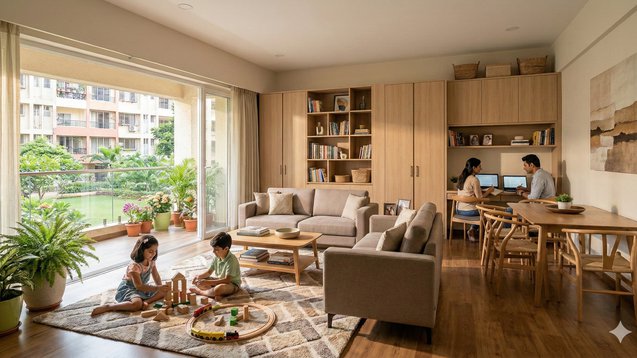
The design of bedrooms functions as private sleeping areas, yet the living space serves as the primary area for family interaction. The space serves as a playground for children and a reception area for guests and a place for people to talk throughout the day. The small size of the living room space creates difficulties for people who need to do their regular tasks. A living room space becomes problematic when its dimensions reach a point of excessive space. Homeowners achieve greater spatial perception through open floor plans that connect their dining and living areas. The design purpose exists for comfort, which extends beyond visual appeal.
Storage: The Silent Space Multiplier
Families accumulate goods that accumulate even more than people initially project. The storage needs of families also consist of diverse items such as toys and clothing, school supplies, celebration decorations, kitchen supplies, and files/records. Without appropriate storage systems in place, clutter will accumulate rapidly in an uncontrolled manner. People have limited accessible space for movement in their homes when they do not have organized storage systems available to them. Here are some examples of some of the more obvious types of storage:
Wardrobes built into walls
Kitchen cabinets with adequate depths
Utility areas
Loft storage spaces above the ceiling of a building
Extra cabinet space
The way the storage space is designed creates a roomier looking space than what it actually is by creating an illusion of its size while still having the same amount of usable floor area as originally intended.
Work From-Home and Study Corners
The design of modern homes needs to create spaces which help people work efficiently at their tasks. The rise of remote work among parents has created a need for children to have quiet spaces which support their online classes and study requirements. People can use their dining table for work but this solution causes stress when it extends beyond the first few days. The creation of even a tiny study area leads to better concentration and decreased interruptions. The selection of space requires you to answer this question: The location of office calls should be established. Can children prepare for exams without noise disturbance? The home office space requires flexibility for future development. Space should support both family bonding and individual productivity.
Outdoor Areas and Natural Light
The emotional value of a home increases through the addition of balconies and terraces and small gardens. The areas provide children with safe outdoor spaces which children can use for fresh air and relaxation. Natural light and ventilation determine the extent to which a home appears spacious. A smaller, well-lit home often feels larger than a poorly ventilated bigger property. When you visit a property you should pay attention to the following aspects of the building. The building's daylighting system controls how much light enters the building at different times.
The building's air circulation system
The building's design determines whether spaces feel tight or open. The factors involve more than space measurements because they determine how comfortable people feel.
Privacy and Emotional Space
The closest family members require their own personal space which teenagers need to develop their independence while parents require times of silence and elderly people need peaceful environments to rest. Better home design exists when private spaces stay apart from shared spaces. The design of homes which place bedrooms away from living rooms creates a quieter space which improves residents' comfort. People experience emotional effects from both physical and non-physical space. Overcrowded situations lead to increased stress. Excessive isolation creates a bond that people find difficult to break. The ideal home design creates spaces for family time together with private areas.
Budget Considerations
Stretching your finances for extra space may create long-term pressure. The higher EMIs decrease your savings capacity and your ability to spend money. Choosing a very small home to save money will end up creating discomfort which leads to an early resale of the property. You need to answer this question with complete honesty about your situation. The monthly payments offer us a financial agreement which we can handle without any problems. The purchase includes extra space which will not be utilized throughout the entire property. The space we need to evaluate must serve our needs for five to seven years.
People find more financial peace at home when they choose a budget-friendly house compared to a big house which creates financial strain.
Practical Space Guidelines
Urban families follow general guidelines which apply to all families because each family has its own distinct characteristics. A small nuclear family can live comfortably in a 2BHK apartment which requires 900 to 1200 square feet of space. A 3BHK space which measures 1300 to 1800 square feet allows families to adapt to their evolving needs. Joint families together with households which need home office space and guest accommodations will benefit from larger residences. The benchmarks establish standards which you can use as a guide to measure your progress toward your goals. Your lifestyle matters more than numbers.
Conclusion:
The right amount of space is not defined by brochures or trends. It is defined by how comfortably your daily life fits into your home. The space requirements need to provide sufficient space which enables children to study without interruptions. The space requirements need to provide sufficient space which enables parents to complete their work tasks without interruptions. The space requirements need to provide sufficient space which allows people to spend time alone when they want to. The area for socializing helps people build relationships with each other. The space requirements need to provide enough storage space which helps people manage their belongings.
The space requirements need to provide sufficient space which allows parents to complete their work tasks without interruptions. Before you choose a property, your family needs to come together and discuss your actual needs which should take priority over your emotional responses. Your home reaches the ideal size when it naturally supports your daily activities while creating a peaceful atmosphere which does not make you feel stressed.
FAQs
1. Is bigger always better when choosing a family home?
The financial issues which arise from larger houses when their extra space remains unoccupied prove that people need to evaluate their home options based on their actual space requirements. The design of a building shows better value when designers create optimal spaces through effective architectural solutions than through their architectural footprint.
2. Is 2BHK enough for a family of four?
The space becomes adequate for a family when their children reach young adulthood and the family does not need more space. The requirement for personal space will become more important as the children become older.
3.Should we buy extra space for future planning?
The practice of financial research enables organizations to prepare for their future development needs when their budget allows it. The practice of financial research forces individuals to make budget decisions which exceed their actual future spending requirements.
4. How important is storage when calculating space?
The answer to this question shows its high value. Proper storage solutions establish order which transforms medium-sized apartments into large open spaces.
5. Does natural light really impact how spacious a home feels?
The answer is affirmative. The combination of bright light and airflow which enters a home through its windows creates a bigger and more pleasant atmosphere than the atmosphere which exists in dimly lit restricted areas.
6. What matters more: bedroom size or common areas?
The two elements hold equal weight because common areas serve as shared spaces which people use throughout their daily activities.
Read more about property matters with our specialists and browse the latest property listings on Property Aaj. Download the app from the Play Store and App Store now for easy buying, selling, and renting!