Introduction
The concept of location undergoes a complete transformation when people become parents. The definition of the term location changed from office distance and resale potential and metro station nearby access to its current definition. The arrival of children brings with it a complete shift in your thought process which introduces different questions into your mind.
Is it safe for them to play outside?
Do the streets offer sufficient illumination?
Who resides in the next house?
What distance separates us from the closest medical facility?
The process of selecting the ideal neighborhood in India holds equal importance to selecting the best house. An attractive apartment situated in a dangerous area that lacks proper urban design results in everyday anxiety. A basic residence located in a secure neighborhood which families prefer brings residents both safety and mental calmness. The evaluation process for a neighborhood in India requires different approaches depending on whether you select Tier 1 metro areas like Bengaluru and Mumbai or Tier 2 cities such as Indore and Lucknow or Tier 3 developing towns.
Look Beyond Property Price Study the Surroundings
The attractive nature of affordable pricing leads people to choose it. The area will become unsafe to enter because it lacks proper safety infrastructure, which will turn your initial good deal into an emotional burden in the future. The Tier 1 cities between different micro-markets charge different prices because they provide better civic services and police protection and planned residential areas. The rapid growth of Tier 2 cities creates areas where development progresses more quickly than safety measures can keep up with. The community knows its residents better, which creates safer conditions for the town. The best way to study the local area requires you to visit its different time periods, which include morning, evening, and late night if you can. The three elements to examine include traffic flow patterns, street illumination levels, and overall neighborhood activities. A safe neighbourhood provides a peaceful atmosphere which people find comfortable to walk around. A safe neighbourhood provides people with protection while they walk through its peaceful streets. When you search for apartments on Property Aaj, you must investigate the local area as thoroughly as you examine the apartment itself.
Check Street Lighting and Road Conditions
The basic task requires people to perform it, but its importance exceeds what most people understand. Well-lit streets discourage criminal activity. Proper roads reduce accident risk. Footpaths protect children and elderly family members by providing them with secure walking areas. The developed areas of Tier 1 cities show better municipal lighting systems, which exhibit different capabilities between two areas that are only a short distance apart. The newly developed areas of Tier 2 cities feature good road systems, but their street lighting remains inconsistent. The efficiency of local governance determines the street lighting system in residential areas.
The best way to study the local area requires you to visit its different time periods, which include morning, evening, and late night if you can. The three elements to examine include traffic flow patterns, street illumination levels, and overall neighborhood activities.
A safe neighbourhood provides a peaceful atmosphere which people find comfortable to walk around. A safe neighbourhood provides people with protection while they walk through its peaceful streets. Children grow into teenagers quickly.
The safe environment of today needs to maintain its security for when children start to explore their surroundings.
Evaluate Traffic and Accessibility
The presence of heavy traffic creates both operational difficulties and dangers which particularly affect child safety. The first question investigates whether the property exists on a main highway while the second question checks whether speed breakers exist in residential lanes. The third question investigates whether drivers exceed speed limits in that specific area. The fourth question investigates the presence of safe pedestrian crossing facilities. Gated communities in Tier 1 cities establish their own internal roads which provide safer walking areas for kids. In Tier 2 cities residential townships have become the preferred housing option. In Tier 3 towns inspectors must examine independent houses which face busy streets because these are dangerous locations. The property which faces main roads remains less secure than the internal area of a good residential pocket. People decide between visible public spaces and quiet spaces which provide better protection.
The Community Profile requires observation
People who reside in the neighbourhood create an essential value. The area functions as a residential space or develops into a mixed-use area which contains commercial stores and office buildings. The area contains families who have children or it serves as temporary housing for short-term guests. The tenant turnover rate in business districts which surround Tier 1 cities exceeds that of other areas. Family-oriented neighbourhoods in Tier 2 cities present easy ways for people to locate their homes. The social network of a community base enhances safety at all public places in Tier 3 towns. residents should exist to speak to. Residents should answer basic questions which require information about security and water supply and local problems. Families who establish relationships with their neighbors create a neighborhood environment which provides them with a safer feeling. The strongest invisible safety net which protects the community requires people to stay aware of their surroundings.
Proximity to Schools and Healthcare
Safety encompasses two main aspects which include crime prevention measures and emergency response protocols. The following elements should be assessed for evaluation purposes Distance to reputable schools Nearby pediatric clinics Availability of 24-hour hospitals Pharmacy access. Tier 1 cities provide strong healthcare access which becomes problematic when traffic delays medical emergencies. Tier 2 cities experience fast infrastructure development. In Tier 3 towns, quality hospitals may be limited, so proximity becomes crucial.
A neighbourhood close to essential services reduces risk and improves daily convenience.
To find properties through Property Aaj, users should first measure their distance from critical locations before they make their final selection.
Check Law and Order Reputation
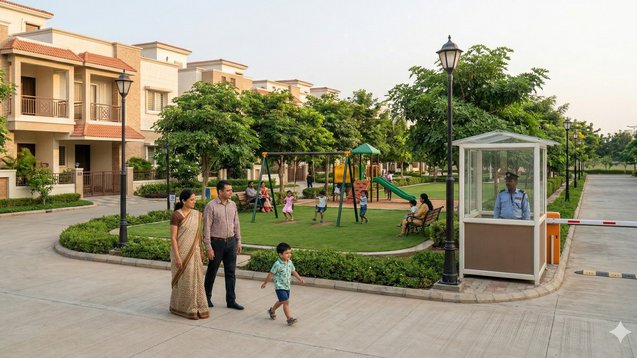
Cities contain distinct locations which demonstrate good safety standards, while their other parts experience challenges with law enforcement problems. The research requires access to two types of data: Crime statistics which exist in public records and the distance from local police stations to various locations and the activities of resident welfare associations and the security measures maintained throughout the region. The organized societies in Tier 1 cities use private security and CCTV networks to protect their areas. The new developments in Tier 2 cities increasingly offer gated security systems. The residents of Tier 3 towns depend on neighbourhood watch programs to protect their independent homes. The implementation of entry point security personnel, visitor log systems, and CCTV cameras results in enhanced safety conditions which people perceive as safe. The builder and society management will provide you with security details which you need to ask about.
Look for Child-Friendly Infrastructure
The definition of a secure neighborhood includes both protection from hazards and its function as a space for personal development. The assessment requires checking. The assessment requires checking. The assessment requires checking. The assessment requires checking. The assessment requires checking. The assessment requires checking. The assessment requires checking. The assessment requires checking. The assessment requires checking. Integrated townships in Tier 1 cities provide citizens with organized recreational areas. Tier 2 cities maintain their municipal parks in better condition through their maintenance efforts in premium areas. The three-tier municipal system provides open space access to Town 3 residential areas which lack organized recreational spaces. Physical activity forms an essential requirement for children. Outdoor play by children in a neighborhood space leads to decreased screen time which results in better social skills development. Safety and opportunity should exist as interconnected elements.
Noise Levels and Environment
The sound environment creates a negative impact on children because it disturbs their sleep and their ability to concentrate which leads to mental health problems. The property owners need to avoid properties that exist within proximity to The property owners need to avoid properties that exist within proximity to. New projects in Tier 1 cities use double-glazed windows to decrease sound pollution through their window design. The most effective method for location selection exists as the primary solution in Tier 2 and Tier 3 cities. The assessment requires checking. The assessment requires checking. Properties located near green belts or less crowded areas provide superior breathing conditions to their occupants.
A quiet environment creates a space that promotes better health during childhood development.
Long-Term Stability of the Area
The process of growing up continues until people reach adulthood. The transformation of communities takes place over time through their ongoing development.
The following two questions need answers:
Does the area currently have any upcoming infrastructure development work scheduled for execution?
Will the area eventually develop into a commercial zone according to future projections?
The area will undergo construction work for both highways and industrial facilities which will occur within the vicinity.
The rapid development of Tier 2 cities can transform their entire character within a five-year period.
The micro-market future growth plans serve as essential criteria when assessing Property Aaj listings.
You prefer a neighborhood which develops into better condition throughout time instead of becoming more noisy and populated.
Trust Your Instinct After Research
The area needs to be spent on for a research break after all the analysis work has been done.
A nearby park provides space for sitting. I observe the way children engage in their play activities. I see the way people in the community interact with each other. I watch the security personnel who are present at the location. Do you feel relaxed? Or slightly uneasy?
Parents possess an ability to detect underlying threats which exist beyond their conscious awareness and this instinct proves to be essential.
Safety exists beyond numerical data. Safety requires people to feel at ease.
Conclusion
The first safe neighbourhood selection process for your children represents the most critical choice in your real estate selection process. The first-tier cities demand businesses to select specific micro-market areas for their operations. The second-tier cities present a dual advantage because they provide affordable options while their infrastructure development progresses. The third-tier towns offer residents a sense of familiarity yet require residents to conduct thorough checks of local government standards. The evaluation process needs to consider six factors which include lighting facilities, traffic management systems, community cultural elements, school and hospital proximity, and the ability to maintain stability over time. The platform Property Aaj operates as a trustworthy resource which allows users to investigate both property details and information about the surrounding area and transportation routes before they make their final choice. The home functions as a protective shield which keeps your family safe. The neighborhood creates the atmosphere which your child will experience throughout the day.
Make your choice with caution.
FAQs
1. How can I check if a neighbourhood is safe?
The person needs to visit the location at various times throughout the day and assess both the illumination and traffic conditions while interviewing local residents and checking the availability of local crime records.
2. Is a gated community always safer?
The answer is yes because controlled entry points and security systems protect the premises. The level of security depends on both the location and the effectiveness of security management at the site.
3. Are Tier 2 cities safer than Tier 1 cities?
The safety of an area depends on its specific location instead of its classification as a Tier 1 or Tier 2 city. The majority of Tier 2 cities provide peaceful living spaces, but researchers must study individual locations for their findings.
4. How important is proximity to a police station?
Police station proximity provides advantages, but it functions as one of several essential elements. The security arrangements established at the community level, together with the activities of resident associations, hold equal significance.
5. Should I avoid mixed commercial-residential areas?
The presence of commercial activities in residential sections creates noise disturbances that make these areas less suitable for families who have young children.
6. Does higher price always mean safer neighborhoods?
The statement does not hold true. Premium regions contain superior infrastructure, but thorough inspection remains essential for all areas.