Introduction
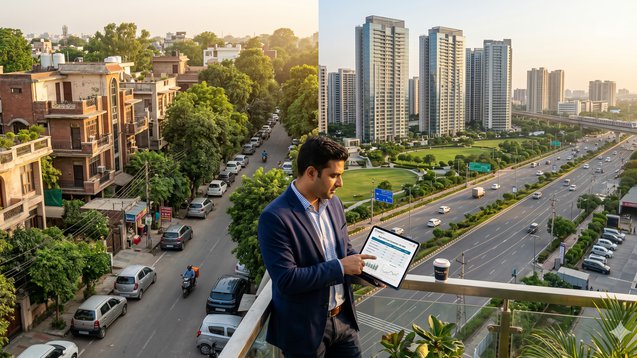
The National Capital Region (NCR) presents a distinct visual contrast between the historical Mughal architecture of Old Delhi and the modern glass structures of Gurgaon and Noida. The discussion in 2026 now encompasses aspects beyond first impressions. The contemporary Indian worker must handle two opposing forces which combine high living costs with increasing real estate values. The multiple urban centers which develop in NCR expansion create a situation where residents find it increasingly difficult to maintain affordable housing. Which option provides better value: paying extra for central Delhi residence or choosing Noida which offers planned community advantages? Homebuyers in 2026 now seek more than a specific pin code according to Property Aaj (https://www.propertyaaj.com) because they want to find an entire community. The rising inflation rate affects all expenses from basic groceries to educational costs which reduces the "disposable income" needed for home loans. The development has created an intriguing process which results in value transfer to different locations. The middle class which aspires to advance its social position now sees Noida and its surrounding areas as their best option to achieve their goals even though Delhi remains the most respected destination. Through this analysis we will examine how daily cost patterns interact with property prices throughout the NCR which creates a pattern that shows cities outside major metropolitan areas are becoming economic growth centers for India.
The Delhi Premium: Heritage vs. Household Budgets
Delhi in 2026 maintains its high market value because of its limited land availability and its developed social systems. The premium builder floors in South Delhi upscale areas such as Vasant Kunj and Saket have reached their current market value which ranges between ₹20,000 and ₹35,000 per square foot. The Dwarka planned hubs have experienced consistent price growth of 6 to 8 percent every year which brought their prices to an average of ₹15,500 per square foot. The high property price represents only one aspect of the situation. Residents in Delhi experience a cost of living that exceeds expenses faced by people in neighboring areas by approximately 15 to 20 percent. The monthly expenses for a family reach substantial amounts because they face both increased electricity costs and the "convenience tax" which comes from living in a crowded metropolitan area. Non-housing expenses for a typical middle-class family of four in Delhi range from ₹45,000 to ₹70,000 every month. The "Delhi address" has become an expensive requirement for people who need two incomes just to cover basic living costs. Young families at Property Aaj (https://www.propertyaaj.com) face financial difficulties which lead them to choose the "planned" areas of the city.
The Noida Advantage: Planned Efficiency and Value Migration
The city of Noida has transformed itself from an industrial suburb during the year 2026 to emerge as the most affordable area throughout the National Capital Region. The market entry point for Delhi residences remains more affordable because Noida offers 2BHK properties that cost between ₹45 lakh and ₹75 lakh. The average property rate in Noida stands at approximately ₹12,900 per sq. ft., providing a "space-to-price" ratio that Delhi simply cannot match. The real draw, however, is the controlled cost of living. Noida’s wider roads decrease fuel usage and shorten travel durations, while its numerous organized retail stores and street markets maintain stable grocery prices. Monthly living expenses for a family in Noida are often ₹10,000 to ₹15,000 lower than in Delhi for a comparable quality of life. The money that buyers save from their home loans gets used for higher EMIs which enable them to purchase 3BHKs instead of 2BHKs. The "lifestyle upgrade" functions as a strong psychological force which drives the quick expansion of Greater Noida and the Yamuna Expressway corridor.
Gurgaon: The High-Cost, High-Reward Tech Hub
The city of Noida has transformed itself from an industrial suburb during the year 2026 to emerge as the most affordable area throughout the National Capital Region. The market entry point for Delhi residences remains more affordable because Noida offers 2BHK properties that cost between ₹45 lakh and ₹75 lakh. The average property rate in Noida stands at approximately ₹12,900 per sq. ft., providing a "space-to-price" ratio that Delhi simply cannot match. The real draw, however, is the controlled cost of living. Noida’s wider roads decrease fuel usage and shorten travel durations, while its numerous organized retail stores and street markets maintain stable grocery prices. Monthly living expenses for a family in Noida are often ₹10,000 to ₹15,000 lower than in Delhi for a comparable quality of life. The money that buyers save from their home loans gets used for higher EMIs which enable them to purchase 3BHKs instead of 2BHKs. The "lifestyle upgrade" functions as a strong psychological force which drives the quick expansion of Greater Noida and the Yamuna Expressway corridor.
The Pan-India Perspective: Tier 1 vs. Tier 2 Dynamics
The financial problems that NCR faces between its costs and prices show a complete example of the national economic situation that India experiences in 2026. The property market in Mumbai, which represents Tier 1 cities, has reached its highest point because current property values have reached ₹31,000 per sq. ft. This situation has created a major movement of people and businesses to Tier 2 cities which include Pune and Ahmedabad and Hyderabad. These cities provide a cost of living which costs 30 to 40 percent less than metropolitan areas while their infrastructure development progresses to match metropolitan standards. The cost of a premium apartment in a gated community in Hyderabad ranges between ₹8,000 and ₹10,000 per sq. ft. The apartment provides a lifestyle which would cost three times more in Mumbai. Investors on Property Aaj (https://www.propertyaaj.com) are increasingly looking at these Tier 2 "stability hubs" because they offer a better balance of appreciation and daily affordability.
Infrastructure as a Price Correction Tool
The year 2026 needs infrastructure development as the only solution to solve the problem of high property prices which create unaffordable living costs. The Delhi-Meerut RRTS project and Jewar International Airport project work toward population decentralization in the NCR region. When high-speed rail allows someone to travel from Alwar or Meerut to their office in Gurgaon within 45 minutes then the city center "Location Premium" begins to decrease. The current infrastructure development creates an environment where people view peripheral real estate as their most secure investment option. Existing urban areas are transforming into new city centers through the development of "Aviation Hubs" and "Industrial Corridors". The new option allows buyers to select between a small apartment which exists in a polluted urban center and a large home which exists in an area without transportation access. A buyer can purchase a modern villa within a planned township at a low cost because of excellent transit links. The "de-urbanization" trend of workforce movement presents a permanent change which will establish the upcoming decade of Indian real estate.
Rental Trends and the "Floating Population"
The rental market in 2026 has become remarkably sophisticated. Rental yields in the NCR now show diverse patterns which differ from previous uniformity. Delhi provides a 2.5% yield which stands below the 3.4% to 4% yields that Gurgaon and Greater Noida currently offer. Young professionals who prefer to rent high-amenity properties instead of owning low-amenity buildings make up the current "floating population" which drives this trend. The student housing and co-living spaces in Indore and Kochi are achieving yields between 5% and 7% which shows that this tendency exists in Tier 2 cities. The current tenant market shows a willingness to pay extra for "Managed Living" services which provide essential amenities through their rental agreements. The "Asset Class" of an investment holds greater importance to an investor than the "Location" of the investment. The Noida managed co-living facility provides a studio apartment which delivers better ROI to investors than the 3BHK unit located in a separate Delhi building.
Legal and Financial Landscape: RERA and Stamp Duty
The legal system reaches its highest point of transparency during the year 2026. The Real Estate Regulatory Authority (RERA) provides developers with established methods to deliver completed projects which did not exist ten years ago. The business operation expenses continue to act as an essential obstacle. The National Capital Region (NCR) displays different stamp duty rates which change between its various state boundaries. Delhi applies a reduced tax rate of 4% for women while men face a 6% tax rate and both Haryana (Gurgaon) and Uttar Pradesh (Noida) impose additional charges through their "Metro Cess" fees. The state selection by an investor who invests ₹1 crore results in an acquisition expense variation exceeding ₹7 lakh. The buyers need to determine this substantial expense which acts as their "friction cost" for the purchase. At Property Aaj (https://www.propertyaaj.com) we recommend our clients to assess the complete expense through "All-inclusive Cost" instead of evaluating only the "Agreement Value." The 2026 home loan market indicates a growing demand for "Green Loans" through which banks provide a 0.05% interest reduction to customers who purchase properties with gold sustainability ratings.
Buyer Psychology: The Shift to "Wellness-First" Homes
The homebuyer of 2026 is smarter and more future-focused. The pandemic-era focus on "extra space" has evolved into a demand for "Wellness-First" living. People now purchase properties which provide them with both indoor space and outdoor space plus clean air and natural lighting and peaceful surroundings. Gated communities that offer "Forest Trails," "Oxygen Zones," and "Quiet Pods" are commanding a 15% premium across the NCR. The psychological transformation makes Delhi's older colonized areas less appealing to younger people. The trend of "Values-based Buying" exists because consumers now consider sustainability features such as rainwater harvesting and EV charging points as essential product requirements. For a developer, this means the "Amenity War" is won on the health front, not just the clubhouse front. Property Aaj (https://www.propertyaaj.com) studied ESG (Environmental Social and Governance) scores, which showed that projects with high ESG scores achieved 30% faster absorption rates.
Tier 3 Cities: The Dark Horses of 2026
The National Capital Region attracts most public attention while Udaipur Siliguri and Alwar represent unexpected contenders for the 2026 competition. The cities provide unmatched chances for investors to profit through price differences between two markets. The city provides low living expenses which match the digital network capabilities of a first-tier metropolitan area. The new ""Digital Nomads"" and hybrid workers arrive because they want to save money while developing their real estate investments. The cities show property prices between ₹3,000 and ₹5,000 per square foot which will increase in value when these areas develop into industrial and tourist centers. A beginner investor can achieve better Compound Annual Growth Rate (CAGR) results through an emerging Tier 3 zone plot than through purchasing a high-priced flat in a stagnant metro suburb. The "India-wide focus" exists as a verified reality which people can prove through data when they examine the 2026 real estate map.
Conclusion: Balancing the Equation
The relationship between living expenses and real estate prices in the NCR functions as an equation that each purchaser must solve through their own assessment. The capital city of Delhi provides its historic sites and essential urban center but these amenities now come with expenses that impose a burden on daily living. Noida and Gurgaon present futuristic developments while requiring distinct types of financial expenditures that Noida needs for space and Gurgaon needs for access to work locations. The definition of "prime real estate" will become more ambiguous as we approach the year 2030. The actual winners will be those who discover "Value Corridors" which represent districts where infrastructure development reaches 80% completion yet property values remain at 50% of downtown prices. The Property Aaj website (https://www.propertyaaj.com) lets you search for a Noida 2BHK apartment or a Tier 2 "Smart City" luxury villa but you should know that your home serves as your primary asset which supports all aspects of your everyday existence. Select a location which provides both visual appeal for spreadsheets and creates positive sensations after you complete your work for the day.
Frequently Asked Questions (FAQs)
1. Does Noida offer lower costs than Delhi when you consider the expenses required to maintain property?
The answer is generally yes through the analysis of Noida gated communities which charge monthly maintenance fees between ₹3,000 and ₹8,000 while their total cost of living expenditures which include fuel costs and grocery expenses and service fees remain lower than expenses in Delhi. The initial property price in Noida provides substantial savings which results in reduced home loan EMIs that create more disposable income for everyday expenses.
2. Which area in NCR offers the highest rental returns for small investors during 2026?
The most profitable rental properties exist in Greater Noida and specific Gurgaon sectors which border the Dwarka Expressway because they provide returns between 3.4% and 4.5%. The rental yield of this property exceeds the typical rental return of 2-2.5% which South and West Delhi properties usually provide. The co-living spaces located near tech parks in Noida Sector 142 and Gurgaon Sector 48 provide excellent yield opportunities for small investors.
3. What effect does Jewar Airport have on property values in its neighboring areas?
The Jewar Airport has been a massive catalyst which started a 25 to 40% property valuation increase that has affected the entire Yamuna Expressway and Greater Noida area during the past three years. The area develops into an international business district which provides high returns on investment for long-term investors. Investors need to wait until the airport reaches complete operational status for their investment to succeed.
4. What are the tax benefits of buying property in a woman's name in NCR?
Women customers in Delhi face a 4% stamp duty charge while men face a 6% stamp duty charge. The states of Haryana and Uttar Pradesh provide similar 1-2% tax exemptions. Many banks provide a 0.05% interest rate discount to women who take home loans. The small interest rate savings during a 20-year period create savings which exceed several lakhs for a family.
5. Are Tier 2 cities like Lucknow a better investment than the NCR suburbs?
The NCR markets do not match the current percentage growth of Tier 2 cities which include Lucknow and Ahmedabad. The systems require less time to enter because they currently experience intense changes. The NCR suburbs provide superior property liquidity because Noida properties sell faster than those in Tier 2 towns during market downturns.
6. How much of my monthly income should ideally go toward a home loan EMI in 2026?
Experts recommend the 40% rule as the current economic conditions show. Your EMIs must stay within 40-45% of your actual net income. This strategy provides you with sufficient financial space to manage increasing living expenses and critical expenses which include health insurance and retirement savings.
Read more about property matters with our specialists and browse the latest property listings on Property Aaj. Download the app from the Play Store and App Store now for easy buying, selling, and renting!