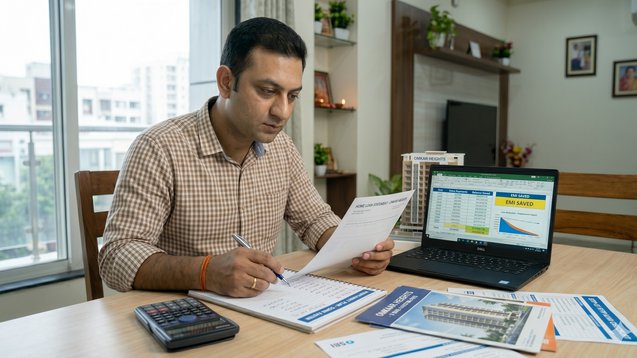
How to Prepay Home Loan Faster
Introduction:
In India, people who want to own a home must commit to paying back a home loan which lasts for 15 years or 20 years or 30 years. The monthly payments that homeowners make through their EMIs enable them to own homes but these payments result in homeowners incurring high interest costs throughout the entire repayment term. Homeowners start to ask this essential question because they want to know: Can I close my home loan faster? The short answer is yes. But the smarter answer is you should, if done strategically. Homeowners need to learn about their loan repayment terms to make their extra payments toward their home loan. Homeowners need to make their extra payments to their home loan at the right time while creating a payment plan that meets their financial targets. People who live in Mumbai should follow the same procedure as residents of Pune while people in Tier 3 towns should adopt a slightly different method depending on their income and property costs and financial needs. The guide will show you practical methods to pay off your home loan faster while maintaining your financial stability. The path leads to two destinations which are debt-free existence and complete financial independence.
The Interest You Pay on Your Home Loan is Often Missed
Most consumers do not realize how much interest they actually pay over the lifespan of their mortgage. For example, if you take out a ₹50 lakh, 20-year mortgage at 8.5% interest, by the time you finish making that payment, you will have paid ₹50-55 lakh in interest alone, nearly twice your loan amount! When borrowers make pre-payments on their loans, their savings grow significantly over time; Pre-paying early in the life of the loan can lead to significant savings on total interest paid. Because of the nature of most mortgages being structured with a higher percentage of total interest being applied during the first five to seven years, even small additional payments made during that period can dramatically reduce the total cost of the mortgage. Due to the higher average loan amounts in Tier 1 cities, a single pre-payment could save tens or hundreds of thousands of rupees more than cities located in Tiers 2 & 3; however, individuals residing in rural areas typically have lower overall costs of living, thereby allowing them to allocate more money towards prepayments on their mortgages. When considering the financial feasibility of purchasing real estate in today's market, use resources such as Property Aaj (https://www.propertyaaj.com) to compare your budget accurately before deciding to make any commitments.
Understand the Two Types of Prepayment
There are two different types of prepayment methods which you need to learn about. Financial institutions use two prepayment methods to manage their operations. The two common prepayment methods include:
Part-prepayment (lump sum payments occasionally)
Full prepayment (closing the loan early)
The majority of borrowers choose to make part-prepayments. You pay a lump sum—say ₹1–2 lakh—whenever you have surplus funds. The payment decreases your principal amount which results in lower interest charges. You need to decide between two options. The shorter loan period enables better financial results. The method reduces total interest payments by a significant amount. The method helps users manage their monthly expenses but it does not provide substantial interest savings. The salaried professional from Bangalore wants to pay lower EMI because of his high living costs. The individual from a Tier 3 town who has predictable expenses will find that reducing his loan tenure will provide him with greater advantages.
Start paying money as early as you can when you have a loan.
The timing of when you pay is more important than how much you pay. If you start paying extra within a few years it makes a big difference. This is because when you first get a loan the money you pay each month mostly goes towards the interest, not the loan amount. Even if you pay ₹50,000 every year at the beginning you can finish paying your loan years sooner. A lot of people wait to pay money because they think they will have more money later. By the time they have more money they have already been paying their loan for a while so paying extra does not help as much. If you are looking at homes, on Property Aaj (https://www.propertyaaj.com) and planning your money, think about how you can pay extra from the beginning, not just later on.
Use Bonuses, Incentives, and Windfalls Smartly
Using irregular income streams represents one of the simplest methods to achieve faster home loan prepayment. This includes:
Annual bonuses
Incentives or commissions
Tax refunds
Maturity of investments
You should allocate part of your earnings to your loan instead of using all your income for lifestyle improvements. Let’s take a practical example. A software professional in Hyderabad receives a ₹2 lakh annual bonus. If they allocate even ₹1 lakh every year toward prepayment, they could reduce a 20-year loan to nearly 12–14 years. People who earn moderate incomes in Tier 2 cities but face lower living costs will experience greater benefits from maintaining a disciplined financial practice. People make deliberate lifestyle choices instead of giving up their entire way of life.
Increase Your EMI Gradually
The basic strategy involves increasing your EMI payments for each succeeding year. The loan period becomes shorter through even slight annual payment increases which amount to 5 to 10 percent. The implementation of this method succeeds because. Your income tends to increase throughout your life. The static nature of your EMI payments prevents you from taking advantage of this income expansion. The current EMI payment of ₹25,000 requires a payment increase to ₹27,000 which creates no immediate financial strain. However, this payment process will help you save more than ₹1 million through interest reductions. This method proves effective for young professionals who work in Tier 1 and Tier 2 cities because their salary growth patterns show consistent development. Think of it as upgrading your financial discipline alongside your career.
Avoid Common Prepayment Mistakes
Avoiding common prepayment errors is essential to preventing costly financial mistakes. Prepayment of loans may seem simple enough, yet there are numerous ways in which borrowers can err while doing so. A frequent misstep occurs when borrowers liquidate their savings accounts or investments entirely in order to make a full or large payment to prepay their loan. Having no cash on hand is obviously risky due to life’s unpredictable nature and the necessity of reasonable liquidity. Another miscalculation occurs when borrowers neglect to consider more attractive investment alternatives. Blindly prepaying may not always be the best option if the borrower has available options to invest their liquid assets into a financial vehicle with an expected return greater than the current loan interest rate. Lenders also continually review their loan terms. Most floating-rate loans made in India do not assess a prepayment fee; however, there may be exceptions to this general rule amongst fixed-rate loans and between certain individual lenders. When considering prepayment and similar decisions relating to debt repayment strategy, it is helpful to analyze one's total financial picture prior to acting on any particular strategy. There are resources available (e.g.: www.propertyaaj.com) that can assist you in developing a comprehensive financial strategy for determining the optimum plan for financing a new property and choosing an appropriate loan type.
Balance Prepayment with Investments
This is the part where things get really interesting.
Should you pay off your loan early?
Put your extra money into something that will earn you more money?
There is no answer that works for everyone. If the interest rate on your loan is 8 percent and you have some safe ways to invest your money that will give you similar or slightly better returns you have to think about how much risk you are willing to take. For people who do not like to take risks, those living in smaller cities paying off your loan early is a good way to save money and feel secure. For people who know a lot about money and live in cities, putting their money into different kinds of investments like mutual funds or stocks might make them more money, in the long run. Usually the best thing to do is to find a balance:
Prepay a part of your loan
Invest the rest of your money
This way you are paying off your debt and still making your money grow.
Prepay Loans with Rental Profit
If you own more than one real estate asset and/or plan to invest in real estate, you can use rental income as leverage for shortening your loan term. Rental yields in tier I markets are often lower than 2-3% with high asset values, while tier II markets tend to provide slightly better yields; however, demand for rental units in tier III markets is mostly driven by the local economic conditions and infrastructure. For example, suppose you own a second rental unit generating ₹15,000 per month in rent. If you allocated just 50% (₹7,500) of your rental income towards making an additional payment on your mortgage each month, you’d be able to pay off your loan much faster. Investors also have the option of using websites such as Property Aaj (https://www.propertyaaj.com) to assist them with locating appropriate rental units. By using this method of payment, your property becomes an active cash flow source, rather than simply a passive investment.
Refinance or Transfer Your Loan
Sometimes paying back your loan early isn't the only way to make it easier on yourself. If interest rates go down, think about switching your loan to another lender that offers deals. Even a small drop of 0.5 to 1 percent, in interest rates can save you a lot of money over time. Remember to think about:
Processing fees
Legal charges
The time it takes
In cities people refinance their loans a lot because there are many banks to choose from. In towns you might not have as many options but it's still worth looking into. Try combining refinancing with paying back a part of your loan to get the most benefit.
Make a Simple Plan to Pay Ahead
Just paying money whenever you feel like it is not a good idea. You need to think about how you want to do this. Here is what you can do:
Decide how extra money you will pay every year
Plan what you will do with your bonus money before you get it
Set a goal for yourself like paying off your loan in twelve years of twenty years
This will help you understand what you need to do and make you want to do it. For example a family living in Pune might want to pay ₹2 lakh every year. If you keep doing this you can pay off your loan faster. When you know what you want to achieve you can make decisions about your money. Paying ahead is an idea and it can really help you so you should make a plan and stick to it like the loan and try to pay it off as soon as you can the loan
The Conclusion
The best way for you to pay off your mortgage quickly is using smart strategies instead of sacrificing heavily. To avoid paying thousands of rupees in interest, and to ultimately have complete ownership of your house sooner, you need to have an appropriate combination of early payment, a consistent payment schedule, and lots of sound financial planning. Regardless of whether you are a first-time home buyer in a Tier One city, an established family in a Tier Two city, or a real estate investor in a Tier Three town, the principle is always the same: spend wisely, plan ahead, and be consistent in how you will go about making those plans a reality. By utilizing trusted services like Property Aaj (https://www.propertyaaj.com) to assist you not only in finding properties but also in better understanding your overall financial obligation to the property you are interested in purchasing, you can achieve your goal of home ownership sooner and with less long-term financial hardship than you originally had in mind.
FAQs
1. Is it better to reduce EMI or tenure during prepayment?
Borrowers should prefer tenure reduction because it delivers better results through decreased total interest expenses. The short-term debt relief from EMI reduction leads to smaller long-term savings for borrowers than they expect.
2. Are there any penalties for prepaying home loans in India?
Most floating-rate home loans do not have prepayment penalties. The fixed-rate loans and particular lenders create prepayment rules which customers must verify in their contracts.
3. How much prepayment is ideal annually?
The ideal prepayment amount for annual payments needs to be 5 to 10 percent of your total outstanding loan balance. The key to success requires regular payments instead of making large payments on a single occasion.
4. Should I prepay or invest my surplus money?
Your investment choice needs to match with your readiness to take risks. The safest option is to choose prepayment for your debts. The best investment strategy combines both debt repayment and investment in assets.
5. Does prepayment affect tax benefits?
Your loan reduction results in decreased tax deductions under Sections 80C and 24. The interest savings usually exceed the tax advantages which accrue over an extended period.
6. Can I prepay home loan online?
Yes, most banks allow online prepayment through net banking. The process provides users with rapid and easy access which more people in India now use.