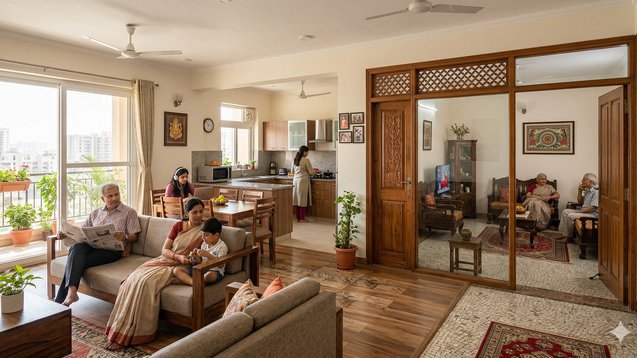
Open vs Closed Living Rooms: What Works for You?
Introduction: The Living Room Layout Decision That Impacts Everyday Life
The current layout of modern Indian homes shows a single common design element which all homes now display. The traditional closed living room with defined walls is steadily sharing space with open-plan designs that merge the living dining and sometimes even kitchen areas. Buyers frequently miss the essential question about which layout better aligns with their personal habits. The housing market in India has developed into a field which now links aesthetic appeal to architectural design decisions. The design choice impacts multiple aspects including ventilation and privacy and resale value and furniture arrangement and comfort throughout the building's lifespan. People who want open spaces will find that open layouts in Tier 1 cities provide them because of the decreasing carpet area regulations. The buying preferences of customers in Tier 2 and Tier 3 cities show that they prefer to have distinct spaces which keep their cultural values and personal privacy intact. Homebuyers who concentrate their attention on square footage and price per square foot will later experience regret because they failed to consider the layout. Your family structure and daily habits and city type and future life plans will determine which living room format works best for you. Let's analyse all the actual advantages and disadvantages together with the specific factors that exist in India so you can reach a practical decision that you can believe in.
Understanding Open Living Rooms in the Indian Context
An open living room removes all walls which separate the living room and dining room and dining room and kitchen area. The 2 BHK compact apartment design has become extremely popular among builders who construct residential projects in Mumbai and Bengaluru and Gurgaon. The reason for this development exists because open layouts create an illusion which makes small carpet areas appear larger. The primary benefit of this design exists because space costs Open living spaces function effectively in real life situations which require:
Nuclear families
Young professionals
People who live in small urban apartments
Modern lifestyle buyers
Indian households function differently from Western households which developed open plan designs. Our cooking involves heavily spiced dishes which our extended family members consume during frequent visits while we maintain multiple generations who live together. A young couple in Pune may love the airy feel of an open living space. The joint family in Lucknow feels discomfort because kitchen activities become visible during family gatherings which occur in the living area. Buyers should assess whether property openness matches their daily activities before they begin shortlisting properties on Property Aaj (https://www.propertyaaj.com).
Closed Living Rooms: The Traditional Indian Preference "
The Indian home design tradition uses closed living rooms because this layout creates better functional space. The design uses complete walls and a door to create separate areas from the living room which functions as an official space. In Indore, Nagpur, Coimbatore, and Bhubaneswar through their Tier 2 and Tier 3 markets, family buyers aged 35 and above continue to choose closed living rooms as their preferred home design. The main practical benefits of this system include: The system provides its main advantage through its ability to maintain privacy. The rest of the home remains hidden from view because guests can enter the house without notice, which happens frequently in Indian households. The system keeps cooking doors inside the house, which becomes crucial for homes that have kitchens located within their residential spaces. The system makes it easier to control noise, which becomes important when people need to work from home and children need to study. A typical example: a family in Jaipur buying a 3 BHK home purchases a closed living room, The Property Aaj (https://www.propertyaaj.com) listing platform shows that many resale buyers today look for properties which contain separate living areas.
Space Efficiency: Which Layout Feels Bigger?
The main interest of the study begins at this point. The two designs show identical carpet area measurements according to their documentation. The design of open living rooms creates an illusion of increased space because people always perceive these spaces to be more extensive than they actually are. The process of wall removal permits natural light to reach more distant areas while decreasing visual obstacles and establishing a room that appears more spacious. The average size of 2 BHK apartments in Tier 1 cities measures between 550 and 750 square feet, which allows open layouts to create a 15 to 20 percent increase in home space. Most buyers who enter the market later will discover an essential trade-off which exists in their choices. The design of open layouts requires users to create intelligent furniture arrangements. The absence of walls creates a situation where you must select new locations for your sofas and TV units and storage spaces. Many first-time buyers underestimate this. The advantage of open layouts in creating space illusions becomes less critical for Tier 2 and Tier 3 cities because their homes already exceed 900 square feet in measuring space. The need for space in this location takes priority over the requirement for open space. My practical advice: if your carpet area is below 800 sq. ft open living space usually works well. Closed layouts serve better usability needs in spaces that exceed 800 square feet.
Ventilation and Natural Light: A Major Indian Consideration
India needs ventilation as an essential requirement because its climate conditions make it necessary to maintain basic indoor temperatures. Open living rooms provide better cross-ventilation through their design which connects adjacent rooms with windows that face different directions. Coastal city builders in Chennai and Kochi support open building designs because they enhance wind movement throughout spaces. Many people fail to realize the complete significance of this element. If the kitchen is part of the open plan and lacks strong exhaust systems, cooking fumes can spread across the living area. This situation becomes apparent in cities that experience humid weather conditions. Closed living rooms enable superior space management through their design. The system allows you to create separate cooling areas while maintaining temperature control and efficient dust control which becomes essential in Tier 2 cities that experience higher dust levels in their expanding suburban areas. The floor plan review process on Property Aaj (https://www.propertyaaj.com) requires you to check window placement and kitchen ventilation together with the living room layout. The layout alone doesn’t tell the full story.
Indian families face a choice between privacy and communal living spaces.
The buyer psychology shows distinct differences throughout various regions in India. Open living rooms enable people to interact with others, creating a social atmosphere. The parents can observe their children while they cook, and people at the gathering can talk to each other, which creates a feeling of homecoming between home spaces. Young urban buyers especially in Bengaluru, Hyderabad, and Pune Increasingly prefer this setup. Compartmentalized spaces continue to serve as essential spaces for traditional Indian families. People can visualize the typical situation where grandparents stay for a month, children take online classes, and one person works from home. The previous open space which appeared trendy has now transformed into a disorderly environment. The closed living rooms create four main advantages which include. The area enables separation of sound. The area allows guests to maintain their privacy. The room offers multiple options for different activities. The area provides TV sound management through improved sound control systems. People in Tier 3 cities prefer emotional comfort as their primary decision-making factor about home design rather than following current design fashion trends. Buyers search for homes which create proper living spaces instead of modern appearance. Buyers at Property Aaj (https://www.propertyaaj.com) use today to assess layout according to family members who will use the space and not just current design trends.
Impact on Property Value and Resale Potential
Both layouts show investment potential but their success depends on market conditions. The open living room design has become a standard feature in new construction projects across Tier 1 cities. Buyers expect them in compact luxury and mid-segment projects. The resale value of this property will remain intact here. Homebuyers in Tier 2 and Tier 3 cities tend to spend more time selling properties which have excessive open designs because their home design preferences are more traditional.
Rental trends also show variation:
Young tenants prefer open layouts in metros
Family tenants prefer closed layouts in non-metros
Premium luxury buyers often want semi-open designs
Investors should select flexible home designs which allow future partitioning through sliding doors or glass panels. The adaptable layout design of properties enables better liquidity results on Property Aaj (https://www.propertyaaj.com) than the fixed design of properties.
Cost Implications and Design Flexibility
Many buyers assume open layouts are cheaper. This assumption contains only partial correctness. The construction expenses decrease because open spaces require fewer walls. The establishment of open spaces requires extra costs because they need:
Larger flooring continuity
Designer ceiling work
Premium modular kitchens
Thoughtful lighting design
Closed living rooms, meanwhile, allow phased furnishing. The complete room process fits budget-conscious buyers in Tier 2 and Tier 3 cities who want to make purchases. Another overlooked factor is air-conditioning cost. The design of open layouts causes buildings to need larger air conditioning systems because their spaces must be cooled down. Home loan eligibility and stamp duty don’t directly change based on layout yet buyers in Tier 1 markets show premium payment tendencies toward open plans because they perceive greater usable space.
Hybrid Layouts: The Growing Middle Path
The Indian market now trends towards hybrid and semi-open living room designs. Developers are introducing
Sliding glass partitions
Foldable wooden dividers
Partial walls with open cut-outs
Kitchen breakfast counters as soft separators
This approach is gaining popularity because it offers flexibility. The space should remain open during parties. The space should be closed when people need privacy. Hybrid layouts have become popular in Ahmedabad and Pune and all Tier 2 cities. Homebuyers who plan to stay for many years should choose this middle path because it provides both essential benefits. Property Aaj (https://www.propertyaaj.com) users should select floor plans that permit future changes because this feature provides significant advantages in the future.
The selection process of your family layout
It requires your understanding of appropriate design options. I present my clients with this decision-making framework which I developed for practical use. Choose open living if:
The space of your carpet area falls under 800 square feet
Your family consists of parents and children
You host friends who visit your home
You prefer to design your space with modern style
You inhabit a first-tier metropolitan area
Choose closed living if:
People require joint family accommodations
People require work-from-home arrangements
People require space to accommodate official visitors
The space of your carpet area exceeds 800 square feet
The location exists in either a Tier 2 or Tier 3 area
You need to resolve your uncertainty through one straightforward assessment: "Will this layout function effectively for me in the upcoming five years?" People make home choices which they intend to maintain throughout their lifetime. People will experience different trends. The daily comfort of people holds greater importance than current trends.
Conclusion: It’s Not About Trend It’s About Fit
The open vs closed living room debate exists to determine which design better suits your actual existence. The open vs closed living room debate exists to determine which design better suits your actual existence. The diverse housing market in India presents different requirements for home buyers. The layout of a Mumbai apartment needs different design rules than an Indore home which has more space. Open living rooms create visual space and contemporary design elements. Closed living rooms deliver private space and adaptable design and conventional home comfort. Modern homebuyers make their purchasing decisions by assessing property features instead of relying on marketing materials. Homebuyers assess different property features including ventilation and family structure and resale potential and long-term usability to make their final choice. If you are house hunting at this time I recommend that you examine floor plans on Property Aaj (https://www.propertyaaj.com) to see how your daily activities would function in that area. The most suitable living room for your needs exists as a space which will serve your needs through time.
FAQs
1. Do small Indian apartments with open living rooms experience better space requirements?
The open layout design of compact homes under 800 square feet creates an illusion of greater space while enhancing natural light distribution. The kitchen requires proper ventilation systems to prevent cooking doors from entering the living room space.
2. Do closed living rooms have better resale value in India?
The answer depends on the particular city. Open layouts in Tier 1 metropolitan areas have become an accepted design standard. Closed living rooms raise resale value because family buyers in Tier 2 and Tier 3 cities show a strong preference for them.
3. Can I convert an open living room into a closed one later?
Most situations permit this conversion. Buyers often add sliding glass partitions, wooden dividers, or gypsum walls. Before making changes to your property you must evaluate both structural constraints and community regulations.
4. Which layout is better for work-from-home setups?
Closed living rooms provide better work environments because they enable sound control and protect personal space. Open layouts can become distracting spaces which particularly affect homes that have children and house guests who come frequently.
5. Are open living rooms more expensive to maintain?
The combined spaces need larger air conditioning systems because their cooling requirements exceed standard AC units and open spaces need complete design planning for their furniture arrangements.
6. What is the current trend in Indian real estate projects?
The market is gradually shifting toward semi-open or hybrid layouts that offer flexibility. Buyers want openness for aesthetics but they also require the ability to establish privacy at specific times.