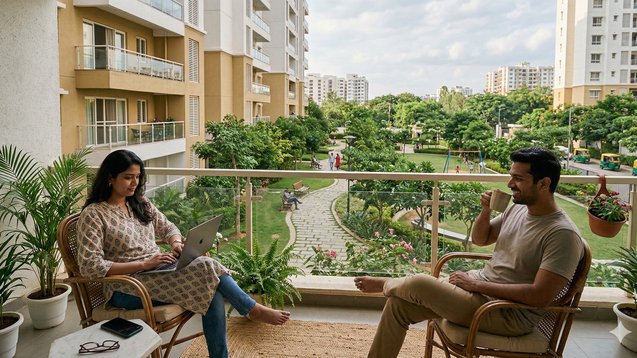
Choosing a Property That Supports Work-Life Balance
Over the last ten years, Indians have experienced significant changes in their understanding of work-life balance. Homebuyers of the past mainly used three factors to assess properties, which included property prices, neighbourhood status, and expected future value. The question of whether a particular home will simplify or complicate daily activities has started to influence what people buy. The view of a property as ideal will change after people learn about its extended travel requirements, its congested residential areas, its insufficient green space, and its ineffective transportation system. The right home needs to be selected with careful thought because it will bring better work output and lower tensions for people while establishing a more beneficial daily schedule. People living in Bengaluru, Mumbai, and Delhi NCR face severe challenges when they try to combine their intense work responsibilities with their need for personal time. Professional demands in Pune and Indore and Lucknow create the same changes that are happening in Tier 2 cities. Younger buyers in Tier 3 towns are starting to consider more than just the size of their homes. People believe that real estate functions as a financial asset but they forget about its role as a fundamental part of their lifestyle decisions. Property Aaj (https://www.propertyaaj.com) presents a detailed framework which guides users through the process of selecting Indian properties that will provide them with effective work-life balance solutions. Let's explore the topic more thoroughly.
Why Work-Life Balance Should Influence
Your Property Choice The home environment which buyers select for their residence passes more influence over their daily activities than they realise. The initial beauty of a house which visitors see during their first visit turns into an exhausting experience after six months of regular weekday use. People should dedicate their full attention to this matter. Your dream home becomes a source of exhaustion when you spend two hours on daily commutes while enduring continuous traffic sounds and experiencing bad conditions in your neighbourhood. Tier 1 cities already show this phenomenon. Professionals who work in Bengaluru's Outer Ring Road and Mumbai's remote suburbs experience burnout because of their extended travel durations. People now prefer to select micro-markets which provide better transportation links even if they need to pay higher costs per square foot. Buyers in Tier 2 cities now take a more assertive approach. Buyers now assess liveability aspects which include distance to offices, schools , healthcare facilities and recreational areas before selecting properties in the outskirts. The concept of work-life balance has evolved into an essential component of modern existence. The condition impacts your mental well-being and family relations and your contentment with your purchase throughout your life. People who disregard this matter will face expensive remorse in the future. Debug output complete.
Location vs Commute: The Real Trade-Off
Homebuyers in India frequently make their most significant errors when they choose to purchase homes located too far from their employment centres because they want to pay less money for homes. The properties which exist outside city limits. The properties which exist outside city limits. The hidden cost which results from this decision requires more time commitment from residents. People who live in Tier 1 cities need to spend between 30 to 45 minutes on their daily commute when they travel 5 to 7 kilometres during peak traffic periods. The result of this pattern continues throughout the year until people accumulate multiple hours of time loss.
Smart buyers now calculate commute time before finalizing budgets. The professional working in Hyderabad's HITEC City will experience a substantial reduction in property costs after relocating to a distant area. The professional's daily commuting will create unpredictability which will significantly increase his living expenses. The distance gap between two points in Tier 2 cities remains smaller than the actual distance but it continues to expand. The growing urban sprawl requires cities to establish their planning processes before their need arises. Property Aja (https://www.propertyaaj.com) listing should display actual travel times through peak hours which users should refer to instead of showing distance in kilometres. The actual traffic conditions during rush hour provide accurate information about current travel conditions. A home which costs slightly more money provides better travel options to its residents. The better travel options which a home offers to its residents will enhance their overall life experience.
The Rise of Hybrid Work and Home Office Needs
Post-pandemic India has established new permanent work patterns for multiple professional fields. Hybrid models, freelance careers, and remote roles have become common work arrangements. People now require dedicated home office space according to their new work arrangement requirements.
The demand for compact apartments without study areas has decreased among certain buyer groups in Tier 1 cities. Professionals now look for:
Extra room flexibility
Silent environments
Stable internet service
Ample natural light
The trend is expanding quickly through Tier 2 cities especially among IT and start-up workers. Tier 3 homebuyers who work remotely for metropolitan companies are selecting bigger residences in peaceful towns to achieve better work-life balance. Your work assessment should include both your video call requirements and your need for concentrated work time. Your assessment should include:
Wall thickness and noise levels
Internet provider availability
Power backup reliability
Your future productivity depends on these seemingly small details.
Green Spaces and Physical Well-Being
The open space access which buyers fail to recognize during their home purchase process results in their lifestyle satisfaction assessment. The Tier 1 micro-markets demonstrate strong project demand when developers create sufficient green spaces and walking paths and establish parks within their projects. The premium appearance of the facilities does not attract users because residents visit them on a daily basis.
Morning walk areas
Jogging tracks
Community gardens
Nearby public parks
Developers in Tier 2 cities still possess sufficient land to establish superior open-space design for their projects. The quality of maintenance however shows significant differences among various locations. The independent houses in Tier 3 towns provide residents with space but they sometimes lack basic community services. The evaluation process for Property Aja properties requires you to consider more than the available amenities on their website (https://www.propertyaaj.com). The question you should ask yourself is whether you will actually use these items on a weekly basis. The work-life balance will improve through your actual weekly usage of the items.
Social Infrastructure: The Invisible Stress Factor
A beautiful apartment in a poorly developed neighbourhood creates daily friction. Work-life balance depends heavily on nearby infrastructure such as: Schools Hospitals Grocery stores Public transport Pharmacies Banking services In Tier 1 cities established corridors usually have strong social infrastructure. But newly developing suburbs may experience social infrastructure development delays that last for several years. The critical evaluation point exists in Tier 2 cities. Residents must drive long distances because some emerging areas lack immediate access to essential services. Customer behaviour shows a current trend shift. Customers used to accept minor discomfort because they wanted to pay less. The dual-income families today prefer to spend extra money for their everyday needs. The weekday period provides better local assessment than weekend site visits.
Noise, Density, and Mental Comfort
Work-life balance exists to achieve two goals which include time management and mental peace maintenance. People living in high-density areas which exist near highways and railway tracks and busy commercial areas experience ongoing stress. The effect appears most strong in Tier 1 metropolitan areas which feature mixed land development.
Ask yourself:
Does the property face a road which sees high traffic?
Does the area have any planned commercial construction projects?
What is the level of population density in the area surrounding the property?
People who buy properties in Tier 2 and Tier 3 cities can choose between two options because they want to live in quiet residential areas but rapid city development creates new residential areas. The residents who live on an interior residential road will experience better long-term comfort than those who live in a premium tower which faces the main street. Smart buyers think five years ahead, not just at possession time.
Amenities That Actually Support Daily Life
Indian developers often advertise long lists of amenities. But from a work-life perspective, only some truly matter.
High-value lifestyle amenities include:
Reliable power backup
Good security systems
Functional clubhouse
Children's play area
Walking tracks
Co-working or business lounge (emerging trend). Hybrid workers in Tier 1 cities prefer to use residential complex co-working spaces. In Tier 2 cities, clubhouse and fitness amenities still influence buyer decisions strongly. You should avoid being impressed by amphitheatres and decorative water bodies which people seldom use except when these features suit your actual way of life. On Property Aja (https://www.propertyaaj.com) users should evaluate projects based on their operational effectiveness instead of counting available amenities.
Investment Value vs Lifestyle Value
Many Indian buyers face this dilemma: should you prioritize appreciation potential or daily comfort?
A property should provide both essential benefits but its evaluation requires assessment of available options. High-connectivity zones in Tier 1 cities provide residents with both potential rental income and comfortable living conditions. Some investment corridors in Tier 2 cities which experience rapid growth still require development of essential infrastructure. An end-user who intends to occupy the property between 5 and 10 years should consider lifestyle factors as more important than potential future value growth. The most intelligent investment decisions occur when both investment and personal use purposes combine as one.
When we talk about Tier 1 cities versus Tier 2 cities versus Tier 3 cities we need to think about where it's easier to find balance.
Each Tier 1 city and Tier 2 city and Tier 3 city has its good things.
Tier 1 cities have some things like
really good job opportunities
strong metro connectivity
The prices of properties are very high
and how well you can balance your work and life depends a lot on where you live in the city.
Tier 2 cities are different because they
are easier on the budget
have roads and buildings that are getting better
have more people with good jobs
and often give people the best balance right now.
Tier 3 cities are nice because they
have homes that are not too expensive
Some areas do not have good roads and buildings
They are perfect for people who work from home or are retired.
It is worth noting that many professionals are now working from anywhere and they are choosing Tier 2 cities because they offer a lifestyle.
Conclusion: Buy a Home That Works for Your Life
The selection of a property which enables work-life balance must now be treated as an essential requirement for achieving happiness throughout life. The Indian real estate market is evolving, and buyer priorities are becoming more sophisticated. Contemporary homebuyers evaluate properties based on multiple factors which include price per square foot and they assess their access to commuting routes and neighbourhood quality and availability of green spaces and their ability to carry out daily activities. The process of making a buying decision requires you to select between three different types of locations which include fast-paced metropolitan areas and developing Tier 2 cities and tranquil Tier 3 towns.
Before finalizing any property, step back and imagine your weekday routine. Will this home reduce stress—or quietly add to it? Use Property Aja (https://www.propertyaaj.com) to compare different locations while exploring their micro-markets and examining their complete project details. The ideal property goes beyond effective appreciation because it provides you with a better life experience.
FAQs
1. How important is commute time for work-life balance when buying a home?
The first-tier cities in the world consider commute time to be their most essential factor which affects their residents' lifestyle choices. Your property selection brings you increased satisfaction when you save 30 to 40 minutes of your daily time because it leads to better personal time management and lower fatigue levels.
2. Should I prioritize a bigger home or a better location?
Work-related travel requires individuals to focus on their job location instead of needing additional residential space. Remote workers find that living in spacious homes located in peaceful neighbourhoods provides them with better advantages. Your work pattern determines which option is the best selection for you.
3. Are Tier 2 cities better for work-life balance than metros?
Most cases demonstrate that Tier 2 cities provide superior work-life balance which they accomplish through their shorter commuting times and their more affordable living costs and their reduced traffic problems. The evaluation process needs to assess both job opportunities and infrastructure conditions at this point.
4. Do lifestyle amenities really improve work-life balance?
Only practical amenities make a difference. The combination of walking paths and green spaces and power backup systems and security features creates actual value. The use of decorative elements does not create substantial effects on daily activities.
5. How can I verify if a locality will remain peaceful in the future?
To do this you need to check the city master plans and see what is coming up in the area. You should also look at commercial projects and road expansions. It is an idea to visit the locality at different times of day to get an idea of what it will be like to live there. This will help you figure out if the locality will have congestion or noise issues, in the future.
6. Is buying near office hubs the best strategy?
No it is not always the strategy. Buying near office hubs can be good because it reduces the stress of commuting to the office. However sometimes areas that are too commercial can become really crowded and noisy. This is something to think about when you're deciding where to buy a house. The office hubs can be big.. They are not the only thing to consider when you are looking for a peaceful locality.
Read more about property matters with our specialists and browse the latest property listings on Property Aaj. Download the app from the Play Store and App Store now for easy buying, selling, and renting!