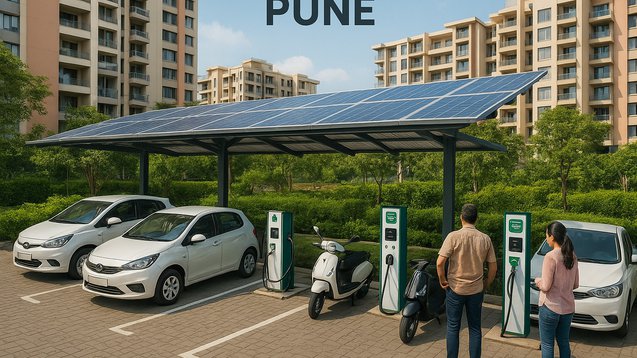
Introduction
Electric vehicles (EVs) are no longer a futuristic concept—they are rapidly becoming a part of Pune’s everyday commuting landscape. With government incentives, corporate adoption, and increasing environmental awareness, residential societies must adapt by integrating EV charging infrastructure.
EV readiness is not just a convenience; it has become a factor influencing resident satisfaction, property marketability, and resale value. Societies in high-demand localities like Aundh, Baner, Hinjewadi, Kharadi, Wakad, and Magarpatta City are increasingly prioritizing EV infrastructure in their planning.
This article, curated by Property Aaj, explores:
Costs associated with EV charging installation
Electrical load and technical considerations
Implications on property pricing and resale value
Best practices for societies and residents
Future trends in Pune’s EV ecosystem
Why EV Charging Infrastructure Matters in Residential Societies
Growing EV Adoption:
Pune has seen a significant uptick in EV registrations, including two-wheelers, cars, and e-rickshaws.
Residents increasingly expect their society to provide dedicated charging facilities.
Resident Convenience:
EV owners save time by charging vehicles at home rather than relying on public charging stations.
Sustainability Factor:
EV infrastructure contributes to a greener, lower-emission urban environment.
Resale Advantage:
EV-ready societies enjoy better market positioning. Apartments with dedicated EV charging access often sell or rent faster, sometimes commanding a 5–10% premium.
Cost of Installing EV Charging Infrastructure
Costs vary based on charging speed, number of points, and electrical setup:
Level 1 (Slow Charging, 3–7 kW):
Cost per point: ₹25,000–₹40,000
Suitable for overnight charging of two-wheelers or low-range cars
Level 2 (Fast Charging, 7–22 kW):
Cost per point: ₹50,000–₹100,000
Suitable for overnight charging of multiple cars; common in multi-story societies
DC Fast Charging (50 kW+):
Cost per point: ₹3–5 lakh or more
Typically for commercial or public setups; rare in residential complexes
Other Costs:
Electrical panel upgrades
Cabling and distribution boards
Civil work for mounting and access points
Software for billing or access control (if shared system)
Property Aaj research indicates that most Pune societies opt for Level 2 chargers for balanced cost and efficiency.
Electrical Load and Technical Considerations
Load Assessment:
Societies must calculate peak load to avoid overloading transformers.
For example, 20 EV points at 7 kW each = 140 kW additional load.
Distribution:
Chargers should be connected to dedicated circuits.
Multi-story buildings may need upgrades to the main switchgear or transformer.
Billing & Metering:
Individual metering per apartment is recommended.
Software-based smart meters help track consumption and charge residents accordingly.
Safety & Compliance:
Use certified chargers and wiring.
Follow BIS (Bureau of Indian Standards) and local PMC/PCMC guidelines for installation.
Impact on Property Pricing and Resale Value
1. Immediate Price Premium:
EV-ready apartments, especially in Aundh, Baner, Kharadi, and Magarpatta City, often command a 5–10% higher asking price.
2. Faster Sales & Leasing:
For societies with dedicated EV points, rental occupancy improves because EV owners prefer ready-to-use infrastructure.
3. Long-Term Marketability:
As EV adoption rises, buyers increasingly filter for EV infrastructure in their search criteria.
Societies without charging points may face slower sales or discounts.
4. Developer Strategy:
New launches advertise EV-readiness as a premium amenity, boosting overall project perception.
Case Study: EV Infrastructure in Kharadi Societies
Project: Premium 200-unit society near EON IT Park
Infrastructure: 20 Level 2 charging points, smart meters, software-based billing
Cost: Approx. ₹12 lakh for installation, including electrical upgrades
Result:
Average apartment price increased ~7% compared to similar non-EV-ready projects.
Leasing time reduced from 60 to 30 days
Residents reported high satisfaction due to the convenience and sustainability factor.
Best Practices for Pune Societies
Plan Ahead:
Allocate space in basements and parking lots for future expansion.
Smart Billing:
Implement software or RFID card systems for usage tracking and billing.
Load Management:
Stagger charging times to avoid transformer overload.
Consider solar integration to offset electricity costs.
Maintenance:
Regular inspection of chargers, cabling, and safety equipment.
Resident Awareness:
Inform residents about cost-sharing models, usage policies, and safety measures.
Challenges & Considerations
Upfront Investment: ₹25,000–₹1 lakh per charger can strain society budgets if multiple points are required.
Space Constraints: Older societies may have limited parking space for new charging points.
Electricity Tariffs: Charging during peak hours may increase electricity bills; societies need tariff management strategies.
Technical Obsolescence: Fast-changing EV technology may require future-proof chargers.
Future Trends in Pune EV Infrastructure
Increased Adoption of Level 2 & 3 Chargers:
Multi-story societies and premium townships will standardize Level 2 chargers in parking areas.
Integration with Solar Panels:
Reduces operational costs and promotes sustainability.
Government Incentives:
Subsidies under the FAME India II scheme and state-level EV policies encourage societies to adopt EV infrastructure.
Impact on Urban Planning:
PMRDA and PMC are gradually mandating EV-ready parking in new residential and commercial projects.
Resale Premiums:
By 2027–2028, EV-ready properties in Pune may command 10–15% higher resale prices, particularly in IT corridors and premium residential sectors.
Conclusion
EV charging infrastructure is no longer optional for Pune’s forward-looking residential societies. It affects resident convenience, long-term sustainability, and property marketability.
Investors, developers, and society management committees must weigh installation costs, electrical load requirements, and maintenance against the resale and rental value uplift.
Prime localities like Aundh, Baner, Kharadi, Hinjewadi, Wakad, Magarpatta City, and Hadapsar are already benefiting from early adoption. Societies that proactively integrate EV infrastructure stand to gain a competitive edge in property pricing, rental demand, and long-term appreciation.
For curated listings of EV-ready properties and expert insights on Pune’s residential market, visit Property Aaj—your guide to sustainable and profitable real estate.
FAQs
1. What is the cost of installing a Level 2 EV charger in Pune society parking?
Approximately ₹50,000–₹100,000 per point, including cabling, civil work, and basic electrical upgrades.
2. How much load does a typical EV charger require?
Level 2 chargers need 7–22 kW per point; societies must assess transformer capacity for multiple simultaneous chargers.
3. Do EV-ready societies command higher resale values?
Yes, typically 5–10% higher than comparable non-EV-ready properties in Pune.
4. Can old societies retrofit EV chargers?
Yes, but it may require transformer upgrades, dedicated circuits, and parking space reconfiguration.
5. Are there government incentives for EV charging installation?
Yes, under the FAME India II scheme and state EV policies, subsidies are available for both private and residential installations.
6. What are best practices for managing EV charging in multi-unit societies?
Use staggered charging schedules, smart meters, and dedicated billing, and ensure regular maintenance of chargers and cabling.
Read more about property matters with our specialists and browse the latest property listings on Property Aaj. Download the app from the Play Store and App Store now for easy buying, selling, and renting!