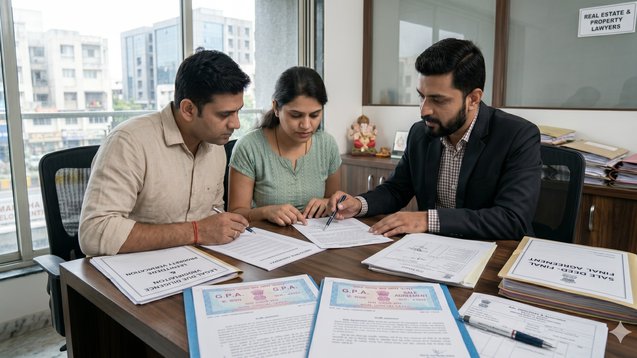
Legal Checklist Before Buying Property in India
Introduction:
Buying property in India is often described as one of life’s biggest achievements and rightly so. But behind the excitement of owning a home lies a complex legal framework that many buyers underestimate. The process requires more than just selecting the ideal apartment and reaching satisfactory price terms. One overlooked document, one unclear title, or one missing approval can turn your dream investment into a long-term legal headache. Across India, the risks vary. The legal systems in Tier 1 cities such as Mumbai and Bengaluru have established frameworks while RERA compliance provides additional protection for residents. The existence of incorrect documents and land records remains a major issue in Nashik and Ahmedabad which are classified as Tier 2 cities and in all Tier 3 towns. Most buyers make their first mistake at this particular point. Imagine buying a property that looks perfect on paper only to discover later that it has multiple ownership claims or pending dues. This situation occurs with greater frequency than people expect. The existence of a reliable legal checklist has become an essential requirement. Businesses need to develop their products by implementing security protocols throughout their organizations. Platforms like Property Aaj (https://www.propertyaaj.com) are making it easier for buyers to access verified listings but buyers still need to conduct their own research. The following legal checklist serves as a comprehensive guide for property purchases across India which will help you make informed decisions while avoiding expensive errors.
Verify the Title and Ownership History
The very first step is confirming that the seller has a clear and marketable title. The property belongs to them which they can transfer without legal disputes. Title verification in Tier 1 cities is simple because land records exist in digital format and documentation follows established methods. Ownership chains in Tier 2 and Tier 3 areas become difficult to trace because of their complex nature which includes multiple ownership transfers that occurred over several decades. A buyer in Jaipur discovered that the seller had inherited the property but had never completed the legal transfer process. The deal collapsed at the last minute. What you should do: Request the title deed to assess ownership history which spans two to three decades. The property lawyer should verify that all disputes and claims and uncertainties have been resolved.
Check Encumbrance Certificate (EC)
An Encumbrance Certificate functions as proof that a property exists without any financial or legal obligations which include loans and mortgages and legal disputes. The document provides information about existing property burdens through its assessment of all rights which exist on the property. People who live in metropolitan areas can access ECs through online platforms. In smaller towns, you may need to visit local sub-registrar offices, where records might not be fully digitized. Why it matters: If you buy a property with an existing loan or legal claim, you could inherit those problems. Always request an EC for at least the past 10–15 years. The details need to be checked with the highest level of precision. The investigation needs to start from any discrepancy which occurs.
Ensure RERA Registration (For Under-Construction Projects)
The Real Estate (Regulation and Development) Act (RERA) requires builders to register their projects while they must show complete information about their obtained approvals and project schedules and product specifications. The enforcement of RERA regulations in Tier 1 cities shows higher standards of compliance. The enforcement in Tier 2 and Tier 3 areas shows different levels of enforcement but people are becoming more aware of the regulations. What to check: The project RERA registration number needs verification together with the assessment of completion timelines and approval details. People should verify RERA information through independent research while they browse property listings on Property Aaj (https://www.propertyaaj.com).
Review Approved Building Plan and Layout
The procedure requires execution because it contains crucial elements which require attention. All construction projects need to use building plans which have received official permission from local government entities. The construction site will face penalties because of unauthorized work and building plan violations which may result in demolition orders. The cities of Delhi and Bengaluru maintain their operations through strict surveillance systems. The towns where people reside experience more cases of building extension through unauthorized methods than their bigger counterparts. What you should do: Request the official building plan which has received approval and then check it against the built structure. The construction site needs assessment to identify all deviations which include additional levels and unauthorized building work. A small mismatch today can become a major legal issue tomorrow.
Verify Land Use and Zoning Regulations
Some areas of land cannot be developed into residential properties. Illegal residential development occurs when agricultural land gets sold without following proper conversion processes. This occurs with greater frequency in developing regions that surround Tier 2 and Tier 3 cities. City outskirts buyers become duped by "farmhouse" and "plot" offers because they lack understanding of zoning regulations. How to stay safe: Land use classification should be verified through local authorities. The property needs to obtain residential approval while meeting all zoning regulations.
When you buy a property you should check the Property Tax Receipts and Utility Bills.
If the Property Tax Receipts and Utility Bills are not paid you will have to pay them after you buy the property. In cities you can easily check these records online because they are well maintained. In small towns you may have to look at the physical records. What you need to do is:
Ask for the Property Tax Receipts
Ask for the electricity bills
Ask for the latest water bills
Make sure there are no Property Tax Receipts and Utility Bills. Checking the Property Tax Receipts and Utility Bills is a thing to do and it can save you from having to pay a lot of money later on.
Check both your Occupancy Certificate (OC) and Completion Certificate (CC).
These two certificates are vital for any property that you can move into immediately. A CC is issued when the property has been built according to the plans submitted for approval. An OC confirms that the property is suitable for habitation. In Tier 1 cities, banks will not lend to you if you don’t have these certificates; whereas in Tier 2 or 3 cities, many buyers may not value them and then run into problems later. Why this is important: If you do not receive an OC, you may have difficulties with setting up utilities, selling the property in the future and there may be penalties, including legal, for occupying the property without an OC. Don't proceed with the purchase of your property until you obtain both of these documents.
Examine Sale Agreement Carefully
The sale agreement outlines all terms and conditions of the transaction payment schedule, possession date, penalties, and more. Most buyers who purchase from direct sellers tend to sign agreements without understanding their contents. What you should do: Read each section of the document. The document contains hidden charges and penalty clauses and timelines which you should observe. If needed, get the agreement reviewed by a legal expert. The website Property Aaj (https://www.propertyaaj.com) displays transparent property listings, but you must still conduct legal examinations of the available listings.
Legal Representation Of Home Loan Acceptance
An interesting fact is a bank completes their own legal check prior to being able to approve a home loan. Having a reputable lender approve the funding for the property is typically an indication that the property should be strong enough to purchase, but it does not diminish the need to conduct your own due diligence. In major metropolitan areas, there tends to be more of a systematic approach taken. In small cities, the property you are considering may not be able to secure financing if documentation is not clear. Suggestion: Even if you are not financing this purchase, it is prudent to check to see if there is a loan purchase on the property to add another level of assurance.
Check the Society and Builder NOCs.
When you are buying a resale flat you will need to get a No Objection Certificate from the Society or the Builder. This is important because it makes sure that there are no problems between people, no unpaid maintenance charges and no issues with who owns the flat. The Society and Builder NOCs are very important in cities with gated communities. They are also important in cities but the process might be a little different. You should always get the Society and Builder NOCs to be safe.
Registration and Stamp Duty Compliance
The property needs to be registered according to legal requirements under your name. The costs for stamp duty and registration differ between different states. The three states of Maharashtra, Karnataka and Tamil Nadu establish different pricing structures and discounts for their female purchasers. What to ensure: You need to pay the correct stamp duty and finish registration at the sub-registrar office to obtain the registered sale deed. The practice of omitting essential registration steps or decreasing their actual value to cut expenses will result in future legal problems.
Conclusion
Property acquisition in India requires both legal procedures and financial processes and emotional assessments. The difference between a safe investment and a risky one usually depends on the depth of your fact-checking. Every step of the process requires attention because it includes title checks, RERA verification tax receipts and occupancy certificates. Tier 1 cities provide more organized systems while Tier 2 and Tier 3 markets require businesspeople to exercise additional caution and diligence. The good news is that today’s buyers are better equipped than ever. The platform Property Aaj (https://www.propertyaaj.com) provides users access to dependable information with only one click. But tools alone aren’t enough.
Take your time.
Ask questions.
Verify every detail.
Real estate transactions operate under the rule that your ignorance will bring you greater financial losses than your actual payments.
FAQs
1. What is the most important legal document when buying property in India?
The title deed is the most crucial document. The document establishes ownership rights while proving that the seller possesses legal authority to transfer the property.
2. Is RERA registration mandatory for all properties?
RERA applies mainly to under-construction projects above a certain size. RERA compliance is not necessary for completed properties but they must undergo other legal inspections.
3. Can I skip legal verification if the property has bank approval?
The property needs legal verification because bank approval cannot serve as the only requirement for verification. The process requires you to perform your own legal verification work because it guarantees complete protection for your situation.
4. How do I verify property documents in Tier 2 or Tier 3 cities?
Your option for document verification requires you to either go to local government offices or hire a property attorney. The availability of online services has grown but still remains restricted in specific regions.
5. What happens if I buy a property with issues?
If I buy a property with issues I will probably have a lot of problems. I might have to deal with disputes. I could lose money or I might even get evicted from the property. It can take time to resolve these legal issues so it is really important to try to prevent them from happening in the first place.
6. Are online property platforms legally reliable?
Online property platforms can be very helpful because they give us a lot of information and they have many listings for properties. However if I am going to buy a property I still need to check all of the documents by myself before I make a purchase. This is because online property platforms are not always one hundred percent reliable and I need to make sure everything is okay with the property before I buy it.