Introduction
The entire Indian real estate market functions under its high-stakes environment because everybody tries to uncover the hidden "diamond in the rough" asset. The common tale exists about a friend who purchased land located on a Tier 2 city's outskirts for a low price, but its price increased when the government announced a new expressway. People should stop using luck as their primary method because it doesn't function as an effective plan. The process of finding neglected properties needs an advanced skill set that combines field investigation work with data examination and knowledge about India's changing social and economic conditions. The Indian market has achieved greater transparency through RERA implementation which maintains existing operational problems that particular users can discover. The mission focuses on discovering properties which currently have no market value yet will achieve high future value across both the vertical development areas of Gurugram and the industrial development zones of Indore. Property Aaj (https://www.propertyaaj.com) demonstrates that successful investors achieve better results through their ability to remain patient while they identify hidden value instead of their financial resources. The guide will remove all advertising content to demonstrate to you which properties are currently unrecognized by the market but will receive future value recognition.
The Psychology of Value vs. Price
Investors need to understand that price exists as a separate concept from value which exists as something different. The current market price represents what sellers want to receive today while value determines what buyers will perceive the property to be worth after five years. Properties in India frequently experience undervaluation because people develop "perceptual bias" toward them. People view a particular neighborhood as having bad roads because they believe it exists outside the main area of the city. Your understanding of the situation will improve once you learn that the flyover project has reached its 60 percent completion mark and the construction of an IT park has started in the vicinity. Your profits exist within the space that separates how people currently view things negatively from how they will perceive positive outcomes in the future. I often tell buyers at Property Aaj (https://www.propertyaaj.com) to look for areas that people "love to hate" today but will "hate to love" tomorrow. People need to develop strong emotional strength which helps them make purchases during times of doubt because this enables them to obtain assets that generate high returns.
Infrastructure: The Ultimate Price Correction Trigger
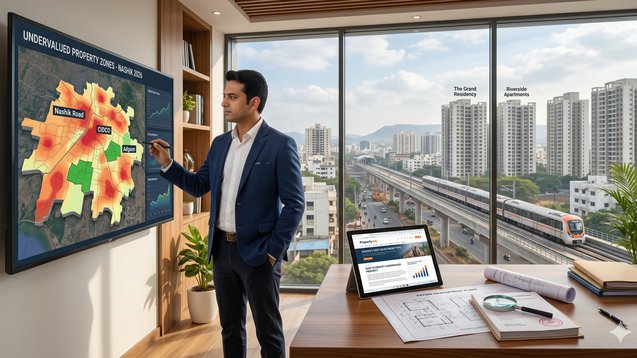
You need to study Government infrastructure plans in order to discover undervalued properties throughout India. The "transit-oriented development" of Mumbai and Bengaluru serves as the research area for your investigation. The accessibility discount of a location disappears when a Metro station begins operations because its existing traffic issues lead to undervaluation.

Shutterstock
In Tier 2 cities, which include Nagpur and Lucknow, the construction of new airport terminals and ring roads functions as the main development driver. The projects bring improved accessibility to the area but they establish new pricing standards which affect all locations within a 5 to 10 kilometer distance. The key task involves finding the "Sweet Spot" which exists between two project phases that start after project approval and end before construction. The moment construction becomes evident to all passing drivers, the "undervalued" designation begins to lose its power. You need to assess whether the existing infrastructure gap will remain for an extended period or whether it will be solved soon. You have discovered the successful option when you reach this point.
The "Tired Landlord" and Distressed Sales
The resale market of Tier 1 and Tier 2 cities shows this situation occurring with high frequency. An NRI who hasn't visited India in a decade and just wants to liquidate their assets, or a family dealing with a sudden need for medical funds, might price their property 15 to 20% below the prevailing market rate for a quick exit. The situation offers two-way "deals" which lead to instant market value increases. The process requires both local broker connections and dedicated time to search through Property Aaj (https://www.propertyaaj.com) database. You have to be ready to move fast. A distressed sale won't wait for you to ponder for three weeks. Buyers in these situations want to complete purchases within a short time frame while being completely certain about their purchase. If you make a "clean" offer which has no legal issues and includes immediate payment, the seller will accept your offer because it brings him comfort.
Analyzing Rental Yields as a Value Compass
The most dependable method to identify an undervalued residential property requires assessment of the rental yield together with the capital value. The average residential rental yield in Indian metropolitan areas ranges from 2.5% to 3.5%. You discover an undervalued property asset when you identify an area where high rents result from a nearby hospital or university while property prices remain low. The market demonstrates strong rental demand because people desire to reside in that location. The capital value will increase to match rental demand because tenants and similar individuals will eventually choose to buy in that area. This phenomenon occurs predominantly in Tier 3 cities which experience a sudden influx of professionals returning to their hometowns. They bring Tier 1 rental expectations to Tier 3 prices. The "High-Yield, Low-Cost" zones which you identify will result in future capital appreciation because your tenants will cover the expense.
The Aesthetic Trap: Look Past the Peeling Paint
The majority of Indian customers make purchases based on what they can see. The customers desire three specific things including the lobby area and the kitchen design and the new paintwork. The market undervalues properties which display unattractive design elements and which builders have neglected. I have witnessed South Delhi and South Mumbai apartments which had prime locations sell at lower prices because their appearance matched 1980s design standards. Your value hunting process needs to include "X-ray vision" as a necessary skill. The wall needs to be removed so that we can create an open-plan living space. The dull flooring solution allows us to replace it with modern vitrified tiles at a cost that falls within the price difference. The cosmetic problems become your most valuable resource when the building is intact and the layout works well. The smart renovation process enables you to create value through your construction work. In the real estate market "ugly" properties present themselves as "opportunity" assets.
Legal Grey Areas and Title Issues
I will state my position about purchasing a property with a disputed title because I will not recommend this option to you. The property assessment shows this to be "undervalued" but it actually functions as a liability. The legal problems of these properties can be resolved through "fixable" solutions. The local municipal corporation has two issues which need resolution: missing succession certificate and outstanding minor dues. Many retail buyers will run away the moment a lawyer raises a red flag. You can achieve a substantial reduction when your legal team accomplishes its work and you remain steadfast through bureaucratic procedures. The property value will return to its market price after the legal obstacle has been removed. This occurs frequently with ancestral properties that exist in Tier 2 and Tier 3 cities. The risk increases but the potential rewards become more significant. People who want to take this route must possess knowledge about local "Lokayukta" and RERA regulations in their specific state.
The "Follow the Big Boys" Strategy
The existence of institutional investors and Grade-A developers provides a simpler method to discover undervalued areas when deep research work proves impossible. Godrej, Tata, and DLF make their entrance into a new market because they have already spent crores on market research about the sector. The information they possess remains unknown to the general public. The land that borders these large branded townships shows signs of being undervalued. The branded project will bring schools, retail hubs, and better roads to the area. At "Mega Township" projects, customers can purchase their first project or resale plot, which allows them to access infrastructure development benefits while avoiding the "Branded Premium" charge. The "halo effect" causes major projects to increase all property values within a 3-kilometer area for 24 months according to our observations at Property Aaj (https://www.propertyaaj.com).
Micro-Market Saturation vs. Emerging Clusters
People tend to make the mistake of purchasing property in an active micro-market which has already reached its highest point. When there is widespread discussion about a particular industry, the opportunity to invest in undervalued assets has already passed. The "Next-Door Neighbor" serves as the essential method to discover actual worth. You should target the area which has developed Sector A to a market value of ₹12,000 per sq. ft. while Sector B across the street offers similar development prospects at a price of ₹8,000. The "Edge-of-the-Map" approach operates successfully when applied to growing cities such as Pune and Hyderabad. The city boundaries exist as a constant shifting element. The areas which currently exist as "outskirts" will transform into "mid-town" areas within the upcoming seven years. The first step requires you to verify the existing zoning regulations. Will the space between the established hub and the new satellite area be developed into residential properties? The gap exists because this process will bring the two elements together. Indian markets experience pricing fluctuations which occur in "leaps" so you must establish your location at the point where future price increases will happen.
The Commercial-Residential Synergy
People frequently discover undervalued residential properties which exist close to developing commercial areas that still lack residential development. In India, people generally like to live near where they work. The residential demand of an area serves as a delayed measurement for new development projects which include large-scale Special Economic Zones and Industrial parks. It doesn't happen overnight. The office construction process typically lasts between two and three years until residential buildings start operating. The window period allows investors to purchase properties at reduced prices during this specific time. The outer edges of Chennai and the new districts of Kolkata will show this pattern. The nearby properties which currently have low value will experience a sudden increase in both rental and market value when thousands of workers begin their home search to avoid a two-hour commute.
Home Loan Trends and the "Credit-Driven" Discount
The home loan trends of 2026 now demonstrate increased complexity than previous years. The growing caution of banks toward "unapproved" and "B-Khata" properties has created a substantial price difference between bank-financed properties and cash-only properties. The cash-only properties which appear "cheap" to buyers actually function as deceptive traps. A property receives undervalued pricing to its actual worth because retail buyers experience panic when a particular builder receives a temporary "Technical Rejection" from a major bank. You can negotiate a "cash-like" discount for the property because you can demonstrate that the issue is only a minor clerical error or a compliance issue that can be easily resolved. The secret weapon for detecting market overreactions against a project lies in your ability to comprehend the "Lendability" assessment of a property.
Conclusion: The Patient Hunter Wins
When people search for undervalued property in India their main goal involves discovering prices that do not match actual property value. The assessment needs you to view an empty remote piece of land as a future active community that will receive high-speed train connections. The assessment needs you to view a broken-down building as a premium rental property. The current information requires you to place your trust in both the data and the infrastructure maps instead of current news articles. The Indian real estate market has established shorter periods in which properties maintain their "undervaluation" status for assessment. Current knowledge spreads at an unprecedented pace throughout the world. The Indian territory extends through multiple regions while the "Path of Progress" keeps experiencing ongoing changes. You can achieve success by monitoring Property Aaj (https://www.propertyaaj.com) together with your infrastructure research and rental income evaluation and legal knowledge assessment. Real estate wealth creation requires people to discover future trends which they should pursue instead of following popular paths. The process of searching brings happiness.
Frequently Asked Questions (FAQs)
1. How do I know if a property is truly undervalued or just "cheap" because of bad quality?
The property assessment uses "Replacement Cost" together with "Utility" as its main evaluation standard. The property value remains undervalued when land costs together with construction expenses exceed the selling price while permanent defects remain absent. A "cheap" property usually has a permanent flaw; an "undervalued" one has a temporary or perceptual flaw.
2. Is it riskier to buy undervalued properties in Tier 3 cities compared to Tier 1?
Tier 3 cities present higher risk because their market requires more time to complete transactions. In a Tier 1 city, even an "okay" property will eventually find a buyer. The economic growth of the local area must progress according to expectations for you to sell your asset in a Tier 3 city. The Tier 3 investment needs to be supported by actual economic development which comes from either new factories or major government institutions.
3. What role does RERA play in identifying undervalued projects?
RERA serves as a valuable source of information because it contains extensive data. The official RERA website allows users to verify a developer's previous project delays, unsold unit counts, and "Encumbrance" information. A project appears to be undervalued because the market doubts the builder but RERA shows that the project has achieved 90% funding with a realistic completion date which allows you to invest safely.
4. Can I find undervalued properties in premium areas like South Mumbai or South Delhi?
The answer is yes but most properties require either "aesthetic" or "distressed" renovations. In these areas, the land value is so high that the structure often becomes irrelevant. Search for apartments located in older buildings which developers intend to tear down and build anew. You are essentially buying "Future Premium Square Footage" at a "Current Dilapidated Rate."
5. How much time should I spend researching an area before buying?
I recommend at least 3 to 4 months of active monitoring. The market requires you to track newly listed properties and their duration on the market until they make a sale. You must understand the real estate market "pulse" before you invest your money. The price tracking tools on Property Aaj (https://www.propertyaaj.com) offer users a more efficient method to acquire knowledge about the price tracking tools.
6. Does "Vastu" affect the value of a property in India?
Vastu has a major impact on property value because it establishes two different architectural standards. The property market values a property which has a major Vastu defect because most Indian buyers will not accept a property with this defect. You can use your knowledge of Vastu and architectural solutions to negotiate better prices because you don't accept Vastu as true.
Read more about property matters with our specialists and browse the latest property listings on Property Aaj. Download the app from the Play Store and App Store now for easy buying, selling, and renting!