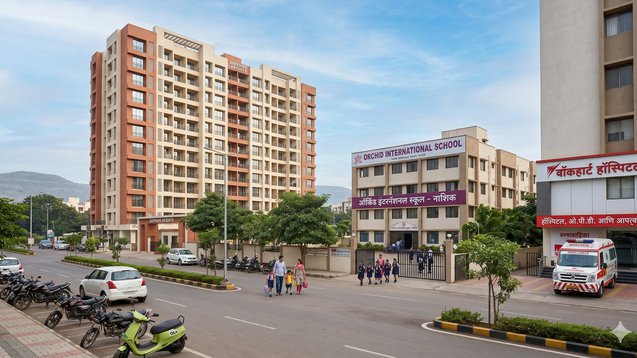
Flats Near Schools & Hospitals, Why It Matters
Introduction:
Homebuyers in India begin their search process by considering primary elements which include property cost and home size and developer trustworthiness and transportation options. The essential services which include schools and hospitals located near a property determine three critical aspects of its value which include daily life experience and long-term happiness and market worth. The buying process requires immediate attention to this matter which becomes essential for living comfortably after it gains importance during the course of time. Think about it. A home is not just four walls; it’s where your daily routine unfolds. The shorter distance between your home and your child’s school brings you and your child to school in a more peaceful manner. The presence of nearby hospitals during emergencies creates a vital distance which has the potential to protect lives. The area near schools and hospitals not only provides personal benefits but also creates strong financial value because properties in those locations achieve higher resale value and rental demand throughout India. The importance of this factor remains consistent across all three locations which include Mumbai and Indore and Tier 3 towns. Platforms like Property Aaj (https://www.propertyaaj.com) increasingly show how buyers are filtering properties based on these practical considerations, not just luxury features. The importance of flats located near schools and hospitals exceeds their initial value which most buyers recognize.
Daily Convenience That Changes Your Life
Living near schools and hospitals makes life much easier. It cuts down on travel stress saves you time and helps you feel more in control of your routine. For example, think of a working couple in Bengaluru. If their child's school is 12 km away, mornings can be hectic. Traffic, delays and missed breakfasts.. If the school is just 2 km away the same routine feels much more manageable. The same is true for healthcare. Regular check-ups visits to the unexpected illnesses are easier to deal with when there's a hospital nearby. You don't take care because it's far away. In cities like Mumbai or Delhi where traffic jams are a major issue, living close to important places can cut your commute time by 50-70%. In cities, like Nagpur or Jaipur it means you don't have to rely on a private vehicle. In towns, where infrastructure is still being built it ensures you can access reliable services without having to travel far. Over time these little conveniences add up. They reduce stress, help you manage your time better and create a lifestyle. Something that homebuyers often realize they appreciate only after they've moved in.
Emergency Preparedness: A Priority
It’s safe to say you cannot predict what type of medical emergency you may be involved in, and in the heat of an emergency, only one thing is important; how far away the emergency room is from you when you need them. A hospital that is only 10 minutes away from your location could save your life, which is where property that is located within reasonable proximity to multi-specialty hospitals or emergency care centers will always be attractive to buyers. In metro areas such as Delhi and Chennai, access to quality healthcare facilities is an important factor influencing the prices of premium residential properties. Similarly, in Tier 2 cities, the availability of high-quality healthcare facilities will also influence the price of residential properties, as nearby hospitals are the main determining factor of what qualifies as a "prime residential area." In Tier 3 towns, where there are few options for high-quality health care, the availability of high-quality healthcare facilities will, again, have the greatest impact on the price of a residential property. More and more buyers consider the proximity to high-quality hospitals to be a priority when selecting a property to purchase. On the Property Aaj (https://www.propertyaaj.com) website, we have found that properties that are located near recognised hospitals receive inquiries significantly more quickly and close with sellers respectively. Emergency preparedness isn’t only for emergencies; elderly family members and children will benefit from having access to health care providers when they need to go in for routine health checks or if they are sick and need to see a doctor. In conclusion, the proximity to quality healthcare is much more than a convenience; it is also a safety net, and safety adds long-term value to real estate.
Better Education Access and Long-Term Family Planning
For families, schools located near their homes become the main factor which they use to make their educational choices. The distance to school affects both the convenience of school travel and the educational results which students achieve. Parents today prefer homes near reputed schools to avoid long commutes for children. Residents in Pune, Hyderabad, and Gurgaon have established residential areas which surround leading educational institutions. In Tier 2 cities like Coimbatore or Lucknow, areas near CBSE or ICSE schools often command higher demand. In Tier 3 towns, even proximity to a decent English-medium school can significantly impact property desirability. Let’s consider a scenario. A family buys a slightly cheaper flat 10 km away from a good school. They will spend approximately two hours every day on school transportation which will cost them extra money throughout the next decade. The option which appeared to be economical at first, became a costlier option because it required more time and energy than expected. That’s why many buyers on Property Aaj (https://www.propertyaaj.com) now prioritize “school radius” filters while shortlisting properties. It’s about today and it extends to planning needs which will span for the upcoming 10 to 15 years.
Stronger Rental Demand and Investor Appeal
From an investment point of view flats near schools and hospitals are options in Indian real estate. People who want to rent a place look for areas like this. Families, working people and even old people like to stay where they can easily access services. In cities like Mumbai and Bengaluru people are always looking to rent near schools and hospitals. These places charge rent about 10 to 20 percent more. In cities these areas have fewer empty apartments. In towns they become popular areas where people prefer to rent and the demand for rent stays steady. For example a 2-bedroom apartment near a school in Indore is easy to rent compared to an apartment in a faraway area even if the other one is newer or bigger. Investors who use Property Aaj often choose these areas because they know how rent they can get. In markets it is good to know what to expect and being close, to essential services helps.
Higher Resale Value and Price Stability
Real estate markets fluctuate. But certain factors consistently protect property value and location near schools and hospitals is one of them. Why? Because demand never disappears. The essential needs which buyers require will continue to take precedence over everything else during economic downturns. A property may not sell quickly due to pricing issues but if it exists near essential services the property will probably sell within a short period. The valuation of such properties in Tier 1 cities maintains a constant upward trend. The properties in Tier 2 cities achieve better performance than the typical market expansion. The properties in Tier 3 towns serve as reference points which determine local market valuation standards. The regions around educational institutions in Pune and Ahmedabad maintain constant property value growth while other areas experience market downturns. Buyers browsing Property Aaj (https://www.propertyaaj.com) compare matching properties and they find that school and hospital proximity delivers better value than other locations. The established pricing method for this product relies on actual consumer demand instead of conventional market practices.
Infrastructure Development follows these zones.
Infrastructure Development tends to happen in areas with schools and hospitals. This is a thing to notice. Infrastructure Development happens because these schools and hospitals bring people to these areas.. When people move to an area businesses that serve these people also move in. You will see that roads in these areas become better over time. Public transport also improves in these areas. You will also find grocery stores and other amenities that people need in their life. In cities these areas become very desirable places to live. In cities they become popular areas to invest in. In smaller towns they become the starting point for the town to grow. For example when a new hospital is built in an area people start to want to live there. This happens because the hospital makes the area a better place to live. Similarly a good school can make an area a very popular place to live. The people who buy property in these areas benefit the most, from Infrastructure Development. Infrastructure Development makes the value of their property go up over time.
Psychological Factors that Cause Preference for Location in Home Purchases
Most home shoppers prefer to live near schools and hospitals, instinctively. This preference is primarily psychological because of the "creature comfort" that exists. Buyers typically envision their daily living being easier by living near a school when they visit a property. Buyers who see a hospital nearby feel secure also. Many times, buyers make their final decision based on these emotional factors rather than negotiating for the price. Buyers in Tier 1 cities may compromise on square footage but will not compromise on location. Buyers in Tier 2 cities will typically find a balance between square footage and location. As for buyers in Tier 3, they typically budget for convenience versus luxury features. Real estate is about more than merely the numbers; it's also about the "feel" of the area. Therefore, when a property is built in close proximity to essential services, it will have a greater sense of liveability than if it were not located close by.
When You Are Buying A House
You need to think about planning aspects. Buyers have to check the zoning aspects of the area they want to buy a house in. Some areas near hospitals may have rules that allow businesses to operate there. Properties near schools can get really crowded during hours when kids are going to or coming from school. The rules of RERA are different in states but they all make sure that projects are approved in a transparent way. Buyers should check these things:
Land use classification
Access roads and public infrastructure
Future development plans
You do not have to pay stamp duty and registration costs just because a house is close to something. Houses in nice areas often cost more money. It is easier to get a home loan for houses in areas that're already developed and have good infrastructure. You should do your research so that you do not miss any issues when you are buying a house in a good location. The location of a house is important and legal and planning aspects of the location are also important. Buyers should always remember that the location of a house like a house near a hospital or a house near a school can have its set of rules and problems. So buyers should always check the planning aspects of the location of a house before they buy it.
Noise, Traffic, and Practical Trade-Offs
Finding a balance is essential. Living near a medical or educational facility comes with some positives and some negatives. For many, schools cause increased traffic congestion during school drop-off and pick-up times; hospitals have ambulance sirens and increased traffic flow into and out of the facility. Tier 1 cities tend to have more noticeable issues with this due to the large number of people living in close proximity and with many major road systems. In a Tier 2 city, the issues are manageable; and in a Tier 3 town, there are usually few problems. Smart property buyers often look to purchase properties located slightly away from a major thoroughfare. These properties are located within transit distance but are also quiet and peaceful. For example, if an apartment is located 300 to 500m from a school, this would be a good fit for someone looking for convenience as well as a residentially quiet location. The main point here, however, is that it is not just about how close something is, but how smartly it is close.
Conclusion
Home buying represents your largest life choice because people often choose their new house based on unimportant aspects of the property including its interior design and its available facilities and its temporary promotional pricing. The essential aspect that determines your long-term happiness with your residence exists inside your house because it enables you to complete your daily activities. Flats near schools and hospitals provide residents essential benefits which include easy access to both academic and medical facilities together with protection from dangers and permanent residency and high-value investment options. This element needs thorough evaluation because it affects first-time buyers and families who need more space and people who want to invest. The Indian real estate market shows that essential services drive higher property values which improve residential satisfaction across all three city tiers. If you’re currently exploring options, take a moment to filter your search accordingly. Property Aaj (https://www.propertyaaj.com) provides users with tools that help them find specific areas while enabling effective location comparison. A good home provides more than just geographical space because it determines your level of comfort and accessibility throughout your daily activities.
FAQs
1. Are flats near schools always more expensive in India?
The prices of flats near schools in India maintain their regular market value except for cases when schools create increased demand which leads to higher pricing. In Tier 1 cities, the price difference between two locations reaches substantial levels, but Tier 2 and Tier 3 cities show a more moderate price difference which remains observable.
2. Is it better to buy directly next to a school or slightly away from it?
The ideal distance from a school campus extends between 300 meters to 500 meters. The location provides you with close access to school facilities, but you can avoid the problems that come with traffic jams and noise disturbances which occur during busy times.
3. Do hospitals nearby affect property prices positively or negatively?
The presence of hospitals in an area creates a positive effect on property values because people value hospitals that have established good reputations. The location within the neighbourhood affects property value because hospitals create noise problems that affect nearby properties.
4. Are such properties good for rental income?
The properties are among the top choices for tenants who want to rent their homes because they serve this purpose. The majority of Indian cities experience continuous demand because Indian cities maintain low vacancy rates.
5. How can I find properties near schools and hospitals easily?
The website Property Aaj (https://www.propertyaaj.com) enables users to search properties through its amenity-based filtering system which helps them to evaluate multiple properties simultaneously.
6. Do banks prefer financing properties in such locations?
The answer is yes because banks see these areas as less risky because they have high property demand and established infrastructure which results in easier loan approval processes.