Introduction
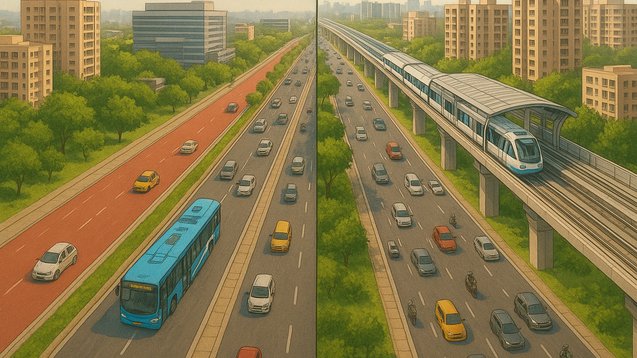
Pune is growing at a rapid pace, and mobility projects are playing a major role in shaping its real estate market. The city’s residents have long struggled with traffic congestion, narrow roads, and inconsistent public transport. But now, two major systems—Bus Rapid Transit (BRT) and Pune Metro—are reshaping how people move around the city.
For property buyers and investors, the big question is: which has a bigger impact on property values—BRT or Metro? Understanding this can make the difference between buying early in an appreciating market or missing the right window. In this article, we will break down how both BRT and Metro influence real estate prices across key Pune localities like Kothrud, Baner, Hinjewadi, Wakad, Viman Nagar, Kharadi, Hadapsar, Koregaon Park, Magarpatta City, Aundh, Pimpri-Chinchwad, Bavdhan, Pimple Saudagar, Yerwada, and Camp.
BRT and Metro: Pune’s Twin Transport Lifelines
The BRT system was one of Pune’s first major public transport upgrades, designed to give buses dedicated lanes and reduce travel time for commuters. Routes such as the Swargate–Hadapsar and Aundh–Ravet BRT corridors have already made daily travel easier for thousands of residents.
The Pune Metro, on the other hand, is a more recent development with a larger transformative potential. Phase 1, covering routes like Vanaz to Ramwadi (Line 2) and PCMC to Swargate (Line 1), is already operational, with future extensions expected to link more suburbs and IT hubs.
Both systems aim to solve the same problem—connectivity—but their influence on real estate is not identical.
Impact of BRT on Real Estate Prices
The BRT offers a quicker and cheaper upgrade to connectivity than Metro. It can be implemented faster, with fewer land acquisition challenges. Here’s how it impacts real estate:
Localized Impact
BRT corridors usually benefit properties that are within a short walking distance (500 m to 1 km) from bus stops. This is especially visible in areas like Hadapsar, where properties near the BRT corridor attract working professionals who rely on buses to reach Magarpatta City or Camp.Affordability Advantage
Since BRT projects do not involve massive infrastructure costs like the Metro, the price appreciation around BRT corridors is usually moderate—about 10-15% over a 3-5 year period. This makes them attractive for budget-conscious buyers looking for improved connectivity without paying a “metro premium.”Examples of BRT-Boosted Localities
Aundh and Pimple Saudagar: The Aundh-Ravet BRT corridor has improved commute times, leading to a steady rise in demand for mid-segment apartments.
Hadapsar: Properties along the BRT route are more appealing to employees of Magarpatta IT Park, and rental demand has seen a healthy uptick.
Bavdhan: With its proximity to BRT routes, Bavdhan has emerged as a preferred choice for families who rely on public transport but want to stay near Kothrud and the western suburbs.
Impact of Metro on Real Estate Prices
Metro systems worldwide have a history of driving significant property appreciation, and Pune is no different. Here’s why the Metro exerts a stronger influence:
City-Wide Connectivity
The Metro creates a network effect, connecting multiple localities through fast, predictable travel. For instance, the Vanaz-Ramwadi corridor links Kothrud, Karve Road, Shivajinagar, Yerwada, and Viman Nagar—cutting travel times drastically. This has already created a surge of interest in resale and rental markets near these stations.Price Premium
Studies show that properties within 1 km of a metro station often see 20-30% price appreciation within a few years of project completion. Buyers are willing to pay extra for guaranteed long-term connectivity.Examples of Metro-Driven Localities
Kothrud: With Vanaz as the starting point of Line 2, Kothrud’s already strong demand has surged further.
Baner and Hinjewadi: Although currently not directly connected, the proposed metro extensions are fueling speculative demand, especially among investors.
Viman Nagar and Kharadi: The Ramwadi terminal is a major selling point for these eastern IT hubs, as professionals can expect seamless travel to Shivajinagar and Swargate.
BRT vs. Metro: Side-by-Side Comparison
Which Influences Prices More?
While both improve mobility, Metro projects consistently show a larger and faster impact on property values. They attract a wider buyer base, including NRIs and investors who see the Metro as a long-term bet on Pune’s urban growth.
BRT, however, plays an important role for mid-income buyers and renters who value affordability. Its impact is steady, predictable, and well-suited for end-users rather than speculators.
Investment Opportunities Around BRT and Metro
If you’re looking for an early-mover advantage, here are some hotspots to consider:
Near Metro Stations:
Kothrud (Vanaz): Excellent for families and end-users looking for social infrastructure.
Yerwada & Ramwadi: Great for investors targeting rental yield from professionals working in Kharadi and Viman Nagar.
PCMC-Swargate Corridor: Pimpri-Chinchwad and Camp will both benefit from faster commutes.
Along BRT Routes:
Hadapsar & Magarpatta City: High rental demand from IT professionals.
Aundh & Pimple Saudagar: Ideal for buyers seeking affordable options with quick access to Hinjewadi and PCMC.
Platforms like Property Aaj make it easy to track new launches and resale opportunities near these connectivity projects, helping buyers make smarter, data-driven decisions.
Role of Infrastructure in Long-Term Appreciation
Real estate appreciation is never just about the property—it’s about the ecosystem. Pune’s growth corridors thrive when transport links, social infrastructure, and job hubs work together. Metro tends to create a ripple effect, attracting retail, office spaces, and better civic amenities around stations.
BRT also supports growth but with a narrower impact radius. It is most beneficial for already-established residential zones where residents are dependent on public transport for their daily commute.
Conclusion
Both BRT and Metro are transforming Pune’s mobility, but when it comes to driving property prices, Metro clearly has the upper hand. Its network connectivity, premium positioning, and ability to save time make it a major value driver for buyers and investors.
However, ignoring BRT would be a mistake. It is a cost-effective solution that continues to improve liveability in localities like Hadapsar, Aundh, and Pimple Saudagar, indirectly supporting real estate demand.
Whether you’re an end-user or investor, keeping an eye on infrastructure projects is crucial. Platforms like Property Aaj offer updated insights on Pune’s property market, helping you identify the right project near a BRT corridor or metro station before prices move further up.
FAQs
1. Does Pune Metro affect rental prices?
Yes, Pune Metro improves rental demand and allows landlords to charge a premium for homes close to stations, especially in localities like Kothrud, Yerwada, and Viman Nagar.
2. How soon after a Metro launch do prices increase?
Prices usually begin rising during construction but see the most significant jump within the first 1-2 years of operation.
3. Is BRT still relevant after the Metro?
Absolutely. BRT serves routes not yet connected by Metro and provides an affordable option for commuters, sustaining property demand in those corridors.
4. Which localities are best for investing near Metro stations?
Kothrud, Yerwada, Viman Nagar, PCMC, and areas near Ramwadi are among the most promising investment zones.
5. Are properties near BRT cheaper than those near Metro?
Yes, generally properties near BRT corridors are more affordable, which makes them a good option for budget-conscious buyers.
6. Can Metro projects influence commercial real estate too?
Definitely. Commercial spaces near Metro stations tend to see higher footfall and attract businesses, boosting property values.
Read more about property matters with our specialists and browse the latest property listings on Property Aaj. Download the app from the Play Store and App Store now for easy buying, selling, and renting!