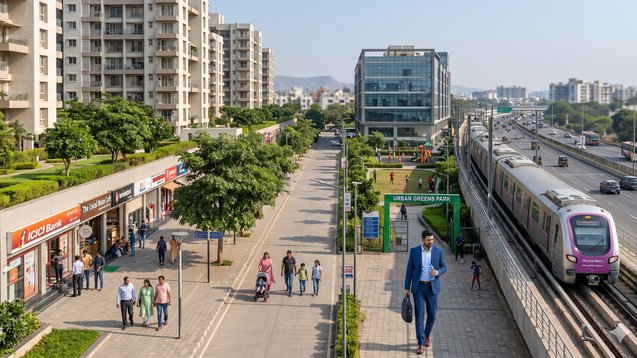
Selecting Property in Areas With Balanced Development
Introduction
The process of purchasing property in India extends beyond the physical structure of the building. Experienced buyers discover through their buying process that both the development pattern of the neighbourhood and their selected apartment or house carry equal weight. A great home in the wrong location can quickly become a regret, while an average home in a well-balanced locality often turns into a rewarding long-term investment.
What does the term "balanced development" actually mean? The term refers to a region which dedicates equal resources to developing residential areas and commercial spaces and social facilities and infrastructure systems. The community demonstrates progress through the simultaneous development of schools and hospitals and offices and roads and parks and daily convenience stores. The environment maintains a balanced state which prevents both extreme crowding and complete emptiness. Every city in India displays different patterns of residential development according to its designated city tier. The development areas of Tier 1 cities operate through balanced systems which connect tech parks with nearby residential communities and emergent suburban regions of Bengaluru and Mumbai and Delhi NCR. Tier 2 cities achieve balanced development through their establishment of affordable housing areas which receive ongoing infrastructure enhancements. Cities in Tier 3 need to establish stable civic development tracks which permit organized residential expansion in order to achieve balanced development. Buyers who explore Property Aaj (https://www.propertyaaj.com) through its listing platform will gain a better understanding of this concept which leads to better living experiences and increased property value over time. The process of identifying and evaluating suitable development areas requires us to examine the areas which achieve their optimal development balance.
What Balanced Development Actually Means in Real Estate
Many buyers mistakenly assume that development simply means more buildings and new projects. A jurisdiction which contains only residential buildings but lacks educational institutions and medical facilities and shopping areas will experience challenges throughout its entire future. Balanced development means a healthy mix of essential infrastructure and lifestyle facilities. A well-balanced locality typically includes:
Residential housing projects
Schools and educational institutions
Hospitals and healthcare centers
Retail markets and grocery stores
Offices or employment hubs nearby
Parks and community spaces
Public transport connectivity
The combination of these elements into a unified system enables residents to access amenities while property values experience continuous growth. Take examples from Tier 1 cities. The development of Whitefield and Hinjewadi in Pune succeeded because IT parks and residential complexes developed simultaneously. The close proximity between their homes and workplaces created a demand for rental properties which resulted in rental price increases. Balanced development in Tier 2 cities such as Jaipur and Lucknow requires different approaches for execution. The development process begins with the establishment of highway connections and residential areas which later expands to include shopping centers and medical facilities and educational institutions. For property buyers exploring listings on Property Aaj (https://www.propertyaaj.com), spotting these patterns early often leads to smarter investment decisions.
Infrastructure is the backbone of any locality.
It is usually a sign that an area is going to grow in the future. Things like roads, metro lines, highways and public transportation are the foundation for development that will last for a time. In India making infrastructure better has become a reason why the real estate business is growing. Big projects like expressways, metro rail networks and ring roads can completely change a region. For example
The Dwarka Expressway corridor in Delhi NCR became a desirable place to live once the road work started moving faster.
The Mumbai Metro expansion made some suburban areas very popular for purposes.
Cities like Nagpur and Indore saw an increase in property prices after the roads were improved.
In cities infrastructure is often used to reduce traffic in the main city area by encouraging people to move to the suburbs. In cities infrastructure is often the reason why development starts in the first place. Small cities benefit from projects like city initiatives, new bus terminals and better highways which slowly attract builders to the area. Before you buy a property ask yourself a question: Is the infrastructure in the area already good or is it still something that is promised? On Property Aaj website you can find listings that talk about how easy it's to get around which makes it easier for buyers to figure out if a location is really a good place to live.
The Role of Employment Hubs and Economic Activity
No neighbourhood thrives without economic activity. Jobs attract people, people create housing demand, and housing demand drives property prices. This cycle is most evident in India’s technology and industrial hubs. For example:
Bengaluru’s Outer Ring Road became a residential hotspot due to IT offices.
Pune’s Hinjewadi region grew rapidly because of technology parks.
Gurugram transformed from farmland into a corporate hub with premium residential towers.
In Tier 1 cities, proximity to employment centers often determines both property value and rental yield. Tier 2 cities are increasingly developing industrial clusters, manufacturing zones, and IT parks. Cities like Coimbatore, Vadodara, and Bhubaneswar are attracting new corporate investments, creating fresh residential demand. Tier 3 cities depend on government offices, educational institutions, and regional trade centers as their primary engines for economic growth. The presence of housing projects without corresponding job opportunities in an area will create persistent low demand throughout the long term. Property Aaj (https://www.propertyaaj.com) buyers should research nearby employment hubs before they compare different localities.
Social Infrastructure: The Everyday Convenience Factor
Even if we have roads and offices a place can feel incomplete without things like schools and hospitals. Think about our life.
We need these things to live comfortably.
Families need schools for their kids to go to.
Older people need hospitals to go to when they are not feeling well.
People who work need supermarkets to buy food, gyms to exercise and cafés to relax.
Areas with social infrastructure are nicer to live in and people want to live there.
In cities the best areas to live in usually have things like international schools, big hospitals, shopping malls and entertainment centers. Some examples of these are:
International schools
Multi-speciality hospitals
Shopping malls
Entertainment centers
In cities social infrastructure usually gets built after people start living there. Developers make areas that have everything people need like schools, stores and parks. In smaller cities people might have to use government schools, local markets and hospitals but things are getting better. It is nice when everything we need is close by so we do not have to travel far. If we can find a place to live that has all these things it is a choice. People who look at properties on Property Aaj often find neighbourhoods that're convenient and will become more valuable, over time. People can look at https://www.propertyaaj.com to find these kinds of places.
When You Are Looking For A Place To Buy
You should not pick an area that's too crowded or too empty. Areas that are too crowded usually have problems like
A lot of traffic
Many people using the same roads and buildings
The air and water are getting polluted
Not many new things can be built there
On the hand areas that are too empty may be cheap but they do not have
Buses or trains to take you places
Parks or community centers
Electricity and water that you can count on
The best areas are usually somewhere in between.
These areas are growing steadily. Still have room to get bigger.
For example in Mumbai the areas that are right in the middle of the city may be too full while the areas that are away may not have basic things like schools and hospitals. The best places to buy are usually in areas that are growing. Not too fast and are connected by metro or highways. Similarly in cities like Pune, Ahmedabad or Kochi the suburbs that are growing at a pace are often very good for living and investing in real estate because they have everything you need but are not too crowded and Balanced areas like these are great for people who want to buy a house and also for people who want to invest in real estate, like the Balanced areas of Pune, Ahmedabad or Kochi.
Pricing Trends Across Tier 1 Tier 2 and Tier 3 Cities
The way a city is developed has an effect on Property Prices. In Tier 1 cities the nice areas are usually very expensive. However the suburbs that are getting roads and public transport are where Property Prices are going to increase a lot. For example:
The suburbs of Bengaluru that got metro lines saw a big jump in Property Prices.
Navi Mumbai saw a lot of growth after they announced infrastructure projects.
Tier 2 cities are an option for many people who want to buy a house. The Property Prices in Tier 2 cities are still affordable. The city is getting better roads and public transport so the value of the houses is going up steadily. Cities like Indore, Surat and Lucknow are becoming popular because people who work are looking for houses.
Tier 3 cities usually have the lowest Property Prices to start with. If the city is not doing well economically and the government is not investing the Property Prices will not go up much. When a city is developed in a way the increase in Property Prices is steady and not just because people think it will go up. This means that the growth in Property Prices remains sustainable than just speculative which is good, for Tier 1 Tier 2 and Tier 3 cities and their Property Prices.
Rental Demand and Liveability
The development process needs balanced development because rental demand functions as a critical component. Urban areas located near employment centers and educational institutions and commercial districts show strong rental market activity. The working population and migrant workforce create rental demand in Tier 1 cities. The presence of IT parks and corporate zones in localities results in higher occupancy rates. The rising student population and increasing healthcare worker and industrial employee presence are driving rental demand in Tier 2 cities. The expansion of educational institutions and government employment centers has led to a slow increase in rental housing demand for Tier 3 cities. Developing an area through balanced development will make it attractive to all buyers and tenants which will help maintain property value over time.
Legal Factors and Regulatory Stability
The development process achieves its best results through continuous regulatory oversight. The Real Estate Regulatory Authority in India has established better transparency standards throughout the country although different regions implement these standards with minor differences. Builders in developed regions follow RERA guidelines with greater accuracy which creates safer conditions for buyers. The different states establish their own stamp duty rates and registration charges which affects property affordability. For example, some states provide reduced stamp duty rates for female buyers while other states change their rates during festive periods. Established areas receive better access to home loans because banks consider these locations as safer investment options. Property Aaj users who search for properties through the website needs to confirm both RERA registration and legal approvals before they make their property purchase decision.
Practical Tips to Identify Balanced Development
The average buyer needs to use property checklists which begin with their first property assessment.
The first step requires you to complete a basic checklist.
People should check the neighbourhood at different times throughout the day.
People need to verify how accessible public transport systems operate in the area.
People need to find educational institutions and medical facilities and grocery shops which exist in the surrounding area.
People need to investigate all planned construction activities which will happen in the future.
People need to evaluate road conditions and their travel patterns which include both their driving routes and the time they spend traveling.
The assessment should include an evaluation of the current resident demographics. A healthy mix of families, professionals, and students usually signals strong demand. The simultaneous development of multiple construction projects in an area indicates upcoming infrastructure expansion which demonstrates developer confidence in market growth. The real estate website Property Aaj (https://www.propertyaaj.com) provides users with tools to assess different neighbourhoods and track property listings throughout multiple urban areas.
Conclusion
Indian homebuyers and investors should choose properties situated in areas that display equal development throughout their entire region. Experienced buyers select neighbourhoods which demonstrate ongoing development of infrastructure and employment opportunities and residential areas and public facilities. The best suburban areas in Tier 1 cities provide their residents with excellent transportation options and future property value growth. The housing market in Tier 2 cities is changing because new organized developments create demand for residential properties in developing areas. The government is assisting Tier 3 cities as they construct their fundamental city frameworks through organized development projects. The main point requires you to examine aspects that exist beyond the building. The value of a property for future years depends mainly on its surrounding elements which include roads and employment centers and educational institutions and medical facilities and city development plans. The platform Buyer Aaj which offers URLs to Property Aaj (httpswww.propertyaaj.com) helps buyers discover optimal neighbourhoods by conducting thorough research and studying infrastructure developments. The perfect real estate location exists because people understand urban development patterns which enable them to select properties that will experience future progress through sustainable development.
FAQs
1. What does balanced development mean in estate?
Balanced development in estate means that a neighbourhood is growing in a way that everything is being built together. This includes homes, shops, roads and things like schools and hospitals. It is not a bunch of apartments being built but a whole community with parks, transportation and other things that people need to live comfortably. This makes it a good place to live and a good investment.
2. Why is balanced development for people who buy property?
Balanced development is important for people who buy property because it makes life easier and helps the value of the property go up over time. When an area has roads, jobs, schools and hospitals more people want to live there and rent properties. This means that the value of the property will increase and it will be easier to sell or rent it out. Balanced development is good for property buyers because it helps them in the run. Balanced development makes the property more valuable and more attractive, to people who might want to buy it or rent it from them.
3. Do balanced development areas cost money?
No, not always. Sometimes new suburbs that are getting roads and buildings can be a better deal than the city center. People who find these development areas early can buy in for a lower price and the value of their property will go up more as the area gets better.
4. How do people looking for a place to live find development areas?
People looking for a place to live should look at what new roads and buildings are being made, how close it is to where people work, if there are schools and hospitals nearby and if they can easily get on a bus or train. They should also drive around the area at times of the day to see how bad the traffic is and visit the neighbourhood to see what it is like. This can help them figure out if the neighbourhood is a place to live.
5. Do Tier 2 cities offer balanced development opportunities?
Yes. Many Tier 2 cities like Indore, Ahmedabad and Lucknow are growing well. They have roads, planned neighbourhoods and more job areas. These cities can grow a lot in value compared to cities, like Delhi and Mumbai.
6. Does RERA help ensure development?
RERA helps control how builders work and makes them tell the truth. This way projects get done on time. Follow rules. Before buying a house always check if the builder has RERA registration.