Introduction
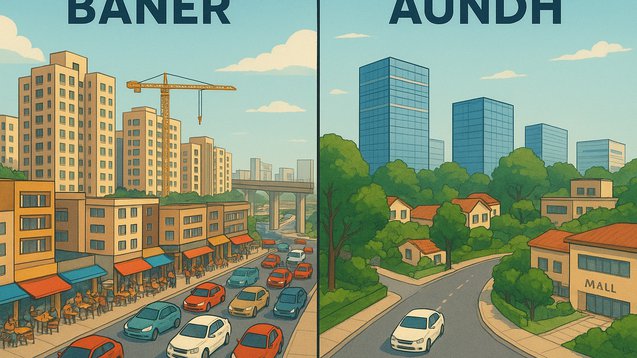
Banner and Aundh are two of Pune’s most desirable western/sub-western localities. Both are popular with professionals, families, and investors. But while they share some strengths (good amenities, proximity to Hinjewadi/IT hubs, social life, etc.), they also differ in important ways. If you’re considering buying a home (for living or as an investment), understanding the trade-offs between Banner and Aundh can help you make a more informed decision. This article dives into three key dimensions:
Lifestyle—what daily life feels like in each place (amenities, social vibe, green cover, infrastructure)
Traffic—commute times, congestion, road conditions, problems you may face daily
Resale score—how well properties hold value, how liquid they are, what buyers look for
We’ll also compare current price levels and suggest which kind of buyer (end user vs investor) might prefer each area.
Lifestyle
Banner
Vibe & Amenities: Banner has grown rapidly over recent years. It’s known for its eating and café culture, boutique shops, rooftop restaurants, bars, co-working spaces, etc. Young professionals like it for its modern feel. Banner High Street, Balewadi High Street, and proximity to the Banner-Balewadi cluster make it lively, especially on weekends.
Green Spaces & Nature: Some parts of Banner are close to hills (Pasha, Banner Hill), which offer hiking trails and relatively better air, especially in upper Banner. But with densification, some streets see less greenery.
Social Infrastructure: Schools, hospitals, supermarkets, etc. are good. Also good access to entertainment and shopping. The Banner Pasha Link Road is being developed/upgraded, which helps connectivity and amenities.
Cost of Living & Home Sizes: Because of the demand, homes are expensive per sq. ft, especially in Banner High Street and adjacent premium zones. Newer premium projects often command high rates. But you may get a better size for the price further away from main roads.
Aundh
Vibe & Amenities: Aundh is more established, with a mix of traditional Pune culture and modern amenities. There are well-known local markets, family-oriented restaurants, more established schools, mature tree canopies in many parts, and quiet residential pockets. It feels more “settled” in many ways.
Green Cover & Layout: Many parts of Aundh are more laid out, with quieter lanes, older trees, and better shade, though also with busy junctions and traffic. For some people, Aundh feels more “homey” if they prefer less hustle.
Social Infrastructure: Very strong. Good schools, medical facilities, and everyday retail. Proximity to places like DP Road, Aundh Road, etc., gives many options. Property stock includes both apartments and villas/bungalows in certain pockets.
Cost of Living & Home Sizes: Aundh tends to have slightly better stability in infrastructure and more predictable services (roads, water, electricity), though prices per sq ft are also high in premium zones. Homes may offer slightly less flashy amenities than the newest luxury in Banner but often better internal build, surroundings, and acceptability.
Traffic
Traffic is perhaps the single biggest pain point in both localities, but in slightly different ways.
Banner
Peak hour congestion: Frequent gridlocks, especially on Banner Road, the Banner-Balewadi stretch, Banner to Hinjewadi routes, etc. Metro construction (Hinjewadi-Shivajinagar line) has introduced pillars, diversions, and narrower carriageways in many places. Weekend traffic & parking issues: On weekends, the High Street/restaurant areas get overloaded. Illegal parking, patrons parking on pavements, shops congesting roads. Road condition and diversions: Metro works, potholes, incomplete roads, and detours are common. Rain worsens these.
Aundh
Major junctions & choke points: Areas like Midpoint Chowk (intersection of Aundh-Banner Link Road, Nagaras Road, DP Road), Mahdavi Shinde Road, etc., see traffic build-up. Frequent bottlenecks at those converging points. Approach roads & signals: Signals sometimes malfunction, approach roads are narrow, and approach bridges or flyovers are often overburdened. Rain and monsoon exacerbate issues.
Parking and encroachment: Shops, local stalls, and illegal parking on major roads worsen traffic flow. Encroachments on footpaths and narrowing of roads make life harder. Comparison of Traffic Between Banner & Aundh
So if your priority is daily commute comfort, both have issues, but Banner's traffic pain tends to be more persistent and more variable (restaurant traffic, nightlife, etc.), whereas Amund's is more predictable but still heavy in certain arteries.
Resale Score
Resale score refers to how well a property is likely to retain value, how easy it is to sell later, and what features/residents/investors look for. Factors include current rates, demand, liquidity, infrastructure readiness, and future potential. Here’s how Banner vs. Aundh stack up:
Current Price / ₹ per sq. ft
According to recent data, Aundh averages around ₹ 9,900/sq ft.
Banner is lower, around ₹ 8,140/sq ft on average.
In premium zones of Banner, especially near main roads/high streets, etc., the price can go much higher, sometimes nearing Amund's levels, especially for luxury apartments. But broadly, Aundh is more premium.
Liquidity & Demand
Properties in Baner are in strong demand from IT professionals wanting proximity to Hinjewadi, modern amenities, and restaurants. New projects attract attention, especially near the link roads and high streets.
Aundh has a more stable demand base: families, settled professionals, people wanting schools, and mature neighborhoods. So resale properties in Aundh often find buyers who want long-term residency.
Expected Appreciation & Growth
Baner’s growth is tied closely to infrastructure projects (metro, link roads) and the lifestyle trend. As amenities and road connectivity to Hinjewadi, etc., its value has been rising. But risks include traffic, road quality, and delays in projects.
Aundh’s appreciation is more gradual but possibly more stable. Less risk of “boom-bust”; the existing infrastructure base is better, although the lifestyle premium is already reflected in prices, so the upside might be more moderate.
Which kind of buyer/investor fares better?
If you are an investor looking for higher appreciation, Banner offers more upside potential, especially if you buy before infrastructure/road improvements in your immediate micro-area.
If you're an end user (want to live there), Aundh may offer better comfort, predictability, resale value in case you decide to sell, and less risk of unpleasant surprises.
Summary Comparison & Recommendation
Here’s a snapshot summarizing:
Conclusion
If I were advising someone, here’s what I’d say:
If your priority is investment or high growth, and you can tolerate some inconvenience (traffic, construction, maybe wait times), Banner is a good bet. You might buy ahead of infrastructure, choose a project in a good micro-locality (close to major roads, link roads, amenities), and benefit from higher appreciation.
If your priority is living comfort, less daily hassle, and wanting predictable resale value (especially in 5-10 years), Aundh edges ahead. For families and people who care about good roads, schools, quieter nights, and are willing to pay a premium, it may give more peace of mind.
Property Aaj Perspective
Platforms like Property Aaj can help you see current listings in both Banner and Aundh, compare prices, filter by amenities, and check micro-locality maps and upcoming road/metro works nearby all of which are crucial in assessing how well a property will do for resale and how comfortable it will be to live in.
FAQs
1. Which area has cheaper flats/homes: Banner or Aundh?
On average, Banner tends to be cheaper per square foot than Aundh. But in Banner, prices vary more depending on how premium or how far from main roads you are. In Aundh, many areas are already premium, so prices are more uniformly higher.
2. Is Banner worse for traffic than Aundh?
Not always worse in all parts, but Banter tends to face more severe traffic pains due to recent construction, metro pillars, diversions, and weekend/leisure-traffic spikes. Aundh also has congestion, especially at junctions, but many parts have better internal roads and more predictable traffic
3. Which area is better for families with kids?
Aundh is likely the safer, more stable option for families: better established schools, quieter residential pockets, and more mature infrastructure. Banner is good too, especially in newer projects, but you may face more noise, more changing roads, and distractions.
4. What areas within Banner or Aundh should I target for better resale?
In Banner: near Link Road, closer to High Street / Balewadi High Street, or premium projects with good builders.
In Aundh: internal lanes with less traffic, good connectivity to main roads but not stuck in jam spots, and projects with good amenities and green surroundings.
5. How will Metro/upcoming infrastructure affect resale in both?
Major impact. In Banner, the metro pillars and works currently causing inconvenience will, once complete, boost connectivity and likely push prices higher. Similarly, opening roads or flyovers will reduce travel time. In Aundh, flyovers, bridge upgrades, road widening (where possible), and better traffic management (like the “Aundh Pattern”) could improve life and thus resale value.
5. Which one has a better rental yield?
Banner potentially has a better rental yield (especially for compact 1/2 BHKs near Hinjewadi or High Street) because of demand from young professionals. Aundh’s rental demand is good, too, especially from people who work in central Pune or nearby areas, but rents may be more stable and yield slightly lower because purchase prices are higher
Read more about property matters with our specialists and browse the latest property listings on Property Aaj. Download the app from the Play Store and App Store now for easy buying, selling, and renting!