Introduction:
Pune’s Industry-Driven Growth Story
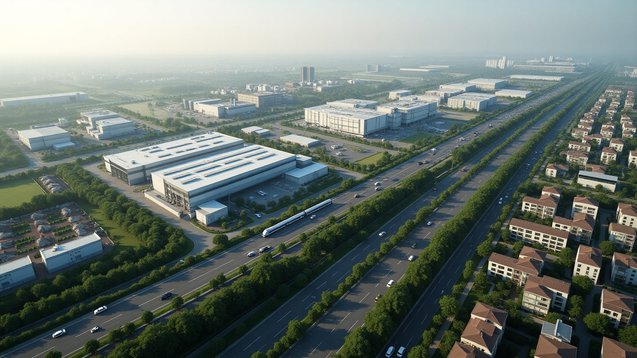
Pune has long been a magnet for education, IT, and automobile industries. But what truly sets it apart is the city's strategic industrial corridors, which have become the backbone of its real estate evolution. Over the last decade, areas like Chakan, Talegaon, Pimpri-Chinchwad, Ranjangaon, and Hinjewadi have seen exponential growth—thanks to their blend of industrial activity and urban development.
As we enter 2025, these corridors are not just employment hubs—they’re shaping housing demand, urban planning, and investment potential. In this comprehensive guide, Property Aaj walks you through the impact of Pune’s major industrial belts on residential and commercial real estate across the city.
1. What Are Industrial Corridors? Why Do They Matter?
An industrial corridor is a planned zone where manufacturing, logistics, and infrastructure development are concentrated to promote economic growth. These zones typically have:
Clusters of factories, warehouses, and logistic parks
Access to highways, rail, and air transport
Government incentives like MIDC, SEZ, and plug-and-play parks
When such zones grow, they create a ripple effect on real estate—leading to higher demand for residential housing, rental accommodation, and commercial spaces.
2. Pune’s Key Industrial Corridors Driving Real Estate
Let’s explore the major corridors and their influence on surrounding property markets.
a) Chakan-Talegaon Corridor
Industries Present:
Volkswagen, Mercedes-Benz, Bajaj Auto, Mahindra, General Electric, and several Tier-1 auto parts suppliers.
Real Estate Impact:
Chakan: Once known for MIDC zones, now has affordable housing projects between ₹25–50 lakhs.
Talegaon: Gaining traction for weekend homes, plotted developments, and budget flats.
Trends:
Steady 8–10% YoY price appreciation
High rental demand from factory employees and executives
Popular among first-time buyers and mid-level professionals
Explore RERA-approved flats in this corridor on Property Aaj.
b) Pimpri-Chinchwad Industrial Belt
Industries Present:
Tata Motors, Bajaj, Thermax, Forbes Marshall, SKF, and over 4,000 MSMEs.
Real Estate Impact:
Older industrial zones are now surrounded by residential clusters like Pimple Saudagar, Moshi, and Nigdi.
Integrated townships and metro development boosting prices and livability.
Trends:
Property values have surged by 35–50% in the past 5 years
Strong demand for 1BHK and 2BHK flats from mid-income families
Proximity to Pune Metro Line 1 and Pune-Nashik Highway is a big plus
c) Ranjangaon MIDC Corridor
Industries Present:
LG Electronics, Whirlpool, Maccaferri, Fiat, and other multinationals.
Real Estate Impact:
Located on the Ahmednagar Highway, ideal for affordable plotted and gated communities.
Increasing interest from blue-collar and semi-skilled workers.
Trends:
Appreciation still in early phases (5–7% annually)
Land parcels and budget flats under ₹30–40 lakhs are seeing high absorption
Better roads and logistics expected with upcoming infrastructure schemes
d) Hinjewadi–Talawade–Mahalunge IT & Tech Corridor
Industries Present:
Infosys, Wipro, Tech Mahindra, TCS, and dozens of tech startups.
Real Estate Impact:
Hinjewadi is now a complete ecosystem of residential townships, malls, schools, and hospitals.
Nearby areas like Mahalunge, Wakad, and Baner have boomed due to IT expansion.
Trends:
10–15% annual property appreciation
Rental yields of 4–6%—some of the highest in Pune
High demand for compact 2BHKs and co-living options
Find metro-connected homes in this area on Property Aaj.
3. Job Migration Equals Housing Demand
Industrial corridors bring jobs—and jobs bring people. This directly translates to a rise in:
Rental housing demand (for workers and executives)
Affordable and mid-range flats
Demand for women-friendly and family-friendly societies
Increased developer activity in underdeveloped villages turned suburbs
The effect is visible across areas like Chikhali, Moshi, Tathawade, and Wagholi, where rural patches are turning into urban housing belts.
4. Infrastructure Development Follows Industry
Real estate thrives when industries grow, and that’s because governments prioritize such zones for:
Wider roads and logistics parks
Metro connectivity and ring roads
Power supply and water treatment upgrades
Public transport access
Example:
Hinjewadi-Shivajinagar Metro Line 3 is not only for tech employees—it’s transforming real estate in Balewadi, Baner, and Mahalunge.
Ring Road and Pune Metro extensions are expected to decongest major corridors and boost outer zones like Ravet and Punawale.
5. Investment Benefits: Long-Term Appreciation and Rentals
Why Investors Love Industrial Zones:
Pro Tip: Use Property Aaj to discover pre-launch and under-construction projects in future growth pockets.
6. Rise of Mixed-Use and Smart Townships
To meet growing demand, builders in industrial belts are now offering:
Mixed-use developments with residential, retail, and commercial
Walk-to-work ecosystems
Amenities like creches, business lounges, and co-working zones
Smart homes with Wi-Fi, solar power, and digital access systems
Example Projects:
Life Republic (Hinjewadi)
Riverdale Heights (Kharadi–Mundhwa stretch)
Woodsville (Moshe–Dehu Road)
These townships have redefined what living near an industrial zone looks like.
7. Risks to Watch Out For
While industrial zones are attractive, investors must keep in mind:
Pollution risks: Check for buffer zones if near heavy industry
Over-dependence on one sector: Auto-only areas may face volatility
Delays in civic infrastructure: In some MIDC zones, roads and sewage may lag
Always verify legal titles, RERA status, and local development plans. All such details are available with verified listings on Property Aaj.
Conclusion:
Industrial Corridors Are Reshaping Pune’s Real Estate Map
Pune’s industrial corridors are no longer just job zones—they’re urban growth engines creating massive opportunities in real estate. Whether you're a buyer seeking affordable housing, an investor chasing rental income, or a developer eyeing expansion—Chakan, Talegaon, Ranjangaon, and Hinjewadi offer a winning mix of demand, infrastructure, and long-term appreciation.
As Pune evolves into a multi-nodal urban ecosystem, staying close to industrial zones means staying ahead of the curve. Use Property Aaj to explore properties that are primed for growth and backed by data, legality, and location advantage.
FAQs: Industrial Corridors and Pune Real Estate
1. What are the main industrial corridors in Pune that affect real estate?
Chakan-Talegaon, Pimpri-Chinchwad, Ranjangaon, and Hinjewadi IT Park are the primary influences on property demand.
2. Are flats nearby industrial areas good for rental income?
Yes!! These areas will have constant demand for tenants, particularly in the IT and auto areas, i.e. Hinjewadi, Moshi etc.
3. Is the land near industrial corridors a good investment?
Yes, if you are purchasing non-agricultural (NA) land that is legally approved for development, residential or otherwise.
4. What is the price appreciation when looking at Chakan or Talegaon?
They are around 8-10% per year depending on where in the townships or in the metro areas you are obtaining properties.
5. How can I find legal, RERA approved properties in industrial areas?
You may browse and browse increase from credible sources like Property Aaj- where all documentation is clear and the projects have ratings for developers.
6. Are industrial corridor homes good for families?
Yes. The infrastructure has gotten better; and the townships make an environment for families- as such you can definitely consider what you want to purchase in Wakad, Moshi, Mahalunge.
Read more about property matters with our specialists and browse the latest property listings on Property Aaj. Download the app from the Play Store and App Store now for easy buying, selling, and renting!