Introduction: The Factor You Notice Only When It’s Too Late
People assess homes primarily by evaluating four essential factors which include location and price and building features and apartment appearance. Emergency access rarely becomes part of the initial conversation. People believe that emergency services will never need to reach their location. The most essential element of a safe and functional living space actually is. The quick emergency service response ability to your home during medical fires and urgent evacuation situations creates a situation that can change your entire life. High population density and restricted space in Tier 1 cities Mumbai Bangalore and Gurgaon create accessibility difficulties which prevent smooth movement through their areas. The planning in Tier 2 cities Pune Indore and Lucknow has reached better levels yet not all projects implement standard planning procedures. The design and execution process in Tier 3 towns encounters difficulties because available space. The property presents an ideal layout with complete amenities but emergency vehicles experience difficulty accessing your building which creates a concealed danger that most buyers fail to see. People choose properties with proper emergency access because it provides them with better emergency response capabilities instead of their fear of emergencies.
What Emergency Access Actually Means in Real Life
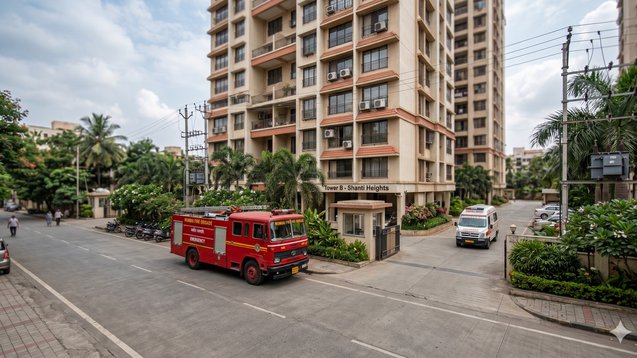
Emergency access requires more than a vehicle-sized gate because emergency services need unrestricted access to your building for fire trucks and ambulances and rescue teams. The design requires control over entry points and internal road widths and turning space and tower locations throughout the layout design. The emergency movement systems of high-density projects face limitations because their access roads exist but lack proper design for actual emergency situations. Response time decreases because emergency responders face obstacles from narrow lanes and sharp turns and parked vehicles. The project allows emergency vehicles to access your tower while giving them space to operate and stop their vehicles. The project on Property Aaj (https://www.propertyaaj.com) requires users to evaluate more than its visual elements because its actual performance requires testing through real-world situations.
Importance of Wide and Clear Internal Roads
The width of internal roads and their overall condition directly impact emergency access capabilities. The speed of emergency response operations depends on every single moment because emergency vehicles need open areas which enable them to drive at full speed. The internal roads of well-designed projects provide sufficient space which enables vehicles to drive in both directions despite parked cars occupying street space. The design of fire truck operations includes adequate turning circles which enable them to handle cornering requirements. The space between streets seems sufficient during site inspections in poorly designed areas because the actual capacity becomes apparent only after all residents have moved in.The space constraints in Tier 1 cities force developers to create tighter layouts which makes this aspect more critical. Proper planning in Tier 2 and Tier 3 cities will create efficient travel routes but buyers must confirm this information when they assess properties.
Tower Placement and Accessibility
The positioning of towers within a project plays a major role in determining how easily emergency services can reach each building. The towers which are situated close to entry points and along main internal roads provide better access to emergency responders. The buildings which are situated deep within the project area and surrounded by other buildings create challenges for quick emergency access. The design of high-density layouts results in some towers becoming "hidden" behind other towers which forces vehicles to navigate through narrow or crowded pathways. This situation creates significant delays for emergency responders who must reach their destinations. A project needs to establish proper access points from main roads to all towers in the facility. While exploring options on Property Aaj (https://www.propertyaaj.com) the master plan requires you to review it in detail to discover how accessible your selected tower will be during emergencies.
Entry and Exit Points: More Than Just Convenience
Emergency access capabilities depend on both the number of entry and exit gates and their specific layout designs. A project with a single narrow entry point may face congestion during peak hours, making it difficult for emergency vehicles to enter quickly. The existence of multiple entry and exit points creates better accessibility for users while it decreases waiting times for all users. The security checks that gated communities implement serve their safety purpose but must proceed without creating delays that impact emergency services. A well-operated society establishes pathways which enable ambulances and fire services to reach their destinations without experiencing any hindrances. The presence of multiple access points in Tier 1 cities establishes a vital solution to solve traffic problems which affect these areas. In Tier 2 and Tier 3 cities, this feature adds an extra layer of safety and convenience.
Parking Layout and Its Hidden Impact
People need to understand that parking affects emergency access because it serves as a main access point for emergency responders. The combination of poorly managed parking and peak hour traffic and limited space in older societies creates blocked internal roads which hinder movement. The lack of appropriate parking organization in high-density developments causes vehicles to invade internal roads which decreases available space for emergency response teams. The usage of basement parking spaces and dedicated parking zones maintains clear roadways which allows traffic to pass without interruption. The implementation of an effective parking management system guarantees that all internal roads stay open throughout all periods, which becomes essential when emergencies arise.
Fire Safety Infrastructure and Accessibility
Emergency access depends on the fire protection systems which exist in the emergency response area. The project needs to provide direct access to fire hydrants and fire engine access points and specialized safety areas. Fire safety regulations in high-rise buildings become more rigorous in Tier 1 cities, yet their implementation shows different results. The two lower population tiers of cities present different compliance standards, so buyers need to confirm compliance with these standards. The property achieves enhanced safety and emergency readiness through its combination of fire safety systems and correctly planned access routes.
Lift Access and Emergency Movement Inside Towers
The building requires two types of access because external access needs to be maintained and internal movement needs to be controlled. Emergency situations require rescue teams to use lifts as their primary method for accessing upper building levels. Building design requires multiple lifts and their scheduled maintenance to enable efficient people movement. Response operations in high-density towers face delays because of two factors which include extended waiting periods and a lack of available lifts. Emergency personnel require this information because stairway access to tall buildings is not a suitable option for their emergency operations. Your choice of tower building with sufficient lift capacity establishes an additional safety measure for your residential space.
Real-Life Scenarios: Why This Factor Matters
People tend to overlook emergency access because it remains invisible until it becomes necessary during their shopping activities. People need to envision a medical emergency situation which prevents an ambulance from reaching their building because of narrow roads and blocked entryways. A fire emergency develops when firefighters experience delayed access which raises danger to nearby areas. People must understand that both planning and accessibility requirements function as mandatory components of their projects. The property which provides swift emergency access through all areas of its premises gives users a feeling of security that exceeds basic advantages.
Comparing Tier 1, Tier 2, and Tier 3 Trends
Emergency access in Tier 1 cities faces difficulties because of high population density combined with restricted space, which makes effective planning crucial for emergency access. The design and accessibility of newer developments in Tier 2 cities show improvement because they provide better buying options to customers. The higher land availability in Tier 3 towns enables development but requires buyers to conduct project assessments because planning standards remain inconsistent. Understanding these differences helps you make a more informed decision based on your location and priorities.
How to Evaluate Emergency Access Before Buying
The process of evaluating emergency access requires observation combined with practical thinking abilities. The site visit needs to verify three specific elements: the internal road width, the total number of entry points and exit points, and the vehicle movement capabilities throughout the society. The main entrance provides access to your tower which must be evaluated for its current location. You need to ask yourself fundamental yet critical questions. The first question requires you to determine whether fire trucks can access the building site. The second question asks whether there exists adequate space for an ambulance to park in the vicinity. The third question requires you to assess whether the roads will maintain their clear condition throughout the entire duration of project occupancy. The website Property Aaj (https://www.propertyaaj.com) provides users with the ability to compare different layouts while discovering projects that present superior accessibility and planning options.
Conclusion: Safety Is a Daily Advantage, Not Just an Emergency Need
The emergency access system operates as a silent determinant which establishes the standard of your residential experience. The emergency access system first appears to be unimportant but its value emerges during critical situations. A property which developers have designed correctly provides emergency responders with unobstructed access to your location during their rescue operations. Home selection involves assessing both residential comfort levels and essential safety measures which build security against potential emergencies. You can evaluate projects through a responsible approach which considers access routes together with road widths and tower locations and overall project design. The process requires you to study these elements while searching for appropriate options through reputable sites such as Property Aaj (https://www.propertyaaj.com). Your ideal residence should offer you both protection and relaxation.
FAQs
1. Why is emergency access important in residential projects?
The system provides emergency services with fast access to your home during critical emergency situations.
2. What should I check for emergency access during a site visit?
You need to assess the internal road widths together with the entrance and exit locations and the tower distribution and the complete accessibility of the site.
3. Do high-density projects have poor emergency access?
The situation occurs more frequently in high-density projects which need proper planning to establish successful emergency response systems.
4. Does parking affect emergency movement?
The answer is affirmative because emergency vehicles face access problems when uncontrolled parking creates road obstructions.
5. Are multiple entry gates necessary?
Multiple entry gates provide better access to the area while they decrease waiting times which benefits both large communities and busy areas.
6. Is emergency access more important in high-rise buildings?
The answer is affirmative because buildings require effective systems to enable people to access their upper levels through both external and internal pathways.
Read more about property matters with our specialists and browse the latest property listings on Property Aaj. Download the app from the Play Store and App Store now for easy buying, selling, and renting!