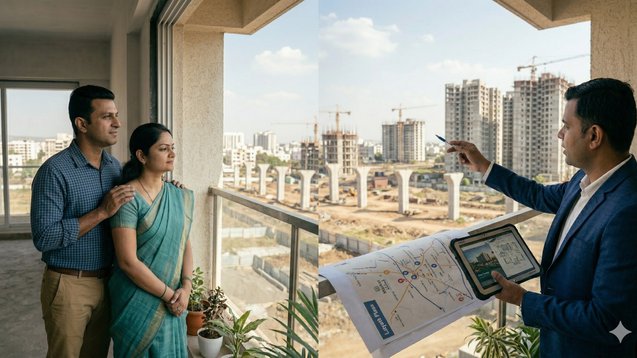
The “Future You” Method for Selecting a Home
Introduction
People who purchase a house often make their choice based on their current needs. Buyers focus on what they need today their current job location, current family size, or current financial comfort. But property decisions rarely stay relevant only for the present moment. In India, homes are typically purchased with a long-term horizon of 10–20 years or more. The home you purchase today needs to remain suitable for your future self.
The "Future You" method provides its most crucial benefits at this point.
The method helps buyers assess their home needs by studying their current situation and potential future developments. The method helps buyers assess their home needs by studying their current situation and potential future developments. Long-term thinking by buyers leads to better property decisions across all Indian real estate markets. The "Future You" method evaluates professional growth and personal development and infrastructure progress and family growth and investment value throughout the years. The property buyers who use Property Aaj (https://www.propertyaaj.com) to check property listings discover that successful purchases involve more than short-term benefits. The evaluation process requires assessment of property suitability for their upcoming life events. The method enables you to improve your home evaluation procedure through its understanding process.
Understanding the Future You Concept
The Future You method is about making decisions on property that will be good for you in the run, not just right now. When people buy a place for the time they usually think about what they need at the moment: how close it is to their office, if they can afford it or if there are nice things to do nearby. These things are important.. They are not the only things to think about. You should think about how your life will change over time.
Your career will get better.
You might have a family.
What you want from life will change.
For example a young person who rents in a city might care a lot about being close to their office and having a fun nightlife at first. Five years later they might want to live in a quieter place with good schools and more space. It is similar for people who buy homes in cities. They might buy a place when they are just starting their career but later they might find that the city is changing in ways that affect how much their home is worth and how they live. If you can imagine how your life might change you can pick a property that will still be great for you a time after you buy it. Websites like Property Aaj help people compare properties to see which ones will be good, for a time not just which ones are nice right now. You can look at https://www.propertyaaj.com to see how they can help you make a choice.
Thinking Beyond Your Current Lifestyle
Many buyers unknowingly make decisions based entirely on their present lifestyle. A single professional who lives in Bengaluru selects a studio apartment which is located near a tech park because it meets his needs for work and everyday activities.
What will occur if they wed three years later?
People need more space because they have different needs for storage and parking and community spaces. In Tier 1 cities where real estate prices are high, upgrading properties later can become expensive. Buying a slightly larger apartment initially may offer greater flexibility. Tier 2 cities provide better opportunities for successful future planning. People who want to buy larger homes should start their budget planning when their careers begin. The largest homes are available at the lowest prices in Tier 3 towns but buyers need to think about their upcoming job changes and how infrastructure development will proceed. The main question for assessment becomes: Will this home still work for the lifestyle I might have five years from now? Property Aaj (https://www.propertyaaj.com) users use their analysis of listings to change their understanding of how property size and layout and neighbourhood options should be evaluated.
Selecting Locations Which Show Potential For Future Development
The most crucial aspect for determining property value is through location selection the "Future You" method exists for choosing locations which will develop throughout time. The peripheral regions of Indian cities have developed into significant residential centers because of their improved infrastructure. The following examples demonstrate this trend which occurs through property development:
Metro system expansions
Construction of new highways
Development of IT parks
Creation of industrial corridors
Construction of new airport facilities
Real estate markets experience substantial value changes because of these development projects. Metro extension projects which connect developing corridors with Tier 1 cities create strong property value growth. Smart city initiatives and industrial development projects drive infrastructure expansion throughout Tier 2 cities. The Tier 3 towns are developing through improved transportation links and programs which promote economic development in their regions. Researching upcoming infrastructure projects before making a purchase decision provides buyers with better market insights. Buyers can discover potential new development areas through Property Aaj (https://www.propertyaaj.com) which displays property listings that show future infrastructure development. People who think like their future selves will make decisions about their perfect location which will maintain its value over the years.
Planning for Family Growth and Changing Needs
The homes which people buy today will require future adjustments to accommodate their expanding families. The young couple requires two bedrooms for their first home purchase because their current needs demand it. The space requirements of the home will increase when the couple has children and their parents and relatives visit them. The practice of multi-generational living exists as a common tradition among Indian families which makes this matter important. The high property prices which exist in Tier 1 cities lead families to choose smaller living spaces during their initial stage. The initial space requirements of families in Tier 1 cities face different outcomes when families implement proper planning methods. Tier 2 cities provide buyers with better options because they can choose to buy bigger houses during their initial buying stage. People in Tier 3 towns can find independent houses which offer spacious living spaces at prices that remain within their budget. Future planning also includes factors such as:
Nearby schools
Healthcare facilities
Parks and recreational spaces
Community environment.
The elements which appear unimportant at first will become essential when the family experiences growth. The home design process uses the "Future You" method to create spaces which adapt to changing family requirements.
When you think about your career you have to consider that you might have to move to a place.
India has a lot of people who move to cities or change jobs many times during their career. Nowadays people can work from home. Have a job that is a mix of working from home and going to the office. This changes the way people think about where they want to live. So what happens if your job requires you to move elsewhere? In that case it is an idea if your house can be used to earn money by renting it out or selling it for a good price. Big cities usually have a lot of people looking to rent houses because they have jobs available. Smaller cities are now becoming popular for people to rent houses because companies are opening offices in these areas. Smaller towns can be a good option because they have a steady demand for rental houses depending on the local economy. People who are smart about buying houses think about whether they can rent out their house if they have to move to a place. Websites like Property Aaj allow people to look at how many people're looking to rent houses in different areas and what the neighbourhood is like. The idea of thinking about your "Future You" is to think about how you can use your house both for living and for making money. You should think about Career Mobility and how it affects your house and consider using Career Mobility to your advantage when you buy a house. Career Mobility is a thing to consider when you are thinking about your Career Mobility and how it will affect your house.
Evaluating Long-Term Affordability
People frequently ignore financial comfort when they plan for their future needs. Many buyers focus only on whether they can afford the down payment and EMI today. Life usually continues to create new financial challenges throughout its course. People experience financial changes throughout their lives because of career shifts, business possibilities, educational costs, and unforeseen circumstances. A home loan should remain manageable even during challenging financial periods. High property prices in Tier 1 cities create larger loan requirements which force buyers to borrow more. Tier 2 cities enable various buyers to achieve better financial balance between their income and housing costs. Tier 3 towns provide residents with affordable homeownership options but they restrict access to financing solutions while experiencing slower property value growth. The "Future You" approach helps buyers select properties which enable them to maintain financial space between requirements. A comfortable home should provide people with better living conditions instead of making them handle ongoing financial burdens.
The process of assessing public facilities which enhance life quality for citizens.
The assessment needs to focus on infrastructure elements which make daily activities better for people. Homebuyers first examine the interior spaces of a property but the actual experience of living in a location depends on its street system. The essential elements of assessment include,
Public transport
Road connectivity
Schools and colleges
Hospitals
Retail and entertainment options
Public safety
Tier 1 cities provide advanced infrastructure systems but they need to solve their traffic congestion and environmental pollution problems. The urban development in Tier 2 cities now reaches its proper equilibrium because of improved city planning methods. Tier 3 towns have restricted access to essential services but they will undergo major development throughout the coming years. The Future You method guides buyers to assess upcoming changes in their neighborhood infrastructure during the next ten years.
Learning from Real Buyer Scenarios
Two buyers evaluate properties in Pune. The first buyer chooses a small apartment in a crowded area close to their current office. The second buyer chooses a development region apartment which has a size that exceeds their current apartment. Five years later, the metro became operational. The second buyer enjoys better connectivity, higher property value, and improved infrastructure. The first buyer experiences both traffic problems and restricted ability to sell his property. Both buyers purchased homes-but only one considered the perspective of their future self. These real-life scenarios demonstrate the crucial importance of long-term thinking in property decision-making processes.
Conclusion
For most Indians buying residential property stands as their most significant financial commitment. Yet many buyers approach it with a short-term mindset focused only on current needs. The "Future You" method operates as a cognitive transformation tool. The method asks you to envision your future life changes during the next ten years instead of evaluating your current life situation.
Will people in the area experience better living conditions?
Will the available area continue to meet all requirements?
Will the real estate maintain its financial worth?
Will the area sustain your preferred way of life?
Indian buyers in all real estate markets from Tier 1 metros to Tier 2 hubs and Tier 3 towns make better choices when they create future plans. Property Aaj (https://www.propertyaaj.com) listing exploration enables buyers to evaluate different properties at various locations and price points and through different growth areas which supports their long-term planning requirements. The ideal residence extends beyond proving suitable for your present circumstances. The ideal residence becomes the one that maintains its suitability throughout your future life.
FAQs
1. What is the “Future You” method in property buying?
The "Future You" method requires people to select their future home according to their anticipated life changes during the next five to ten years. The assessment evaluates current needs through various factors, which include career development and family growth and infrastructure expansion and investment opportunities.
2. Why is long-term thinking important when buying property in India?
Property purchases become permanent financial obligations because buyers need to secure home loans that last multiple decades. Long-term thinking establishes that the property maintains its usefulness and worth throughout upcoming years.
3. Should buyers prioritize future infrastructure developments?
Yes. Property values in regions that show plans for upcoming metro lines and highway construction and new commercial developments tend to increase. Future infrastructure development studies show their strong impact on property valuation and residential living options.
4. How does the "Future You" method help first-time homebuyers?
First-time buyers often focus on immediate affordability. The method helps users to think about future life transitions which will determine whether their home will meet their needs throughout different life stages.
5. Does this approach apply to Tier 2 and Tier 3 cities as well?
The answer is yes because multiple Tier 2 and Tier 3 cities face substantial growth in their development. Buyers who anticipate infrastructure improvements and economic expansion can benefit from long-term property appreciation.
6. Can a property chosen using this method become a good investment?
The answer is yes. Homes selected with long-term growth factors in mind achieve better resale and rental market performance because they match developing urban development trends.