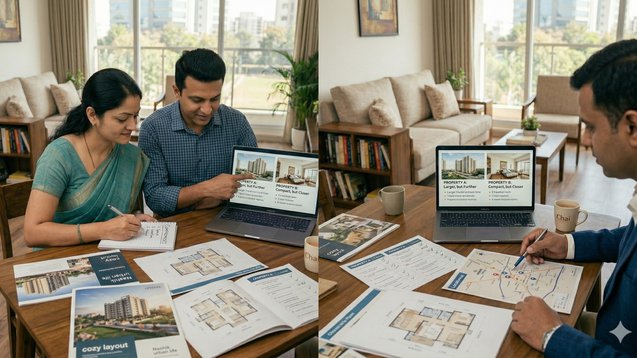
How to Decide What You Can Compromise On in a Property
Introduction
Home ownership in India involves more than just finding the ideal house. Property buyers discover through their search process that every real estate option requires them to make some type of concession. The main issue examines which aspects of a situation can be accepted and which must be rejected. You will discover a two bedroom apartment that matches your financial requirements although it exists at a distance from your employment site. The second property provides good transportation links but its rooms are smaller than expected. The third choice provides an ideal location but it does not include necessary facilities.
How do buyers reach their final decision?
Purchasers in India must evaluate multiple factors because they need to choose between properties available in Mumbai and Delhi and Bengaluru and Jaipur and Indore and Kochi and their respective Tier 3 towns which include developing neighbourhoods. No property checks every box. The process of making decisions needs this level of thoughtfulness as its main requirement. Successful buyers achieve their goals because they establish which aspects of their life become essential during their daily activities and their future development. Property Aaj (https://www.propertyaaj.com) listing system enables buyers to discover that their best choices emerge through understanding trade-offs instead of trying to eliminate them. Home buyers who select proper trade-offs will receive a residence that delivers high value and excellent appreciation potential and peaceful living conditions. Home buyers face the task of determining which areas they must make concessions in and which areas they must maintain their standards.
People need to realize that all properties have both positive aspects and negative aspects.
The first step in making smart property decisions is accepting a simple truth: perfect homes rarely exist within realistic budgets. Every property comes with a mix of strengths and limitations. Homebuyers in Tier 1 cities must accept space restrictions because both land inventory and housing costs prohibit them from purchasing their desired property size. A compact apartment in a well-connected area might be far more practical than a larger home located far from workplaces. Residents of Tier 2 cities need to decide between two types of areas when they make their homes. The first option includes emerging neighbourhoods that have growth potential while established areas provide mature infrastructure as the second choice. Tier 3 towns may offer spacious homes at lower prices but sometimes lack advanced urban facilities or employment opportunities. Buyers who recognize these trade-offs from the beginning will find better results during their home search process. Property platforms such as Property Aaj (https://www.propertyaaj.com) provide buyers with multiple city listing comparisons which show how different property features impact both their home budget and daily activities. Decision-making becomes easier for buyers after they understand that compromise exists throughout the entire process.
Identifying Your Non-Negotiables
Buyers need to determine their essential requirements before they start making decisions about which aspects of a deal to give up. People maintain their non-negotiable values because these values represent their most essential needs in life and financial matters. Some buyers need to choose their home location because they believe their commute distance will affect their ability to spend time with their family. Parents whose children attend school will choose to live near schools and medical centers. Investors prefer to invest in locations that show high demand for rentals and ongoing development of their infrastructure. People who live in Tier 1 cities prefer to live close to metro stations and business centers and main highways which become crucial requirements for their home needs. Buyers in Tier 2 cities want to choose between two options which include selecting high-quality neighbourhoods or selecting areas that will develop into commercial centers. People in Tier 3 towns need to consider how they can reach market centers and educational institutions and medical facilities. Buyers create a better property visiting experience by establishing their important needs before visiting actual properties. A site tour may show a property as attractive but if the property fails to meet your non-negotiable requirements it usually becomes an unsuitable option.
Compromising on Size vs Location
Indian buyers most commonly face a dilemma which requires them to select between two property attributes: location and property size. Urban markets which charge high prices lead buyers to select between two options which are either a larger house in the suburbs or a smaller apartment which provides access to downtown areas. Urban buyers now prefer better transport links instead of needing additional space.
Why?
People value daily convenience more than they value extra living space. People who live in a slightly smaller apartment near their workplace and train station and community facilities experience better daily living. In Tier 2 cities buyers can achieve their ideal home size because they can choose from developing areas which have better access to transportation links. People in Tier 3 towns can purchase large homes at low costs yet their selection of properties depends on available job positions and transportation systems. Exploring options on Property Aaj (https://www.propertyaaj.com) helps buyers visualize these trade-offs across different locations and property types. The correct equilibrium exists when you determine the importance of your daily travel needs and your need for things and your requirement for space.
Evaluating Amenities vs Affordability
Modern residential projects in India include gyms, swimming pools, clubhouses, landscaped gardens, and sports facilities as their standard amenities. The property prices and maintenance costs increase because the amenities improve the quality of life. Some buyers happily pay extra for these facilities because they actively use them. The initial excitement of new amenities causes many people to find most facilities empty after their first usage period. The clubhouse and sports facilities at the building remain unused by a young professional who works extended hours. Higher maintenance fees become unnecessary when expenses reach their highest points. Developers in Tier 1 cities provide premium amenities for their projects because they need to compete with other developers. Tier 2 cities provide comparable features to Tier 1 cities but their services cost lower prices. Tier 3 towns provide fewer luxury amenities than metropolitan areas because they offer larger living spaces. Your lifestyle patterns determine which amenities provide sufficient value to justify their extra expenses.
Considering Future Infrastructure Development
Buyers make trade-offs between current benefits and future development prospects. This method is most frequently used in new residential areas. The regions which now show low development status will undergo fast expansion after the completion of infrastructure projects which include metro systems and highway networks and IT park facilities. Hyderabad and Pune and Bengaluru have proven successful property investments which occurred in locations that would now be considered central to city activity. The development of business centers and better transit systems has created urban changes that currently affect Tier 2 cities. Smart city programs and regional infrastructure initiatives have created positive outcomes for Tier 3 towns through government development efforts. Property Aaj visitors who search listings at https://www.propertyaaj.com check upcoming infrastructure developments before making their choices. The current development needs minor reductions which will result in greater future value growth.
Budget Management Needs to Work Together with Future Objectives.
The process of buying property requires buyers to maintain strict financial control. Buyers select homes that exceed their financial limits because those homes seem more valuable and prestigious. Higher monthly loan payments create financial obligations that continue throughout life. People who stretch their budgets to buy homes in Tier 1 cities which have high property prices will experience financial difficulties that last for multiple decades. Tier 2 cities provide buyers with housing options that remain within their financial limits while offering them comfortable living spaces. People who want to buy homes at the lowest price need to consider employment options and economic development in Tier 3 towns which provide the lowest property costs. The best option for smart buyers involves choosing between two property elements which they can reduce instead of taking on a home loan that exceeds their payment capacity. People value their ability to manage their finances more than they value having a slightly superior property.
Lifestyle is really important when you are looking for a home.
A home is the place where you spend most of your time every day. You should not make compromises that make your life uncomfortable. For example if you buy a house that's very far from your work you will have to travel for two hours every day. This can make you feel stressed and unhappy even if your house is nice. It is the same when you buy a house in an area that does not have things like shops and schools. This can cause you a lot of trouble on the run. When you look at houses, on Property Aaj (https://www.propertyaaj.com) you should think about how each house fits with your routine and your family's routine. It is okay to make compromises on how the house looks or how it is laid out. You should not make compromises that will make your daily life difficult. Lifestyle compatibility is what should guide your compromises when you are looking for a home.
Learning from Real Buyer Scenarios
Property decision-making requires effective trade-off management because real-life situations demand complex decision-making processes. The young IT professional who works in Bengaluru faces a choice between two apartments which are located in different areas of the city. The larger apartment first appears attractive to him, but the smaller apartment enables him to achieve a better lifestyle balance because it provides him with shorter commute times. A family in Indore which exists in a Tier 2 city will select an older property located in a developed area instead of choosing a new building which exists in a growing area. The two options require buyers to make trade-offs, but they reflect the actual needs of their respective buyers. The examples demonstrate that compromises need to deliver both comfort and convenience which serve customers throughout their entire time with the product.
Conclusion
Property buying is rarely about finding a flawless home. The process requires you to reach educated compromises which fit your personal needs and financial objectives and upcoming requirements. Indian buyers assess multiple aspects according to their preferences while deciding on a property in all urban areas, metropolitan areas, Tier 2 cities, and Tier 3 towns. The Property Aaj platform, which can be accessed through https://www.propertyaaj.com, enables buyers to assess various property options that exist in different areas at multiple price points, thus simplifying the assessment of trade-off decisions. The smartest property buyers are not those who avoid compromises entirely. Strategic compromise helps individuals protect their essential needs while they maintain their capacity to adapt to various situations. The right compromises will produce homes which deliver practical comfort and maintain permanent value.
FAQs
1.Why should buyers reach financial agreements when they purchase property?
Most buyers operate within financial limits and no property can meet all their requirements. Buyers use compromise to select their top priorities which include location, budget and lifestyle requirements.
2.Which property elements should buyers keep at their highest value without making any compromises?
The core elements of location legal approvals safety and basic infrastructure should be protected from all but essential compromises. The property value and long-term residential comfort depend on these particular factors.
3. Is it better to compromise on size or location?
In many cases, choosing a superior location results in greater long-term benefits when building size requirements are designed to be partially reduced.
4. Should buyers compromise on amenities to reduce costs?
The decision to purchase a property without certain amenities becomes advantageous when those amenities will not be used frequently.
5. How can future infrastructure affect compromise decisions?
Areas with metro lines, highways or commercial developments growing fast make buyers think about the future. They sometimes give up on infrastructure for a chance to make more money later.
6. How can online platforms help buyers make compromise decisions?
Property websites let buyers look at homes, in different areas, price ranges and types. This helps them find homes that fit what they want and need.