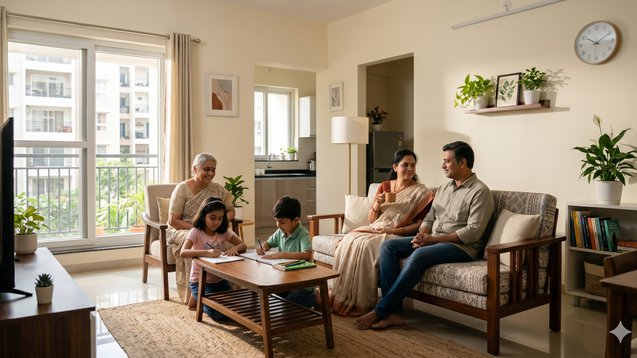
Vastu and Stress-Free Living
Introduction:
The Indian people today face stress because of their need to keep up with fast-paced life in modern society. People cannot attain mental peace because they face pressure from their long work hours and their need to commute and the increasing costs of housing and the never-ending stream of digital notifications. The concept of a "peaceful home" has become the most important thing people need to establish their home environment. Vastu Shastra provides guidance for designing balanced living spaces because it functions as a flexible design system instead of an inflexible design manual. People buying Mumbai studios or constructing Lucknow homes actually want to know their future home experiences beyond basic cost and site selection. The assessment requires users to determine which results they want to achieve through their home environment. The assessment requires users to determine which results they want to achieve through their home environment. Vastu provides a system which helps buyers to find answers to their inquiries. The system enables people to live without stress while they achieve their goals or it operates through their mental capacity and their perception of reality. The article examines real estate through three domains which include psychological factors and design elements and market trends that exist in Indian cities classified as Tier 1 Tier 2 and Tier 3.
Understanding Stress in Modern Indian Homes
Before we connect Vastu to stress-free living, it’s important to understand what causes stress in modern homes. Bangalore and Delhi as Tier 1 cities experience stress through external elements which include traffic and work pressure and noise pollution and restricted personal space. People use their homes as safe spaces where they can take breaks to refresh their energy. Nashik and Indore represent Tier 2 cities which contain slower moving environments that still create stress for residents who deal with both financial obligations and changes in their daily activities. In Tier 3 towns, stress originates from family obligations and requirements to maintain continuous performance which creates pressure. People across all social classes desire homes which provide them with peaceful spaces that enable them to work efficiently and feel safe. This is exactly where Vastu principles start aligning with real-world needs.
How Vastu Connects with Daily Living Experience
The main principle of Vastu requires homeowners to design their houses in accordance with the natural forces of light and air and the physical space and compass directions. However, the concepts of the system become evident through their effect on the atmosphere that exists in a residence. A house with proper ventilation systems allows residents to experience more comfort. Natural sunlight flooding into a room creates a positive effect on people's emotional states. A home that maintains an organized appearance enables its residents to handle everyday activities with greater ease. The various factors which reduce stress also function as essential principles in Vastu design. The design of modern apartments in Hyderabad includes these elements as essential components of their architectural framework. Developers create functional living spaces by using Vastu principles which they combine with their own architectural designs. People who claim Vastu brings them peaceful living conditions actually experience advantages from intelligent architectural design. The belief in superstitions exists independently from the actual effects which space has on your everyday activities.
The Psychological Comfort of Vastu Belief
The study of belief as a psychological concept deserves recognition because people tend to disregard its value. The homeowner who believes their house meets Vastu standards and produces beneficial energy from their house will experience positive results. The process of anxiety reduction leads to confidence development which occurs through their home environment assessment. A family from Pune moves to a new apartment and establishes their home. The Vastu-compliant home which they believe in will help them stay confident about their choice. The mental clarity which they achieve will lead to lower stress levels. The effect shows greater strength in Tier 2 and Tier 3 cities. Vastu functions as more than a guideline because it serves as a basis for establishing trust. Platforms like Property Aaj show special interest in Vastu-compatible properties because of this reason. The decision process considers buyer emotions which go beyond the available features.
Design, Space, and Emotional Balance
A home’s layout which shows how people will use each space will affect their emotional state. The design of a space causes people to experience stress because it creates an environment which makes them feel both restricted and disorganized and uncomfortable. Vastu recommends that spaces should be designed with two elements which include open paths for movement and designated areas for different activities and appropriate room arrangements. The compact apartments found in Gurgaon make it possible for even minor design changes to create significant changes in residential areas. The right location of a living room together with a sleeping room creates better comfort throughout the day. The practical elements of a home design hold more important value for Tier 1 buyers than Vastu requirements. Tier 2 buyers try to achieve both. Tier 3 buyers may focus more on traditional alignment. The approach used to create a home design needs to support emotional balance.
Which is more beneficial? Is it Vastu? Or is it location?
How do we determine that location has greater or lesser value than Vastu? For instance, living in a completely Vastu designed building can provide a stress-free lifestyle if you do not spend 3 hours traveling to and from home every day. Many locations in cities like Mumbai and Noida greatly affect your every day experience of stress and therefore quality of life. Proximity to your work, schools, grocery stores, etc. are greatly associated with the extent of stress experienced on a daily basis. While in Tier 2 cities there is generally a more balanced market place; the balance will favour those buyers looking for a good location as well as a building that is built in accordance with Vastu principles. Serious buyers of real estate will be using the Property Aaj portal as a resource when making their real estate decision as they will take into consideration additional variables beyond just directional specifications of either Vastu or non-Vastu homes. Serious buyers are also considering commute time, infrastructure and lifestyle while they consider the premise of Vastu and the relationship to stress free living.
Family Harmony and Shared Beliefs
The Indian household experiences stress as a shared problem which affects all members of the family. A home that aligns with family beliefs can reduce internal conflicts. The shared comfort emerges when all people in the house reach consensus about what constitutes the correct state of their residence. The joint family system of Jaipur enables Vastu to sustain family unity between relatives who share a common home. The shared space between two different groups establishes a base which they use to make choices. The Vastu system continues to shape discussions in metropolitan areas because its principles are used by families who live in nuclear units to decide which home they will purchase. The shared belief system between both parties creates an environment which decreases stress through two mechanisms. First the system decreases conflicts between them and second it establishes a bond which unites all members.
Investment viewpoint; reducing the stress associated with making financial decisions.
Buying a piece of real estate represents one of the largest financial investments many people in India will ever make. Therefore, buying a house comes with the associated stresses of monthly instalments, fluctuations in the market prices and uncertainty about what the future might hold. That leads us into discussing the role of Vastu in all this as well. Even for investors who don't necessarily believe in Vastu, they often look at how it will impact potential buyers when evaluating whether or not to buy a property. In Tier 2 and 3 cities, Vastu-compliant properties facilitate selling (the future uncertainty similar to buying a house is, therefore, lessened), which is a significant way to reduce the financial stresses created by purchasing a home. In Tier 1 cities, the effect is not as strong; however, there is still an effect. The likelihood of selling a Vastu-compliant apartment at an appropriate price may result in your property attracting a larger pool of potential buyers, even if the potential sales price difference is marginal at best. For further examples of the relationship between market behaviour and property registrations on Property Aaj you can refer to their statistics.
Achieving Legal and Financial Security is the Actual Way to Relieve Yourself of Stress
The actual basis of living stress-free, as opposed to simply feeling good (which is achieved through Vastu), is clarity in the legal and financial circumstances related to your home. A property with clouded title, lack of clearances and/or ongoing legal disputes will always create anxiety in its owners, no matter how strongly Vastu compliant it may be. Through many regions of India, land and developer regulatory bodies, such as Maharajah and Karnataka RERA, are in place to help consumers have confidence and secure their investments by ensuring transparency in developments. Tenants that are wise will complete their legal and financial checks first; they know that, only when secure, will they enjoy the stress-free lifestyle they desire through Vastu. Building on such security will allow the use of Vastu as just an enhancement of the already established foundation of security.
Changing Trends Among Younger Homebuyers
Younger buyers show a clear change in their approach to Vastu and stress-free living because Vastu now serves as a home design element which helps them create their ideal living space. The group operates with less strictness while their analytical abilities remain intact with their strong practical skills. The group succeeds in reaching their target outcomes because they prioritize three elements which include comfort and usability and long-term value. Young professionals in Hyderabad and Bangalore choose well-designed homes which do not need to follow Vastu rules. The group makes small changes to their space by adjusting furniture and lighting which enables them to achieve better spatial experience. The evolution of Vastu shows its current development because it marks the end of its previous system which required complete accuracy and now demands practical standards.
Conclusion
The question of Vaastu's ability to create peaceful environments requires two different perspectives. The answer lies somewhere between the two opposing viewpoints. Vastu creates emotional balance through its design which provides people with safe spaces to experience their emotions. The design supports better functionality through its three elements which create a structured and efficient residential space. The process requires multiple solutions to achieve stress-free living because various elements including location and personal outlook must be managed. People living in Tier 1 cities most frequently choose practical solutions. Vastu exists as a dominant force in Vastu practice within Tier 2 and 3 cities. The most effective method to address all Indian situations requires a balanced approach. Property Aaj users should use Vastu as their home search guide. Choose the elements which create actual positive changes to your routine activities. Home environments achieve stress-free conditions through proper directional placement because they enable people to live their daily lives.
FAQs
1. Can Vastu actually reduce daily life stress for people?
Vastu creates better design solutions which enhance natural light and improve airflow in buildings. The actual stress reduction results from three factors which include personal mindset and environmental conditions and the person's lifestyle choices.
2. Is Vastu more important in Tier 2 and Tier 3 cities than in other areas?
Yes, buyers in smaller cities often place more emotional importance on Vastu compared to metro buyers who prioritize location and infrastructure.
3. Should I compromise on location for Vastu?
The answer is no because location impacts both daily activities and permanent property value more than any other factor. Vastu needs to be balanced with actual practical requirements of the situation.
4. Do tenants care about Vastu?
Most tenants focus on rent, location, and amenities. However, some long-term family tenants may consider Vastu, especially in smaller cities.
5. Do contemporary apartments meet Vastu requirements?
Most apartments meet Vastu requirements to some extent which developers attempt to match through their design work but they fail to achieve complete Vastu compliance because of design limitations.
6. What matters more for stress-free living is Vastu or design.
Design usually has a more direct impact. The combination of proper ventilation and lighting and building layout systems proves to be more important than following Vastu guidelines exactly.