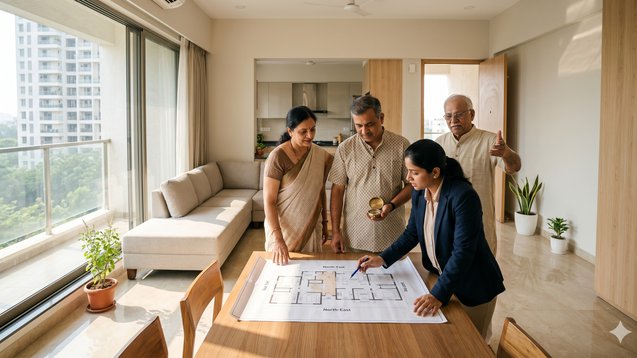
Why Vastu Matters for Indian Home Buyers
Introduction:
The process of purchasing a home in India extends beyond selecting suitable walls and floors and determining appropriate square footage because it requires buyers to establish a complete home environment. The process of home buying starts with buyers who conduct thorough assessments of every element from financial planning through to finding their ideal home location. The Vastu Shastra system which functions as an invisible factor continues to shape decision-making processes throughout the nation. The question of Vastu arises whenever people search for premium apartments in Mumbai or gated communities in Bangalore or independent houses in Lucknow. Vastu requirements should not be considered absolute but they need to be assessed during architectural planning processes. The Vastu system preserves its importance because it helps buyers access modern design and data-driven design decisions and contemporary building systems. The explanation emerges from four elements which include traditional beliefs and human behaviour and market trends and actual home environment. Some people seek to achieve spiritual harmony through their practice. Some people seek to achieve one particular emotional state through their practice. Many people use this method to transform their most challenging choice into a certain outcome path. The Indian home buying process still requires Vastu considerations in Tier 1, Tier 2, and Tier 3 cities which we will examine through practical, realistic, and current real estate market framework.
Cultural Significance and Deep-Rooted Beliefs
Vastu exists as an ancient practice which has existed in Indian culture since ancient times. For many families, it functions as a rule which they have maintained throughout their family history. The cultural bond between people and their home environment exists in Indore and Jaipur because both cities represent Tier 2 and Tier 3 urban areas. Vastu requirements serve as a vital component which buyers need to fulfill before they can create a complete home design. The belief exists in Tier 1 cities which modern lifestyles control because it has changed over time since its original form. In Pune, working professionals do not demand Vastu compliance from their homes yet they want their residences to follow fundamental Vastu rules. Vastu maintains its relevance because it enables people to maintain their cultural heritage while making contemporary real estate decisions.
Psychological Comfort and Decision Confidence
In India people face their biggest financial obligation when they buy property. The process brings people stress because they must deal with unknowns which lead to second-guessing their decisions. Vastu functions as a powerful psychological comfort system because it operates through subtle mechanisms. People need to decide which flat to choose between two identical units. One building meets Vastu standards while the other fails to do so. Buyers prefer the Vastu-compliant option because it makes them feel better about their choice. Many buyers in Hyderabad admit they follow Vastu because it helps them stay safe. People follow these beliefs because they need solutions to eliminate their uncertainty. Platforms like Property Aaj let buyers choose properties according to their desired direction and layout specifications. Home purchases involve both logical thinking and emotional attachment because they represent an ultimate decision.
Impact on Daily Living and Comfort
Vastu principles establish direct connections between their design elements which benefit daily operational needs of space users. The following examples demonstrate this concept. Natural light enters through proper orientation which provides optimal daylight access to spaces. Airflow through spaces gets improved by the layout design which was created with deliberate planning. Room arrangement through organized systems delivers better functions for users. The importance of these factors increases for cities such as Delhi which experience high population density and have limited space. A house which receives adequate light and fresh air flow delivers a more pleasant living experience which reduces mental strain. Buyers in Tier 2 cities which have flexible building designs can discover homes that fully meet Vastu standards without having to make significant trade-offs. People who claim that Vastu enhances their living experience actually benefit from improved design elements which extend beyond traditional Vastu practices.
Resale Value and Market Demand
Vastu has direct effects on market behaviour from a real estate viewpoint. Vastu-compliant homes in many regions throughout India:
Attract more buyers
Sell faster
May command a slight premium
In Tier 1 cities like Gurgaon or Noida, this impact is moderate. Location and infrastructure still dominate pricing. The demand for Vastu in Tier 2 and Tier 3 markets affects customer interest. People show more interest in north-facing plots than they do for other properties and east-facing flats. This is why even investors consider Vastu when browsing listings on Property Aaj. Personal belief determines marketability for future purposes.
Developer Strategies and Market Trends
Developers have an excellent understanding of buyer preferences, including Vastu. In locations such as Bangalore and Mumbai, many developers promote their buildings as being "Vastu-compliant." While they will not generally be able to ensure complete compliance, they will do their best to align important elements, such as entrance direction and kitchen location, as closely as possible to Vastu principles. This is not simply an aesthetic decision, but a method to market a product. By providing Vastu-compliant features, buyers can confidently make decisions without having to worry about evaluating all potential impacts. In highly competitive markets, Vastu-compliant characteristics of properties are often very significant sellable attributes on sites like Property Aaj.
Tier-Wise Differences in Buyer Behaviour
Vastu demonstrates different levels of importance through its varying significance across different city tiers. In Tier 1 cities, buyers show greater freedom in their purchasing decisions because they consider multiple factors. They prioritize location, commute, and lifestyle. Vastu becomes a secondary filter. In Tier 2 cities like Nashik, buyers aim for a balance. They want both practical convenience and Vastu alignment. Vastu serves as the main focus in Vastu Towns for people who require basic Vastu standards. Buyers may outright refuse to buy properties that fail to fulfil fundamental Vastu standards. The different Vastu implementations show that Vastu functions as a flexible system which changes according to individual living patterns and their experience with different things and the existing market environment.
Family Influence and Social Factors
In India, property decisions require multiple people to participate in the decision-making process. Family members of Vastu and Vastu become the mutually accepted solution which family members use to make their decisions. Parents and elders may strongly advocate for Vastu compliance, even if younger buyers are more flexible. In Ahmedabad, family members who participate in the decision-making process have the power to determine which option will be selected. The social aspect exists as well. Buyers often think about resale and perception. A Vastu-compliant home provides residents with an easier way to explain their home to others. The collective mindset of the community establishes Vastu as an essential element of Indian real estate.
Balancing Vastu with Practical Considerations
Vastu constitutes an important factor but it should never take precedence over actual needs. The location of a home determines its value because an ideal home in a bad location creates more problems than it solves. Daily life experiences major disruptions because of long commutes combined with non-existent infrastructure and poor transportation links. In cities like Mumbai, where time is a critical resource, location often outweighs Vastu. Smart buyers use a layered approach:
First, they check the location and budget.
The next step involves checking all necessary legal documents.
The last step requires them to assess Vastu compatibility.
The method creates value through Vastu while maintaining all available choices.
Financial Security: The Non-Negotiable Factor
No matter how important Vastu is, people need to think about legal and financial security first. In India there are groups like Maharajah and UP RERA that help buyers and make sure everything is clear. If a property is perfect according to Vastu but has problems it can cause a lot of worry and financial trouble in the long run. Buyers should always make sure to check these things:
RERA registration
Title clarity
Builder reputation
After checking these things, should people think about Vastu? This way buyers can have peace of mind. Feel safe emotionally and practically about their Vastu and legal and financial security.
Transformations Affecting Today's Customers
Now, consumers are more knowledgeable than ever, are looking for items to be practical and have the ability to conform to change. For example, young professionals living in cities like Bangalore and Hyderabad now prefer "Vastu-compliant" homes rather than ones strictly based on compliance with the guidelines. With their focus on usability, design, and lifestyle, these buyers are more than willing to make small changes such as furniture or lighting placement to create a better sense of alignment. These changes are indicative of a larger trend: the concept of Vastu is moving away from being a strict rule and becoming more of a guideline. And as a result, this is making it increasingly relevant (not less).
Conclusion
Indian home buyers consider Vastu for their homes because it fulfils their needs although people expect them to decide by other criteria. The assessment requires more than just analysing room directions and spatial configurations. The assessment needs to evaluate three specific factors which include both confidence and comfort and cultural connection. The assessment provides buyers with a secure feeling during their major life decision. The process exists through all stages of urban development from Tier 1 cities to smaller Tier 2 and Tier 3 cities. The process exists throughout all urban areas of India because it plays a vital role in how people make their choices. The essential requirement for success involves maintaining an equilibrium between two opposing forces. Vastu serves as your primary guide which should not restrict your design choices. Use it together with essential practical elements which include site selection and legal understanding and financial resources. The balanced approach which you take to evaluate properties through Property Aaj leads to better decision-making and increased decision-making assurance. The ideal home for your needs requires Vastu compliance because it meets all your life requirements.
FAQs
1.Why do Indian home buyers need Vastu as their essential requirement for home selection?
Vastu delivers three benefits to buyers through its psychological comfort and cultural match and increased property marketability. The system helps buyers make their hiring choice through improved decision-making confidence and security.
2. Does Vastu affect property prices?
The answer is yes for particular situations. Vastu-compliant properties attract higher demand in Tier 2 and Tier 3 cities which results in minor price increases.
3. Is Vastu more important than location?
The importance of location which affects daily life and future property worth. The practical aspects should receive primary focus which Vastu should serve as supporting element.
4. Can I ignore Vastu completely?
You can do so but your decision will decrease resale value and diminish market interest from buyers. The best solution usually involves finding a middle ground between two opposing options.
5. Do contemporary apartment buildings meet complete Vastu standards?
The majority of developers pursue partial Vastu compliance because of design limitations that exist for their urban development projects.
6. Do Vastu principles affect the value of investment properties?
The resale value of properties in non-metro areas depends on Vastu principles. Investors use Vastu principles to create more attractive properties for potential buyers.