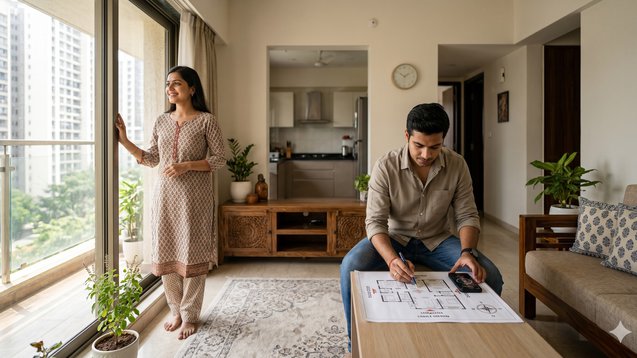
Emotional Comfort vs Vastu Compliance
Introduction:
The process of purchasing a house in India extends beyond a mere financial exchange because it serves as a vital emotional life event. The property functions as a safe haven that people acquire to show their success and create their personal life experiences. Yet the process of visiting properties and estimating expenses and getting funding brings up an important decision about choosing between personal preference and Vastu requirements. The true conflict starts at this point. Vastu Shastra establishes a system that maintains traditional elements to create equilibrium together with beneficial energy flows. Homeowners experience emotional comfort when they enter their residence which traditional rules and directions cannot fully explain. People living in Mumbai and Bangalore choose to buy practical items because their choices are restricted and costs are high. Vastu creates a stronger emotional impact in Tier 2 cities such as Nashik and Indore. Which factor needs your attention first? You need to choose between emotional comfort and Vastu compliance. The blog will present an analysis of this inquiry through the lens of a real estate expert who will assess psychological factors together with market behaviour and actual decision-making processes that take place throughout India.
What does Emotional Comfort mean in a home environment?
The definition of "emotional comfort" needs to be explained through its application to property assessment. Your home assessment requires more than your personal preference for a particular house. The assessment of the space depends on the feelings which you experience during your time there. The space needs to create an atmosphere which invites people to enter. The space needs to create a peaceful atmosphere which enables you to relax after your workday. The space needs to provide a comfortable environment which supports your normal activities throughout the day. People in fast-moving urban centers which include Delhi and Hyderabad achieve emotional satisfaction through practical elements which include peaceful environments and effective air circulation and daylight access and efficient building design. The design elements of a space create a direct connection with your emotional state and your ability to handle pressure. People in Tier 2 cities link emotional comfort through their existing knowledge of space design which matches their cultural norms. Emotional comfort exists as a personal experience which people develop. A single flat can be viewed by two buyers who will experience different feelings about it because one buyer will develop instant love while the other buyer will show no interest. Most people tend to undervalue their first reaction to situations.
The study of Vastu compliance needs to be approached through its current understanding.
The Vastu Shastra system establishes rules for architectural design. The system uses architectural design principles to measure spatial orientation and natural element interaction with air and water and sunlight. A Vastu-compliant home exists as a traditional practice which brings prosperity to its inhabitants while promoting their health and maintaining family harmony. Urban apartments in Tier 1 cities of modern times face challenges because complete Vastu compliance remains unattainable. In cities such as Pune and Gurgaon developers prefer to create buildings with Vastu-friendly designs instead of achieving complete Vastu compliance. The design process includes elements such as entrances facing east and kitchens located in the south-east and bedrooms which have proper placement. Many buyers use Vastu as their purchasing guideline. The system helps users make their choices. The checklist creates problems when it clashes with their personal tastes and what they need to achieve. The situation needs to reach a state of equilibrium.
The Human-AI Conflict Between Emotional Decision-Making and Rational Decision-Making
Home buying represents one of the few situations where people use both rational thinking and emotional responses to make decisions. You discover a flat which meets all your practical requirements through its excellent location and reasonable price and perfect layout yet it fails to achieve complete Vastu compliance. You find another flat which follows Vastu guidelines yet it makes you feel restricted in space and unattractive. Which one will you pick? People who live in Tier 1 cities tend to choose between their emotional needs and their practical requirements. Buyers in Tier 2 cities work to achieve an equal distribution between their emotional needs and practical requirements. People in Tier 3 towns give Vastu priority over other aspects even when it results in reduced options. This difference shows how Indian people make buying decisions. The study shows why Property Aaj provides filters which enable users to choose their preferred layout and Vastu design. The buyers evaluate properties according to their life requirements because they need to examine each property option.
How Vastu Affects How We Feel
Here’s where it gets interesting. Vastu. How we feel is not always against each other. They actually work well together in cases. For example a home that follows Vastu principles often has:
natural light
Proper ventilation
An organized layout
These things naturally make us feel better. So when someone says, "This home feels peaceful because it follows Vastu " they might be reacting to these design elements. In cities like Chennai, where the weather and sun lightered important, homes that follow Vastu often feel more comfortable simply because they are designed well. Instead of thinking of Vastu and comfort as opposites it’s more accurate to see them as connected. With some benefits that are the same and some that are different. Vastu helps create a home and a comfortable home follows Vastu principles. Vastu is about designing a home that makes us feel good.
When Emotional Comfort Should Come First
There are times when emotional comfort should be the priority. For example:
If the location makes your daily life much better
If the layout fits your lifestyle well
If the home feels peaceful and works well for you
Imagine living in Mumbai, where how long it takes to get to work can be really stressful. In that case a home that's a bit off in terms of Vastu but close to work can make your life better than a Vastu home that's far away. In cities what matters most is lifestyle and convenience. People care more about what works for them in life. This doesn't mean you should forget about Vastu completely. It means you shouldn't let it be more important than your comfort.
Having Vastu Compliant Properties Are Very Important For Your Decision Making Process
Conversely, there are times when having a Vastu Compliant Property will play a more significant part in your purchase decision. In Second Tier and Third Tier Cities, the sentiment of purchasers is heavily influenced by their cultural beliefs; as such, a Vastu Compliant Property will be viewed by many as a safer and more complete investment than a non-compliant property. When it comes to re-sale, it is also widely accepted that a property in Jaipur or Lucknow that complies with the Vastu Shastra principles will (upon re-sale) generally sell more quickly and to more purchasers than a non-compliant property. For families that are looking for a long-term family home, having a Vastu Compliant Property can also provide emotional comfort. This is due to it giving a sense of belonging through tradition and therefore eliminating the need for second guesses. Therefore, in these situations, Vastu is not simply a preference rather, it is part of the decision-making process.
The Role of Family and Social Influence
In India, property decisions are rarely made by individual people. Family members have an important role in property decisions because Vastu serves as a shared topic for their discussions. Elders and parents will actively support Vastu adherence. Younger buyers will consider Vastu requirements because they want to preserve peace with others. In Ahmedabad, which has a high rate of family participation in property decision-making, Vastu requirements will determine which properties families choose to purchase. This social factor adds another layer to the emotional vs Vastu debate. People from different groups choose Vastu-compliant homes because they want to create a comfortable environment for others.
Investment Perspective: What Really Matters?
Investment professionals consider emotional comfort as unimportant but Vastu still functions as an investment factor. The location and infrastructure and market demand conditions determine property returns in Tier 1 cities while Vastu affects them only slightly. Vastu serves as a factor that impacts resale value and buyer interest in Tier 2 and Tier 3 cities. Investors often consider this when shortlisting properties on Property Aaj. The logic is straightforward because buyers should purchase products that the market favours. Vastu becomes important for future buyers even if you do not consider it valuable. Vastu functions as a strategic investment element in decision-making because it affects investment choices.
Legal and Financial Clarity: The Ultimate Priority.
The legal and financial protection needs to be established as the most important aspect of this discussion. A Vastu-perfect home with unclear documentation causes greater stress than a non-compliant home with proper approvals. The Indian authorities which include Maharajah provide transparency throughout the country. Buyers should always verify:
RERA registration
Title clarity
Builder credibility
These factors directly impact peace of mind.
Emotional comfort and Vastu both come after this foundation is secured.
Finding the Right Balance in Real Life
What method should you use to reach your decision?
The answer requires three essential components which start with three fixed elements of a budget and a location and a requirement for legal comprehension. First, the examiner needs to assess two elements of comfort, which include layout and light and ventilation. The Vastu alignment assessment should proceed as the last step. The process requires you to choose between two options which require different decisions according to your needs. When you use this technique on Property Aaj to search for properties, you will discover better ways to narrow down your choices without experiencing excessive stress. The objective of the search process requires you to discover a suitable home which matches your needs instead of searching for an ideal residence.
Conclusion
The decision between emotional comfort and Vastu compliance requires people to understand both elements which make up their decision-making process. Your daily home experience depends on the emotional comfort which you feel. Vastu provides a framework that can enhance that experience, especially if you believe in it. Practicality serves as the main driving force in Tier 1 cities. Vastu holds greater importance in Tier 2 and Tier 3 cities. The most intelligent buyers throughout India prefer to implement a combined strategy. They listen to logical arguments while they honour traditional customs and they follow their personal instincts. A home serves as more than a physical space because it provides essential support for your daily activities and mental wellbeing.
FAQs
1. Should I select emotional comfort above Vastu compliance requirements?
The ideal solution requires people to maintain equilibrium between two opposing needs. The home space becomes acceptable when it fulfills essential functions for the user while remaining socially acceptable in its small Vastu deviations.
2. Does Vastu impact the market value of a property?
The answer is yes because it especially applies to Tier 2 and Tier 3 cities. Vastu-compliant properties attract more buyers who make faster purchases.
3. Can emotional comfort mislead people who want to purchase real estate properties?
People need to manage their feelings during real estate assessment which requires them to evaluate three essential factors: the property's location and its legal status and its construction standards.
4. Is Vastu more important for self-use or investment?
Self-use requires Vastu more because of its connection to emotional aspects. Market demand and location factors hold greater importance for investment purposes.
5. Are modern apartments fully Vastu-compliant?
Most buildings will follow Vastu principles but they will not achieve complete Vastu compliance because their designers face space restrictions.
6. Can I improve Vastu after buying a home?
The space will become better aligned through small changes which include furniture placement and lighting and colour adjustments.
Read more about property matters with our specialists and browse the latest property listings on Property Aaj. Download the app from the Play Store and App Store now for easy buying, selling, and renting!