Introduction
If you've recently bought a home in Dwarka, inherited a property in Rohini, or sold land in Janakpuri, you’ll need to complete one critical legal step: property mutation. Mutation helps update the ownership record in municipal land revenue records, ensuring the new owner's name appears for tax and official purposes.
This article explains the property mutation process in Delhi, who needs to apply, the documents required, and how Property Aaj can help simplify your property transactions—whether you're a buyer, seller, or inheritor.
What Is Property Mutation?
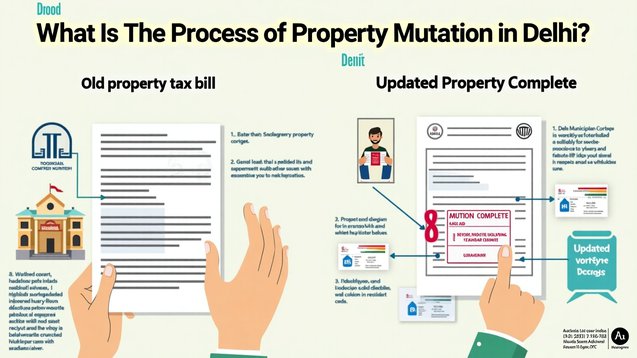
Mutation is the process of changing the title of ownership of a property in municipal records after a sale, gift, inheritance, or other transfer. While registration gives you legal ownership, mutation reflects that ownership in the local municipal corporation’s records for purposes like property tax billing.
Why Is Property Mutation Important in Delhi?
Updates ownership for property tax purposes
Helps in utility connections (water, electricity, gas)
Prevents future ownership disputes
Required for selling or leasing the property later
Useful for getting building permits or layout approvals
In Delhi, mutation is processed by MCD (Municipal Corporation of Delhi), covering areas like Lajpat Nagar, Karol Bagh, South Extension, and Saket.
When Do You Need to Apply for Mutation?
You should apply for mutation in the following cases:
Sale or purchase of property
Inheritance due to death (with legal heir documents)
Transfer through gift deed or will
Court order (like divorce, partition)
Power of Attorney-based transfer
Whether you’re transferring a plot in Narela or a flat in Saket, mutation is necessary to reflect the rightful owner in civic records.
Step-by-Step Property Mutation Process in Delhi
Step 1: Collect Required Documents
Here’s what you’ll typically need:
For Sale-Based Mutation:
Registered Sale Deed
Latest Property Tax Paid Receipt
Copy of Aadhar and PAN Card
Electricity/Water Bill for address proof
Application form with passport-size photograph
For Inherited Property:
Death Certificate of owner
Legal heir certificate / Succession Certificate
Affidavit and indemnity bond (on stamp paper)
No Objection Certificate (NOC) from other heirs (if applicable)
You can find mutation forms and document templates on Property Aaj, especially for properties in South Delhi and West Delhi.
Step 2: Submit Application to MCD Online or Offline
Online (Recommended):
Visit the official MCD portal based on your area:
https://mcdonline.nic.in/
Select your zone (North, South, East) and navigate to Mutation of Property.
Offline:
Submit your documents and form to the relevant Zonal Revenue Office (ZRO) based on your property’s location (e.g., Connaught Place, Vasant Kunj, etc.)
Step 3: Pay Mutation Charges
As of 2025, mutation charges are nominal:
Payment can be made online or via Demand Draft (DD) at the local office.
Step 4: Verification and Inspection
Once the application is submitted:
A Revenue Inspector (RI) may visit the property for verification.
The documents will be cross-verified with the property tax and ownership records.
This process typically takes 15–30 working days.
Step 5: Issuance of Mutation Certificate
After approval, your name will be updated in the municipal property records.
You can download the mutation certificate from the MCD portal. This document is crucial for future resale or property-related services.
Keep this safe along with your sale deed and registration certificate.
Common Mistakes to Avoid
Submitting incomplete documents
Not paying latest property tax dues
Applying in the wrong MCD zone
Failing to get NOC from co-owners or legal heirs
You can check mutation status and document requirements for specific localities like Golf Course Road, Palam Vihar, and Sector 82, Gurgaon via Property Aaj.
Conclusion
Whether you're a new homeowner in Gurgaon’s DLF Phase 3 or inheriting a property in South Delhi, getting the mutation done is a must for legal clarity and municipal compliance. Though it's often overlooked, property mutation helps you avoid tax and ownership issues later.
Use Property Aaj to track property-related legal requirements, view verified listings, and access ownership tools tailored for Delhi NCR buyers and sellers.
FAQ
1. Is property mutation the same as property registration?
No. Registration gives legal ownership through the sale deed. Mutation of property only updates municipality records for tax obligation and as your address for civic purposes.
2. How long does property mutation take in Delhi?
It takes about 15-30 days as there needs to be verification, and therefore depends on how accurate the documents are.
3. Do I need to do mutation for DDA flats or CGHS flats in Delhi?
You still need to do mutation for DDA or Cooperative Group Housing Society flats in Delhi. Planning authorization does need to be given to the municipality after ownership.
4. Can mutation be done online in Delhi?
Yes. Online application, fee payment and tracking is all available via https://mcdonline.nic.in/.
5. Is mutation mandatory for home loan?
Most banks will wish to see an ownership registered document, although mutation may only be required of you when you either resell or require to lend against with property, or if you have legal issues.
6. What happens if I do not get the mutation done?
You may encounter problems over time, if you delay and do not undertake the mutation, it could cause problems with property tax bills, transference of utilities, or may cause impacts with legal avenues in resale or inheritance
Read more about property matters with our specialists and browse the latest property listings on Property Aaj. Download the app from the Play Store and App Store now for easy buying, selling, and renting!