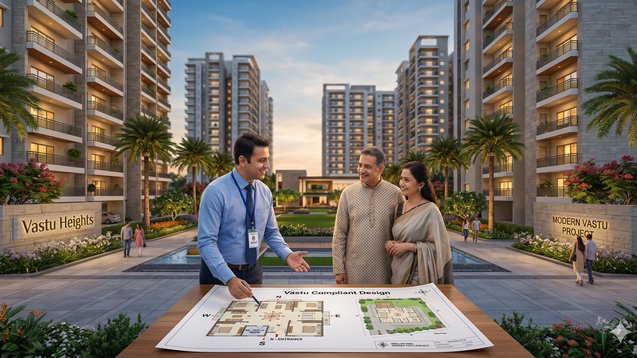
Vastu Trends in Modern Real Estate Projects
Introduction:
The moment you enter any new residential development in India today, which includes premium high-rises located in Gurgaon and mid-range residential communities found in Nashik and Tier 3 town plotted developments, you will discover a common element. The developers now showcase Vastu as an additional feature which they present together with their clubhouses and smart security systems. The design presents a modern Vastu that people currently use without restriction for their residential spaces because it meets contemporary needs through flexible construction methods. Homebuyers today possess advanced knowledge about their choices yet maintain their connection to familiar cultural practices. Homebuyers who do not seek complete Vastu compliance still show a strong preference for houses which provide them with the right atmosphere. Modern Vastu trends provide the necessary solution to this situation. The website Property Aaj (https://www.propertyaaj.com) serves as a clear demonstration of this market transformation. The rising demand for "Vastu-friendly layouts" and "energy-balanced designs" in property listings demonstrates the growing significance of these features in real estate marketing and buyer decision-making. What new Vastu trends exist at present? Which methods do developers use to implement these trends between Tier 1 cities, Tier 2 cities, and Tier 3 cities? The buyer or investor needs to know how to assess these trends which exist at present. We will present a practical solution which uses real world examples.
The Shift from Traditional to Practical Vastu
The biggest change begins with Vastu because it has transformed into a flexible system. Domesticated spaces required complete Vastu compliance in the past but now people accept home design choices as valid. Developers now follow a "maximum possible compliance" approach. The urban environment does not permit people to achieve complete satisfaction. The cities of Mumbai and Bangalore need space optimization because their land parcels have irregular shapes. Traditional Vastu rules cannot be used to create perfect designs for every unit. Builders focus on essential factors like entrance direction and kitchen placement and ventilation while they decrease design requirements for other features. Indore and Nashik provide their residents with slightly greater design freedom than other cities do. The projects here achieve better alignment with Vastu principles. The system allows near-perfect compliance in Tier 3 towns which use plotted development. Modern buyers can now access Vastu through this shift which also provides them with better Vastu solutions.
East and North Facing Units Still Dominate Demand
The demand for units that face east and north remains significantly higher than for other directions. This preference is so consistent that developers have accounted for these preferences when developing their projects. In most projects, there are also fewer units for sale for both east face and north face than there are for other directions. Because of the limited supply for both of these face orientations, east and north facing units typically command a price premium compared to south and west facing units. In terms of the geographic difference of premium pricing for these face orientations, buyers in the Tier 1 cities have observed a more moderate east and north price premium than buyers in the Tier 2 and Tier 3 cities. Therefore, for a buyer purchasing a home in a Tier 1 (e.g., Sydney) city, proximity and lifestyle amenities are equally important. However, with buyers purchasing homes in Tier 2 and 3 cities, their preference for east and north face orientations is significantly stronger, creating noticeable differences in price. Additionally, Property Aaj's (https://www.propertyaaj.com) filtering of properties based on their face orientation illustrates the entrenched presence of east and north facing homes in the overall real estate market. Young buyers, who consider themselves practical, still seem to have a subconscious affinity towards homes that are east and north facing.
Layout designs for modern apartments are becoming much more precise.
The general guiding principles of modern apartment layouts include;
Living rooms being designed with optimum access to natural light
Kitchen locations are primarily located to the southeast or at least close to this location
Bedrooms are positioned to provide the most amount of privacy and least amount of instability
Toilets are preferably located away from sensitive areas such as the northeast.
Are all of these types of layouts fully compliant with Vastu? Probably not completely but they certainly are better optimized than traditional layouts. In Tier I markets; compact apartments have put a premium on proper use of space, resulting in greater use of the Vastu principles. As you progress down the city ranks, to Tier III cities, larger units have provided more room to work with on the alignment to Vastu. The most significant development trend over the past few years has been the conscious planning of Vastu by many builders. Rather than considering these issues after-the-fact, builders are now thinking about them as part of their larger overall design process.
Integrating Vastu in Modern-day Architecture
Here's where it gets interesting. Modern real estate will incorporate Vastu principles into modern design and will include the latest in design features such as glass exteriors, open kitchens, smart home automation and many other features, while still including some reference to Vastu.
Examples of blending Vastu and modern design include:
Large windows in eastern facing walls, maximizing natural light in each home.
Open floor plans that allow for improved air circulation (using the same principles of energy flow as found in Vastu).
A design with minimal clutter will allow for more space for movement.
In Tier 1 luxury projects, many times Vastu is incorporated into the project as part of "wellness living." In Tier 2 and Tier 3 projects, Vastu will be incorporated directly as part of traditional beliefs. However, regardless of whether you are in a luxury or more reasonably priced home, the concept remains the same, balancing style with energy.
Popularising “Vastu-Friendly” instead of the term “Vastu-Perfect”
A new term you will find all over the place now is "Vastu-friendly." That's a clever pivot in marketing language. Rather than saying their entire project is in full compliance (that would be difficult to do) they say that it is “in alignment with Vastu principles. This creates trust without overpromising. This terminology is becoming common on online platforms like Property Aaj (https://www.propertyaaj.com). Buyers know perfection is not an option but effort counts. Frankly, most buyers today are fine with this. So, they would prefer an aesthetically pleasing, user-friendly home with elementary Vastu alignment than a strongly compliant but impractical design.
The demand for Vastu is really growing in housing.
Vastu was usually for -range and premium homes. That is changing now. Today people who make housing projects are using basic Vastu principles. The people who buy these homes want it that way. In cities like Tier 2 and Tier 3 cities people really want Vastu. For them Vastu is something they must have. In cities like Tier 1 cities people who buy affordable homes are not so strict about Vastu. The people who build these homes still use Vastu so they can sell more. This means Vastu is important, for all kinds of homes, not expensive ones. Vastu is becoming a part of affordable housing.
Vastu and Layouts in Plots/Gated Communities
Plot development as well as villa project developments are making a comeback-and Vastu plays a great role. Buyers developing homes on plots want to construct houses that suit their liking and in this development one of the first things that is paid attention to is Vastu, which buyers ensure are in line with what Vastu requires. Developers have begun to offer east or north facing plots and have arranged the entire plot and the surrounding infrastructure in a grid layout so that Vastu requirements for sunlight and airflow are met. This trend is stronger in Tier 3 cities as well as in the outskirts of Tier 2 cities and for those who are looking for plots or land at Property Aaj (https://www.propertyaaj.com), this is a key consideration as it is a factor that will later determine what can be constructed and how.
Influence on Buyer Psychology and Decision Making
Vastu exists as a psychological system which functions through its architectural elements. The Vastu system creates a sense of security which many homebuyers find appealing. The process enables people to make choices faster because it decreases their uncertainty. The first tier of cities shows this effect in a subtle manner while second and third tier markets experience a stronger effect which operates in a direct way. Two properties exist at the same price point and location; one property meets Vastu requirements while the other property does not. Most buyers would select the Vastu-compliant option because it provides better value. The developers choose to use Vastu-based design solutions because they generate psychological advantages.
Impact on Resale Value and Appreciation
The way Vastu trends work does not just stop at buying a home. It also affects the resale of that home. Homes that follow Vastu rules are really good for people who want to sell their homes because they attract people who want to buy. This can lead to things like:
Faster resale of the home
The owner has power to negotiate the price
People think the home is worth money
In big cities like Tier 1 cities the effect of Vastu is okay, it is not too much. It is still there. In cities, like Tier 2 and Tier 3 cities Vastu trends can be a really big factor. People who invest in homes and understand Vastu trends usually look for Vastu- homes so that they can sell them easily in the future. Vastu-friendly homes are what these investors want because they know it will be easier to sell Vastu- properties.
Legal and Regulatory Aspects What Doesn’t Change
Vastu rules do not require legal compliance according to Vastu requirements which people often forget. Indian real estate transactions follow specific regulations which include the Real Estate Regulation and Development Act 2016 RERA and the stamp duty regulations and banking rules governing home loans. Vastu compliance does not exist as a requirement in any of these systems. Banks assess your home loan application through their evaluation of your submitted documents and your credit history and your legal ownership of the property and its estimated worth. Registration authorities need to verify ownership documents and contracts and legal obligations because they do not require verification of your kitchen or entrance directional alignment. From legal and financial perspectives Vastu holds no relevance. The market functions according to its own set of rules which differ from the legal system. Vastu creates strong effects on buyer decisions even though it does not exist as an official regulatory requirement. The result leads to an indirect market effect which creates a strong effect on both pricing and demand and transaction velocity. Buyers will almost always want to know about Vastu although banks might not require this information. Both buyers and sellers need to comprehend this distinction between two different situations. Your property will not have any documentation issues because you ignore Vastu but this choice will determine your property sale speed and market interest level.
Conclusion
Vastu in current real estate practices functions as a practical method which developers use to adjust their design work according to new market demands. Indian developers use traditional architectural elements together with modern building design techniques to develop properties which meet the changing needs of their customers. Vastu principles continue to shape property development and marketing and public perception for both high-end urban apartments and residential plots in rural areas. The best buying strategy for buyers requires them to create an equilibrium between two opposing forces. The pursuit of absolute Vastu compliance should not be done when it creates difficulties for real-world situations. The complete disregard of this element proves unwise because buyer emotions maintain their substantial influence in the present market. The initial assessment of space should determine its effectiveness for light and air flow and functional design needs. Vastu certification provides additional advantages for properties that meet fundamental Vastu requirements but this certification remains optional. Property Aaj enables users to evaluate properties through emotional elements and logical criteria which simplifies their decision-making process. Buyers need to find homes which provide structural integrity and proper location and match their personal sense of comfort. A suitable home space exists beyond the constraints of regulations and assessment tools. The area provides users with a comfortable space which achieves equilibrium between their needs and their daily activities. Modern Vastu practices currently develop new methods which help homeowners reach peaceful states of mind while maintaining their essential daily requirements.
FAQs
1. What does “Vastu-friendly” mean in modern projects?
The project has to follow the main Vastu rules which include entrance direction and layout alignment but it cannot achieve complete compliance because of existing practical restrictions.
2. Are Vastu homes more expensive in India?
Yes, because many properties in India now use Vastu design principles which make them more costly. The demand for east and north-facing units creates a premium value which especially affects Tier 2 and Tier 3 cities.
3. Does Vastu matter for investment properties?
The answer depends on the specific situation. Vastu-compliant homes attract higher buyer interest which results in increased resale value and rental demand.
4. Can apartments be fully Vastu-compliant?
Most apartments need to follow partial Vastu alignment because design and spatial limits prevent them from achieving complete Vastu compliance.
5. Is Vastu more important in smaller cities?
Tier 2 and Tier 3 cities use Vastu more than Tier 1 cities because those cities follow practical needs.
6. Should I prioritize Vastu over location?
The most important factors for a property should include its location and its connection to other areas and the reputation of the builder. The only factor Vastu should actually be treated as.