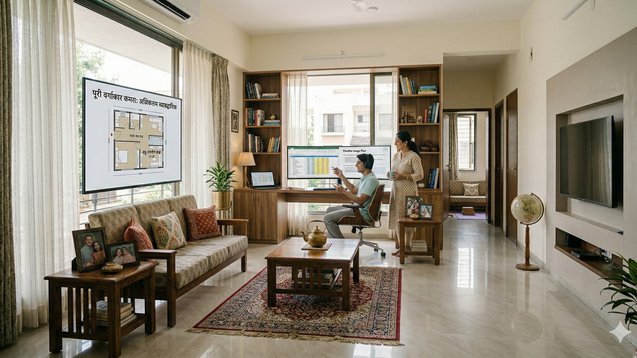
Choosing a Property With Flexible Room Usage
The Indian homes from 15 to 20 years back built their rooms with permanent functions which people could see when they entered the house. The house required one bedroom and one drawing room and one dining area which completed the design. People today live their lives in a different way. A bedroom might double up as a work-from-home office. The living room could host weekend guests. A study might later become a nursery or parents' room. Modern Indian households from Tier 1 metropolitan areas to Tier 3 small towns now consider home flexible design as their topmost purchasing requirement. Yet many buyers still focus only on BHK count and carpet area while browsing listings on Property Aaj. The home requires one essential question which needs an answer for your future life requirements five years from now. The single question determines whether your home provides upcoming needs or permanent problems. This India-wide guide provides detailed information about how to select a property which offers flexible room arrangements and which layout elements create actual value and how strategic design decisions will safeguard your personal habits and your property value throughout time.
Why Flexible Room Usage Matters More Than Ever
The usage of flexible rooms has become more essential than before because Indian families are undergoing changes which have led to the development of nuclear families and remote work becoming standard practice and parents staying at home with their children and parents staying at home with their children and parents needing their children to study while their parents operate home-based businesses. The work-from-home trend has created permanent modifications to consumer behaviour in Tier 1 cities which include Bengaluru and Mumbai because people now expect different home features. People need more than 2BHK apartments which lack convertible spaces because their basic needs become insufficient after two years of use.
The demand for homes with study nooks and multi-use rooms has been rising in Tier 2 cities which include Pune and Jaipur. The buying preferences of Tier 3 customers who want to become their own home owners have shifted because they now expect to add extra rooms that will accommodate their future family needs. The flexible layout system provides protection for your investment because it protects your investment from future design changes. Homeowners who want to spend less money on home upgrades will find that they can modify their current home space instead of needing to purchase new properties. Property Aaj users who search for homes on their website (httpswww.propertyaaj.com) now use layout adaptability as their primary search criterion because they have learned that this metric carries more value than home size.
Fixed layouts and flexible layouts create distinct design differences for building construction projects.
The usability of 2BHK and 3BHK homes shows different results because their actual space arrangements differ between two different home types. The fixed layout system requires users to work within these specific layout elements:
bedrooms with narrow dimensions
corridors that end without further access
spaces that have excessive partitioning
wall space that cannot be altered The flexible layout system provides these design elements which include
rooms that have square dimensions or equal length and width measurements
The design achieves maximum efficiency through its corridor layout which requires only essential movement
The design provides multiple entrance points
The design maintains standard room size relationships between different spaces In Hyderabad developers who create compact.
Tier 1 apartment projects frequently select between two options which include building more units or making their layouts flexible. Buyers must review floor plans carefully. The project developers need to create their construction plan first at Tier 2 and Tier 3 sites because their larger land area enables better flexible capacity. The system functions because designers constructed everything with specific intentions in mind.
Room Size and Proportion: The Hidden Enabler
A room becomes adaptable when its dimensions enable different furniture layouts to be implemented within the space. For example:
A 9 ft wide bedroom severely limits options
A 11 x 11 ft room allows bed + desk + wardrobe
Square rooms allow easier conversion
Developers reduce secondary bedroom widths in Tier 1 cities because carpet area costs too much in these areas. This is where buyers must be alert. On Property Aaj (https://www.propertyaaj.com), always check the smallest bedroom dimension — not just overall area. Tier 2 buyers often have better luck finding proportionate rooms in mid-segment projects. Tier 3 independent homes usually offer flexibility during construction, but poor planning can still create unusable narrow rooms. A practical rule: if you cannot comfortably place a bed and a study table together, the room is not truly flexible.
Sliding Doors, Movable Partitions, and Open Plans
Indian home design during modern times now permits the use of adaptable partitions for different living areas. The following features provide increased operational capacity to the system:
Sliding doors between living and dining
Folding partitions
Open kitchen with optional enclosure
Study alcoves
Convertible guest rooms
Developers increasingly include these features in Gurugram and Noida Tier 1 premium projects. The second-tier markets are developing at a similar pace to new market entries. Tier 3 homes can incorporate these during custom construction at relatively low cost. Buyers must confirm which walls serve as structural elements before they start designing alterations. RERA-compliant plans normally include clear identification of all load-bearing walls. The design approach achieves its highest efficiency when structural elements restrict building space to a minimum.
Work-from-Home: The New Non-Negotiable
The period after 2020 indicates that people need to create home environments which enable them to work remotely. Property Aaj (https://www.propertyaaj.com) currently provides Tier 1 city tenants and buyers with search options which specifically show them properties that include study rooms and home office spaces. You don’t need a dedicated study room for all your work requirements. You need a space which can function for both study and other purposes.
The ideal flexible setups for work include these elements:
Master bedroom with work area
Living room work area
Additional bedroom which can transform into workspace
Study area located in spacious hallway
Hybrid work culture is growing in Tier 2 cities. Hybrid work systems operate in Tier 3 towns because freelancers and small business owners create similar workplace needs. The long-term value of your home decreases when your home office space needs exceed your available space.
Rental and Resale Advantage of Flexible Homes
Market results show that flexibility provides more than comfort benefits. In Tier 1 rental markets like Chennai and Delhi, tenants increasingly prefer homes that allow work desks, guest accommodation, or kids’ study zones. Properties with adaptable layouts enable landlords to:
Attract more types of tenants
Decrease the time needed to find new tenants
Charge tenants higher rent rates
In Indore and other Tier 2 cities, young families prefer flexible 2BHK homes as their ideal housing option. Tier 3 resale markets show a gradual progression because they move at a slower pace. Buyers in that market area prefer homes with flexible design options. The investment value of flexible designs results in a wider customer base that leads to improved resale marketability.
Budget Trade-Off: Bigger BHK vs Smarter Layout
Many buyers face this dilemma: Should I buy a small 3BHK or a well-designed 2BHK?
In Tier 1 cities, a poorly planned 3BHK can feel more cramped than a smart 2BHK with flexible rooms. The price gap between 2BHK and 3BHK in Tier 2 cities shows narrower differences which leads buyers to extend their financial limits. But layout quality still matters. Three-dimensional space design permits larger houses in Tier 3 towns but interior design determines their functional value. As a real estate expert I recommend that people should choose spaces which can adapt to different needs instead of considering BHK numbers. When browsing Property Aaj (https://www.propertyaaj.com), visitors must view all floor plans through direct comparison while viewing complete unit designs. Smart architecture outperforms additional entrances
When we talk about Legal and Planning Considerations
Like RERA and Loans and Modifications we have to make sure we are doing things correctly. We need to be flexible. We must remain within the legal boundaries of what is allowed. There are some checks we have to do these include:
We have to make sure the project is RERA registered
We have to find out which walls are walls
We have to confirm what the society rules are on making changes
We have to check what the stamp duty impact will be if we are combining units
In India RERA has really helped to make things more transparent especially when it comes to projects in Tier 1 and Tier 2 cities.
If you want to get a Home loan you will typically need to get approval based on the plans that have been sanctioned.
If you make structural changes you can run into problems when you try to sell your home or get a new loan.
If you have a home, in Tier 3 you will have more freedom to make Modifications but you still have to follow the local municipal norms.
We should always remember that flexible living is great. It should never mean making legally risky alterations to our homes like RERA and Loans and Modifications.
Common Mistakes Buyers Make
Even experienced buyers sometimes overlook flexibility. Warning signs include:
Second bedrooms which are too narrow
Excessive corridor space
Dining areas which are permanently fixed
Rooms that have irregular shapes
Furniture arrangements that are not suitable
The sample flats in Tier 1 compact housing show incorrect dimensions because actual measurements need to be checked. Tier 2 buyers sometimes assume bigger carpet area equals flexibility — which doesn’t always happen. Tier 3 home builders may copy outdated designs without future-proof thinking. The room needs to serve multiple functions before I can decide on its final design. The answer needs to be no for you to take another look at the situation.
Conclusion: Buy for the Life You Haven’t Lived Yet
The smartest property buyers in India are no longer buying just for today. The buyers make their purchases to cover all areas of their upcoming 10 to 15 years. Children grow. Careers shift. Parents move in. Remote work expands. People adopt new methods. A home with flexible room usage adapts quietly through all these phases without forcing expensive upgrades or relocations. The residential real estate market shows a strong trend toward adaptable living which has become a core element of residential real estate. The next time you explore listings on Property Aaj (https://www.propertyaaj.com) my advice is to stop counting bedrooms. You need to examine the layout because you need to imagine different ways to use the space and then plan for future uses. The best homes remain functional after many years of use because they maintain their operational value.
FAQs
1. What does flexible room usage mean in real estate?
Flexible room usage refers to spaces that can serve multiple purposes throughout time because they include bedroom space which can transform into both home office and guest room areas. The system operates based on the dimensions together with three-dimensional space arrangement and architectural design elements of each room.
2. Is a flexible 2BHK better than a poorly designed 3BHK?
In many cases, yes. A well-planned 2BHK with adaptable spaces can feel more comfortable and functional than a cramped 3BHK with rigid room layouts.
3. How can I identify if a property layout is flexible?
The assessment requires examination of room dimensions and furniture distribution options and assessment of whether spaces can function as study areas and guest sleeping quarters without creating space limitations.
4. Do flexible homes have better resale value in India?
Yes, homes with flexible designs sell better in the Indian market according to general trends. The homes that attract multiple buyer groups including families and professionals and investors sell at higher prices and achieve faster sales.
5. Can I modify my flat later to make it more flexible?
The building permits only small changes to its interior spaces because its actual structural walls must remain untouched. RERA plans and society rules should be verified before any modification work begins.
6. Is flexible layout more important in Tier 1 cities?
The need for flexible spaces in Tier 1 cities exists because of increasing space costs yet it has become essential in Tier 2 and Tier 3 markets as buyer expectations have shifted.