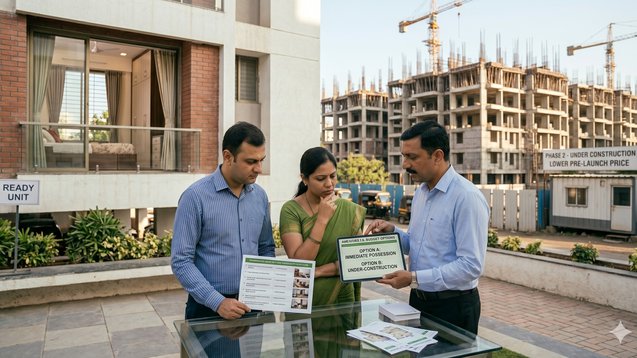
Choosing Between Immediate Possession vs Lower Price
Introduction
When you decide to purchase a house in India, you must choose between two options: an existing home which enables immediate occupancy or a building which has not completed construction yet which costs less. At first glance, the answer seems obvious: why not save money and wait? The decision-making process becomes more challenging after you investigate the situation beyond its initial appearance. Immediate possession offers certainty, convenience, and peace of mind. The lower-priced under-construction homes provide affordable housing options that will increase in value over time, but buyers must wait until construction finishes to move in, which introduces multiple hazards. High property costs in metro areas such as Mumbai and Bengaluru and Delhi NCR make this decision vital for your financial situation. The housing market in Ahmedabad and Coimbatore shows a clear price distinction between ready homes and under-construction properties, which remains affordable for buyers. In Tier 3 towns, where buyers face fewer financial restrictions, people prefer to purchase homes that already exist. Do you want to spend less money now or do you want to prevent future uncertainties? Your financial situation and your level of urgency and your willingness to take risks determine your answer to the question. Let us establish a practical framework for India to help you select the best solution for your particular situation.
Understanding the Core Difference
Immediate possession properties are ready-to-move homes. The buyer will receive ownership rights together with immediate access to the property after finishing the deal. Under-construction properties, on the other hand, are sold at earlier stages of development. Developers offer lower prices to attract buyers, but possession can take anywhere from 1 to 4 years or sometimes longer. High demand for property combined with limited land supply causes Tier 1 cities to have many under-construction projects. Buyers in Tier 2 cities can choose from two different purchasing options. The availability of ready homes exists as the main housing option in Tier 3 towns. The key difference between two things involves two different elements which include time and present danger compared to complete assurance of safety. When you explore the Property Aaj website (https://www.propertyaaj.com) to view property listings you will observe how property values differ between the two categories throughout the same neighborhood.
The Price Advantage: Why Under-Construction Looks Attractive
The biggest advantage of under-construction property is the lower price. Developers use attractive launch rates together with flexible payment plans and discounts to attract buyers who want to purchase their homes at the early stage of development. The cost of living for residents in metropolitan areas increases because property prices reach their highest point. In cities like Pune or Hyderabad, buyers can save a noticeable amount by investing early in a project. The Tier 2 cities show a smaller price gap between products at different price points which still matters to customers. The basic price needs to be examined together with other expenses. Under-construction properties require GST payment which increases their total expense. The total expenses of the project include additional costs for floor rise and parking and maintenance deposits. Ready-to-move homes do not have to pay GST charges. The cost of under-construction properties seems lower than their actual expenses because partial savings from these properties do not meet anticipated savings.
Immediate Possession: The Value of Certainty
When you see the exact product that you want to purchase it brings you peace of mind. The completed properties which people can occupy immediately bring no unexpected findings for buyers. The buyer has the right to conduct property inspections which include checking construction standards and assessing nearby areas before making a choice. You also avoid the uncertainty of project delays—a common concern in Indian real estate which persists despite RERA regulations. Families who currently rent their homes will benefit from immediate possession because it leads to long-term financial savings. You avoid the burden of paying both rent and EMIs simultaneously. This benefit becomes more valuable in Tier 1 cities because that area has high rental prices. The impact exists in Tier 2 and Tier 3 cities but it remains less significant than in higher population areas. The majority of buyers choose to pay extra money for certainty because they find it beneficial.
The Financial Impact of EMI and Rent Comparison shows their respective costs.
The decision-making process leads to execution on this point. You will make EMI payments in multiple installments according to your loan disbursement schedule when you select an under-construction property. You will need to continue renting until you obtain possession of the property. The need to pay two different expenses at once creates financial difficulties for you in metropolitan areas. The first payment of EMI starts on the day you receive immediate possession of the property. The higher EMI payment allows you to build ownership instead of making rent payments. The financial burden becomes less severe because Tier 2 cities have lower rental costs. In Tier 3 towns, this factor is often minimal. A simple question to ask yourself: Can you comfortably manage both rent and EMIs for the next few years? The safer option for you to select requires you to choose immediate possession.
Risk Factor: Delays and Uncertainty
In India, project delays continue to happen because of existing regulatory improvements. RERA has brought more transparency, especially in states like Maharashtra, but timelines are not always guaranteed. Delays occur when there are problems with funding or when approvals and construction face difficulties. Reputable developers in Tier 1 cities decrease this risk for their projects, although some risk still remains. Buyers in Tier 2 and Tier 3 cities must exercise extraordinary caution when dealing with purchases. Your financial planning and living arrangements will experience disruption because of a one-year delay. The risk of this situation gets completely solved through ready-to-move properties. Potential savings need to be weighed against peace of mind, which stands as a main factor that requires your evaluation.
Appreciation Potential: Where Do You Gain More?
When you buy a property that is still being built you have a chance of the property value going up. This is because you are buying it at a stage so you can benefit from the price increase as the building work is completed. In areas that are growing this can mean you make a lot of money from the property. For example in cities like Bengaluru or Hyderabad people often see an increase in property value in areas that are being developed. However the property value does not always go up, it depends on things. Where the property is, how good the roads and transport are and what is happening in the property market. Properties that are ready to move into may not increase in value much at first but they are more stable especially in areas that are already well established.
In cities both types of properties can be a good investment.
In smaller towns the property value tends to go up more slowly.
If you are thinking of buying a property as an investment then a property that is still being built may give you a return but it is also riskier so you have to be careful with under-construction properties and ready- to-move properties.
Rental Income: Immediate vs Delayed Returns
The ability to receive immediate possession of a property provides advantages for people who want to generate rental income. You can start earning rent as soon as you take ownership. The property business generates consistent income because it operates continuously in metropolitan areas with strong rental demand. Under-construction properties, on the other hand, generate no income until completion. Investors in Tier 2 cities find ready properties more attractive because rental demand continues to increase. The rental yields in Tier 3 towns are lower than other locations. The waiting period for possession does not work for your rental income strategy.
Lifestyle Considerations: When Do You Need the Home?
Your personal situation is very important when it comes to buying a home. You should think about what's going on in your life right now.
Are you going to move into the home?
Are you moving to a city for a job?
Is your family getting bigger?
For example a couple that is having a baby may not want to wait three years to get the keys to their home. On the other hand a young professional who can live anywhere may not mind waiting. In cities like Tier 1 cities people usually want to move in right away because their lives are moving so fast. In cities like Tier 2 cities people may have more time to wait. In smaller towns, like Tier 3 towns people usually do not need to hurry. You should think about when you need the home and let that guide your decision, not the price of the home.
Legal and Documentation Aspects
Both options need thorough legal examination. The project needs RERA registration and verification of approvals and land titles and construction progress for its under-construction properties. The ready properties require verification of occupancy certificate (OC) and completion certificate and ownership history records. RERA enforcement differs between states which requires Tier 2 and Tier 3 city buyers to exercise extra caution. The website Property Aaj (https://www.propertyaaj.com) provides verified property listings which help you decrease your investment risks. You need to establish legal clarity before making your decision.
Buyer Psychology: What Do Indians Prefer?
Indian buyers traditionally chose ready-to-move homes because of their developers' trustworthiness. Younger buyers now show different purchasing behavior because they accept under-construction properties when it helps them save money or make early investments. Both housing options have equal popularity in Tier 1 cities. In Tier 2 cities, buyers show growing interest in exploring under-construction projects. Ready homes continue to dominate in Tier 3 towns. Your comfort level with risk plays a big role. The level of risk which you are comfortable with will decide your investment choices. Your risk comfort level helps determine your investment path. Your investment choices will depend on your ability to handle risk.
Finding the Right Balance
The best solution for particular situations requires using ready-to-move units which exist in completed projects. The modern amenities of these products become available to customers immediately although their cost exceeds that of under-construction units. The website Property Aaj (https://www.propertyaaj.com) allows users to search for properties which provide an optimal combination of affordability and accessibility. The process aims to achieve maximum value while maintaining all necessary elements to function effectively.
Conclusion
The decision between immediate possession and a lower price requires you to select the option that suits your needs. Home buyers who need guaranteed results and easy access to their purchases should select ready-to-move properties. Under-construction properties provide financial benefits to buyers who are willing to wait and want to postpone their purchases until later. You should assess financial stability together with your required lifestyle and your ability to handle risks. India’s real estate market offers options across all city tiers. You can achieve your goals by conducting appropriate research and using Property Aaj (https://www.propertyaaj.com) as your decision-making tool. The value of a home extends beyond its financial cost because it provides its owner with mental calmness.
FAQs
1. Is it cheaper to buy under-construction property in India?
The initial cost of under-construction properties stays lower than the price of complete homes according to their immediate availability yet buyers must account for GST and project delays which will increase their total expenses.
2. Are ready-to-move homes a safer option?
The two solutions exist as safer alternatives because they provide buyers with immediate home access and encryption certainty.
3. Can I get better returns from under-construction property?
The answer is yes because early investments lead to greater property value increases in developing regions.
4. What are the risks of under-construction property?
The main risks of the project include two particular dangers which involve project delays and changes to the initial plans of the project together with financial difficulties that arise from having to pay both rent and EMI obligations.
5. Do I have to pay GST on ready-to-move homes?
No, GST does not apply to ready-to-move properties, which can reduce overall cost.
6. How should I decide between the two options?
You must evaluate your budget together with your urgency requirements together with your risk tolerance. The immediate needs should lead you to select ready while the construction needs should make you choose under-construction.