Introduction
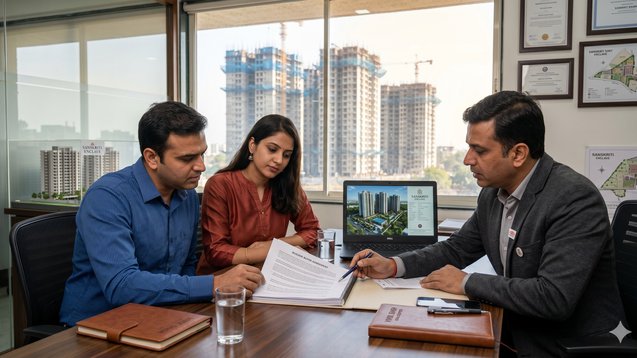
The process of purchasing a house in India starts with people shaking hands and paying a booking fee. The contract becomes legally binding only after both parties sign the Builder-Buyer Agreement (BBA). The document presents a challenging legal text for most people because it contains between eighty and one hundred pages of complex legal writing. The BBA stands out as the most important document to sign in the Indian real estate market. The document provides a complete guide which includes your key handover time and the quality specifications for your kitchen tiles. The Real Estate (Regulation and Development) Act (RERA) of 2016 established balanced agreements because developers used to create contracts that favored their interests. Homebuyers need to understand contract details to protect themselves because the law now provides equal power to both parties. The BBA protects you from project delays and hidden expenses and problems with construction when you want to buy a luxury high-rise in Gurugram or a low-cost apartment in Nagpur. At Property Aaj (https://www.propertyaaj.com), we believe that a well-informed buyer is a protected buyer. The agreement requires us to explain its contents while you should read it fully before you sign your name.
The Legal Sanctity of the Agreement
The Builder-Buyer Agreement functions as a legal contract which establishes the conditions through which a developer will sell property to a buyer who will purchase it. The BBA serves as a binding contract which parties can present as evidence in court proceedings or before RERA authorities while a simple allotment letter functions only as an expression of intent. In India, the BBA is typically executed after the buyer has paid 10% of the total property value. The document functions as your home loan application foundation because banks require a registered or signed BBA to validate the project's legal status and your financial obligations. The RERA regulations require developers in many states to follow a standardized agreement format which prohibits them from inserting arbitrary exit clauses and unfair penalty rates that existed in the industry ten years ago.
Possession Date and the Grace Period
The "Possession Clause" stands as the most examined section of any BBA document. The builder must deliver the keys by the date which this clause establishes. Builders used to include a "Grace Period" which lasted six to twelve months and they would use vague explanations such as "force majeure" or material shortages as their justification. The current RERA regulations require builders to provide specific possession dates which must match their scheduled dates that they submitted to the state RERA authority. If you are purchasing property in Bengaluru which is a Tier 1 city with extended construction cycles you should examine how the term "Completion" gets defined. The definition determines whether "Completion" refers to the finished building or the building's final inspection approval through the Occupancy Certificate (OC). At Property Aaj (https://www.propertyaaj.com) we always advise buyers to ensure that "possession" is legally tied to the issuance of the OC because most Indian municipalities consider entering a building without an OC to be illegal.
The Payment Plan and Hidden Costs
A transparent BBA should establish all financial details without permitting any unexpected financial events. The document must explain the payment schedule which includes three options: construction-connected payments, time-based payments, and down-payment payments. The "Total Price" displayed on the initial page fails to include multiple "Additional Charges." The charges include External Development Charges which are EDC and Infrastructure Development Charges which are IDC and club membership fees and car parking allotments and electric meter installation costs. Buyers in Tier 2 cities face unexpected charges when they purchase apartments which include "preferential location charges" (PLC) for units that overlook parks or main roads. Your BBA should explicitly list these costs so that your final outgo doesn't balloon by 15 to 20% at the time of possession. The law provides you strong rights to dispute any charges which lack agreement documentation between both parties.
The Penalty Clause: A Two-Way Street
The equalization of penalty rates for Indian homebuyers stands as the most important achievement under RERA regulations. The pre-RERA period established a payment system which allowed builders to impose interest rates between 18 and 21 percent when buyers failed to make their payments within one week. The builder would face a three-year project delay yet provide only ₹5 per square foot per month as compensation. The BBA needs to achieve present-day equality. The builder must charge you 10% for late payments while he must pay you the same 10% interest rate which normally consists of SBI's MCLR plus 2% for each month you experience a delay in receiving your possession. Your agreement needs to show this symmetry through proper documentation. The clause functions as an effective deterrent which prevents developers from using project funds to finance their other work because this practice caused extensive project delays in Noida and Chennai.
Specifications and Amenities: The Promise of Quality
Have you ever visited a show flat and been dazzled by the Italian marble, only to find vitrified tiles in your actual home? The BBA is where the "fine print" of quality lives. The document needs to include a specifications schedule which lists all materials that will be used in the project along with their corresponding brand and grade information from elevators through power backup systems to bathroom fittings and flooring. The developer needs to provide a system for informing users about material changes when they plan to replace items with standards of quality which match the original products. The agreement needs to specify all shared facilities that will be provided to residents including the dimensions of the swimming pool and the maximum number of people who can use the community hall. The specifications operate as the sole legal protection for buyers in Tier 3 cities who want their premium payments for "luxury" to be delivered according to their expectations.
The Right to Cancel and Refund Policy
Life is unpredictable, and sometimes a buyer needs to exit a project due to financial distress or a change in personal circumstances. A fair Builder-Buyer Agreement must outline the "Cancellation Clause." Builders usually have the right to keep "earnest money" which represents 10% of the property value when buyers fail to complete their purchase. The agreement should explain the methods and timing of which the outstanding amount will be returned. Does the builder return the money within 45 days, or only after they find a new buyer for the unit? Knowing your exit route is just as important as knowing your entry point. At Property Aaj (https://www.propertyaaj.com), we suggest that buyers negotiate for a clear refund timeline to avoid their hard-earned money being stuck in a legal limbo for years.
Structural Defects and the Five-Year Warranty
The current BBA distribution system has its fundamental advantage which people tend to disregard. RERA establishes a five-year period during which developers must fix any structural defects or substandard work that exists from the moment they hand over possession to their customers. The builder must repair any cracks that appear in the pillar or basement leaks that occur during this period without charging homeowners any additional fees. Your BBA agreement must exclude all provisions that attempt to decrease the duration of this period while transferring operational responsibility to the Resident Welfare Association (RWA) before it becomes necessary. The five-year warranty period functions as an essential protective measure for coastal cities like Mumbai and Kolkata which experience high humidity levels and salt air that can damage even the most durable construction materials.
The Role of the Association of Allottees
All documents which relate to the BBA must include a description of how the project will be maintained through its transfer to the Association of Allottees which typically operates as a residential welfare association. The document needs to specify the duration during which the developer will transfer control of shared facilities and the sinking fund and the maintenance fund to the residents. The housing society reaches this point through a crucial process which determines its operational existence. Developers seek to maintain their authority over property management because it generates continuous revenue for them. The BBA establishes a procedure that empowers residents to assume control of the property after most units have been sold. The long-term value of your property in both metropolitan areas and smaller towns depends on the independence which the RWA maintains.
Conclusion
The Builder-Buyer Agreement functions as more than a simple contract because it serves as the official founding document of your upcoming residence. RERA has established basic standards for construction projects but each project requires its own specialized handling. You should not allow "limited-time offers" or "spot booking discounts" to force you into signing a BBA before you complete your detailed examination of the document. The reader should take the document to a legal expert or use Property Aaj resources (https://www.propertyaaj.com) to learn about the consequences of each document clause. Indian real estate professionals must execute their tasks with precision because today's actions will determine their future success. The process of transforming land into a safe and successful residence begins with an agreement that demonstrates complete transparency and fairness while complying with legal requirements.
Frequently Asked Questions (FAQs)
1. Can a builder change the layout of the project after I sign the BBA?
A builder requires written approval from two-thirds of all project allottees to make any substantial changes to approved project plans and layouts and specifications which RERA regulations control. Minor architectural and structural changes receive approval, but all major modifications which impact your unit and shared spaces must receive your direct permission.
2. Is it mandatory to register the Builder-Buyer Agreement?
The registration of the BBA at the local sub-registrar's office functions as a legal requirement which applies to most Indian states. The unregistered agreement presents minimal legal value in court and banks will not accept it for processing home loans. The registration process prevents multiple sales of the same unit to different buyers which creates additional protection for the seller.
3. What happens if the builder fails to deliver the project on the date mentioned in the BBA?
The buyer has two options when the project gets delayed beyond the specified date plus all legally permitted grace periods. The buyer can choose to leave the project and request a full refund including interest or they can remain in the project and receive monthly interest payments for each delay month until they receive possession.
4. What is "Earnest Money," and how much of it can a builder forfeit?
The buyer shows their serious commitment to purchase property through their first payment of earnest money. The Supreme Court of India together with multiple RERA tribunals determine that builders can only retain 10% of total property value as earnest money when buyers cancel deals despite BBA rules establishing different amounts.
5. Does the BBA cover the maintenance of the building?
The BBA typically includes a clause about the "Maintenance Agreement," which is often a separate document signed alongside. The agreement states the monthly fees which will be charged and their security cleaning and lift AMC and Maintenance Corpus and Sinking Fund components. The document establishes the date when RWA will receive responsibility for maintenance services.
6. Can I negotiate the terms of a Builder-Buyer Agreement?
Developers create standard contracts for their projects but you have the right to negotiate all terms until you complete the signing process. You can request changes to specific clauses regarding penalty rates, finishing materials, or payment milestones. A developer's refusal to negotiate an obviously unjust term presents a warning about their business practices.
Read more about property matters with our specialists and browse the latest property listings on Property Aaj. Download the app from the Play Store and App Store now for easy buying, selling, and renting!