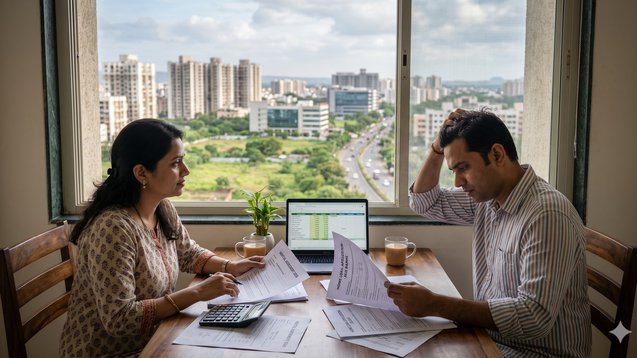
Rent vs Buy in 2026 What Makes More Financial Sense?
Introduction
“Should I keep paying rent or finally buy a home?”
It stands as one of the most frequently asked questions in Indian real estate which carries strong emotional weight. The answer for 2026 presents greater difficulty than it did in previous years because multiple factors now affect property values. Property prices have risen in many cities, home loan interest rates have fluctuated, and rental markets have become more dynamic than ever. People who live in Mumbai or Bengaluru face financial challenges when they want to purchase a home. People tend to think that their rent payments vanish into thin air when they pay rent throughout the years without owning anything. People use the rent versus buy decision process as a way to examine their monetary situation. The process requires people to consider their personal lifestyles, their upcoming needs and their capacity to handle risks while selecting the best time to enter the market. People in Tier 1 cities prefer to rent because property expenses remain extremely high. People in Tier 2 cities now find buying a home to be more appealing because they can afford it. Tier 3 markets create an entirely different situation. What are the most reasonable options that exist in 2026. We will analyse the Indian real estate market through practical examples and current market conditions which show its present operating status.
The Fundamental Financial Difference Explained
On a basic level, Renting is an expense while Purchasing is an investment or at least this is the majority view. When you Rent:
You make monthly payments without creating equity in a property
You will have liquidity and flexibility
When you Purchase:
You make regular monthly payments (EMI) towards owning the property
You will build an asset over time
However, there are other factors to consider regarding Renting versus Purchasing. Purchasing has:
A down payment that is typically (10%-20%)
Costs of stamping and registering
Maintenance and Property taxes
On the contrary, when renting you typically have very little cost associated with your upfront cost. If you perform a detailed financial comparison using Property Aaj’s (https://www.propertyaaj.com) data on with respect to City, you will observe that there is a huge variance between EMI versus Renting.
Rent vs Buy in Tier 1 Cities (Mumbai, Delhi, Bengaluru)
In Tier 1 metro areas (Mumbai, Delhi, Bangalore), renting typically makes much better financial sense than buying for short- and possibly medium-term renters as property prices are very, very high. Let’s take a look at the numbers to understand why. For example, an apartment in Mumbai priced at Rs. 2 crores will generally have an EMI of Rs. 1.5 lakhs and will typically rent for Rs. 60,000 - Rs. 70,000. That’s a huge difference! As a result, buyers are struggling with the decision of whether or not it’s worth the extra Rs. 60,000 - Rs. 70,000 a month. In cities such as Gurgaon and Bangalore, the amount of money that you would spend on renting vs. buying is marginally smaller, but is still large. Renting is very appealing to many professionals particularly those that are just getting started in their careers as it allows:
Flexibility
Ability to invest in other assets (i.e. stocks, mutual funds)
Freedom to move or relocate at their discretion
Rent Vs Buying In Tier 2 Cities (Pune, Nashik, Ahmedabad)
This is where the shift starts to happen. In Tier 2 cities:
Prices of properties are generally cheaper.
EMI to rent ratio is much more balanced.
For instance, in Pune an ₹80 Lakh Property could have an EMI of ₹60000, whereas the rental price for a similar property can be found at ₹25000-₹30000. So while the EMI is still higher than the rent, it is not nearly as much there is less of a gap between them than what is experienced in many Tier 1 cities. There are more reasons to support this decision;
Higher potential for appreciation.
Continued investment in Infrastructure Development.
Therefore, for people looking to make a long term investment, purchasing real estate typically makes more sense in Tier 2 cities compared to Tier 1 cities. The statistics provided by Property Aaj (www.propertyaaj.com) poker check this evidence—there has been a substantial increase in the number of end users buying properties directly from builders indicating that more end users are entering into the market in these locations.
Renting versus Buying in Tier 3 Towns
In Tier 3 towns: Home values are quite reasonable The rental market is relatively low. That creates an interesting situation. In general, it is usually cheaper over the long-term to purchase rather than rent However:
The potential for rental income is limited
Appreciation is likely to be slower
It is reasonable for end-users and/or long-term residents to purchase in a Tier 3 town. But investors should evaluate Tier 3 towns carefully before purchasing.
How Home Loan Interest Rates Affect Rent vs Own Decision in 2026
For those deciding whether to rent or to buy a house, the rate of interest plays a very large part in making that decision. In 2026:
Rates are stable, but not at historic lows.
Compared to a few years ago, EMIs are slightly higher.
A small increase of interest rate has a big impact on EMIs.
For example,
A 1% increase in interest can increase the EMI by thousands of dollars a month!
So if you are in the market to buy a home:
Locking in a good rate is very important.
Loan terms and type are an important consideration.
Renters will not be directly impacted by interest rates.
The Hidden Factor of Opportunity Cost
Buyers tend to ignore opportunity cost which represents a hidden expense. If you invest:
₹20 lakh as down payment
Plus monthly EMI difference
Will the invested funds generate faster growth in other locations? The answer in Tier 1 cities usually ends with a positive response. A renter who invests their EMI savings into mutual funds will experience substantial wealth growth throughout their investment period. Property investments in Tier 2 cities will outperform financial assets because these areas experience faster value increases. Personal strategy becomes important at this particular point.
Stability versus Flexibility
In this regard, let's leave behind the number of advantages/disadvantages.
When you rent, you have:
Flexibility to relocate
Freedom from a long term commitment
When you purchase, you retain:
Stability
Emotional peace of mind
Ownership
If we consider a young IT professional, who may change jobs or location often, they would likely find greater value in renting. If we consider a family with children, they require stability and would therefore have a greater value in purchasing. In many ways, the emotional component plays a substantially larger role than simple arithmetic solutions will indicate.
Rental Trends Across India
The rental market of India has undergone changes throughout its history. The Tier 1 cities exhibit:
High demand
The post-pandemic period has resulted in increasing rental prices.
The Tier 2 cities experience:
The area has restricted demand which shows signs of development.
The Tier 3 cities maintain:
The area has an insufficient system for renting properties.
The current situation leads to two outcomes:
The cost of renting apartments in metropolitan areas has increased.
The cost of purchasing properties in smaller cities has become more appealing.
The website Property Aaj (https://www.propertyaaj.com) provides users with complete rental data for different cities, which enables them to make better rental choices.
Capital appreciation is one reason people purchase property.
However, this does not mean that every piece of property will be worth more over time. Tier 1 cities have consistent but lower rates of appreciation than Tier 2 cities. Tier 3 cities could see capital gains but have an uncertain future. More importantly, when considering where to buy, the location, infrastructure, and timing are paramount to making a smart real estate investment. When looking for a good deal on a property, if you buy in the right micro-market, there will be a significant difference between the appreciation of your investment and that of other investments.
Legal and Tax Considerations
The act of purchasing goods brings about both legal obligations and financial obligations. You need to consider:
Stamp duty costs which differ between states
Costs associated with registration
The requirements for RERA compliance
Tax benefits include:
Home loan interest deductions
Principal repayment benefits
Renting, on the other hand, offers: The act of renting provides HRA benefits which apply to salaried individuals. The tax implications affect both options because they create advantages for both choices.
Who Should Rent in 2026?
Renting is ideal for:
Young professionals
People with uncertain job locations
Those prioritizing liquidity
People who lack knowledge about their future location during the next three to five years should choose renting as a better option.
Who Were The Prospects of 2026 to Buy?
It Makes A Lot Of Sense To Buy:
LDPs usually long time residents
Stable-Position Seeking Families
Capital-Appreciation-Seeking Investors
On the mention of one's financial stability as well as their intent to make home wherever they are buying, steps could eventually be a really rewarding experience. Carefully review all prospective options of Property Aaj (https://www.propertyaaj.com) to match your needs with the right property.
Conclusion
To purchase or lease in 2026, there are too many variables to give an accurate answer, this is just a fact. For instance, if you are in one of the Tier 1 cities, it often makes more sense from a monetary perspective to rent versus buy unless you intend to hold onto the property for a longer time. However, in Tier 2 cities, the value of the purchase is increasing because of both affordability and growth potential. In Tier 3 cities, people are usually more inclined to purchase because of primarily end-use. When determining to purchase or rent, look at:
Your current financial position
Your future career intentions
Your ideal lifestyle
It is important to treat real estate as part of a holistic financial plan. If you look at real estate in an emotional context you are much less likely to make a positive decision. Evaluate your options carefully over a longer period of time. Use reputable sources, such as Property Aaj, to ensure that you stay current and informed on all of your options. In 2026 there is no better option, simply choose to do what will be the best thing for you.
FAQs
1. Is renting cheaper than buying in India in 2026?
In Tier 1 cities, renting costs less than paying EMIs which makes it more affordable for people who need short-term housing solutions.
2. Does buying a house always make financial sense?
The answer to this question depends on multiple factors including location and price and loan terms and your planned duration of property ownership.
3. Which cities are best for buying property in 2026?
Pune Nashik and Ahmedabad function as tier 2 cities which provide better housing affordability and strong development potential.
4. How do interest rates affect the rent vs buy decision?
Higher interest rates lead to increased EMIs which create a situation where home buying becomes less appealing than rental housing.
5. Can renting help build wealth?
The saved money from EMI difference should be invested wisely in financial instruments to create wealth.
6. What is the biggest risk of buying property?
The main danger of property acquisition exists through purchasing a property at an excessive price in an area which experiences low development or through acquiring a property without establishing financial preparation.