Choosing Property Without Getting Influenced by Marketing
Introduction: The Real Estate Marketing Trap Many Buyers Fall Into
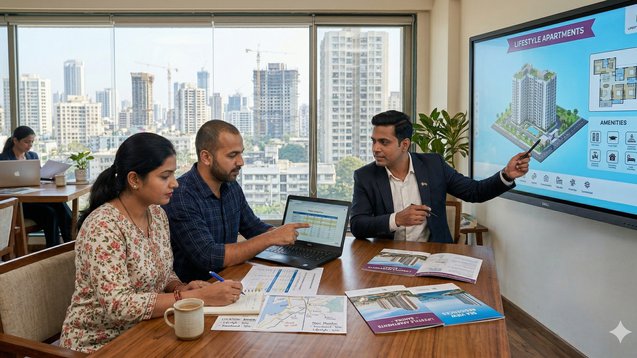
The instant customers enter a contemporary Indian property sales office they will observe the complete office setup which aims to create a strong impression. The model apartment looks flawless. The sales manager shows glossy brochures. The digital screens display luxurious amenities together with upcoming metro links and major value growth expectations. First-time buyers find the experience to be highly convincing because they can hardly resist its power. The marketing system for real estate products generates emotional responses that customers use to make their purchasing decisions. Developers throughout India make substantial investments in marketing psychology across all city tiers from Mumbai and Bengaluru and Delhi NCR to Pune and Indore and Lucknow and emerging Tier 3 markets. The combination of attractive launch offers together with limited inventory messages and celebrity endorsements and pre-launch pricing creates urgent buying pressure. The danger exists because buyers make their choices based on how things look instead of how they work. To make smart property decisions people need to stop listening to advertising claims and start assessing essential elements which include location basics and legal details and actual price and infrastructure development and future residential living conditions. People who want to purchase property throughout India should learn how to distinguish between marketing exaggeration and actual worth because this ability helps them avoid losing lakhs and sometimes crores in future disappointments. The Property Aaj platform (https://www.propertyaaj.com) enables buyers to verify the truth of promotional statements through its detailed property information and location assessment and market evaluation. We will examine methods which enable buyers to make better choices because they remain unaffected by real estate advertising methods.
The impact of real estate marketing on buyer behaviour needs examination.
Understanding the marketing process requires knowledge of its operational methods. The research team of developers and real estate marketers studies buyer psychology to create marketing strategies. They aim to establish emotional responses which will block logical reasoning from starting. The common strategies show these two methods:
Pre-launch pricing available for limited time”
Only 5 units left in this tower”
Metro line coming nearby soon”
Guaranteed rental income for 3 years”
The statements contain truth but their presentation method leads people to make choices without complete information. The statements contain truth but their presentation method leads people to make choices without complete information. In Tier 1 cities like Mumbai or Bengaluru, marketing campaigns focus heavily on luxury lifestyle — rooftop pools, co-working lounges, sky decks, and international architecture. In Tier 2 cities such as Jaipur, Coimbatore, and Nagpur, marketing emphasizes affordable options which will experience future growth. Township developers in Tier 3 towns use infrastructure development promises to market their projects. Through township development projects developers in Tier 3 towns use infrastructure development commitments to market their projects. The statement contains truth yet it creates risk for following essential steps which require assessment of fundamental elements. The statement contains truth yet it creates risk for following essential steps which require assessment of fundamental elements. A disciplined buyer treats marketing material as an introduction not a conclusion. The real analysis begins after the presentation ends.
Identifying The Difference Between Marketing And Reality
Learning to tell the difference between what you see in marketing and what is real is an important skill for someone who is buying a property. Take a luxury apartment in Bengaluru for example. The pictures in the advertisement might show you gardens, jogging tracks, yoga decks and a nice view of a lake. When you actually go to the site you might see that:
The lake is there during certain times of the year and is often dry
The gardens and trees in the pictures will take a time to grow
The roads near the property are still being built
It can take a time to get to work because of heavy traffic
This does not mean that the property is bad. It just means that the pictures in the marketing materials show what the property will look like in the future, not what it looks like now. The same thing happens with projects in cities like Ahmedabad or Kochi. A developer might talk about IT parks or highways that are going to be built but these projects can take many years to finish. Before you believe what the marketing people say, you should check:
When the infrastructure will be ready
If the government has approved the project
If the project is registered with RERA
If the developer has finished projects on time before
Websites, like Property Aaj (https://www.propertyaaj.com) can help you compare properties, locations and prices in different cities, which makes it easier to see if the marketing claims are true. Remember, marketing shows you what could be. Doing your research shows you what is really going on.
The "Launch Price Advantage" Myth Explained
The phrase "launch price offer" represents one of the most effective marketing tools. Developers use early buyer discount promotions to attract customers who will select their projects for upcoming price increases. The statement holds true in some cases while it remains false in other instances. In Tier 1 markets like Mumbai or Gurgaon, launch pricing may be slightly lower to attract initial buyers and build momentum. However, price increases later depend on construction progress and demand for the project. The price increase from launch to completion reaches only minor levels in Tier 2 cities like Surat and Bhopal because the market maintains a high level of supply. The growth of property value in Tier 3 towns experiences its slowest rate when projects exist in remote areas that lack proper infrastructure. Buyers should therefore compare:
Current launch price vs nearby resale properties
Construction timeline
Demand in that micro-market
When a ready-to-move apartment costs the same as a pre-launch unit, the marketing discount does not exist. Platforms such as Property Aaj (https://www.propertyaaj.com) offer project comparison tools that enable buyers to assess whether a launch offer provides actual value or acts as a marketing gimmick.
When you are looking to buy a property you should not think that amenities are the important thing.
Amenities are a part of what makes a property look good in marketing brochures. You see things like infinity pools and mini theatres and clubhouses and yoga lawns and pet parks. These amenities make a property seem like a place to live, especially in big cities where properties are competing with each other to have the best amenities. Amenities should not be the main reason you buy a property.
Why is that?
It is because a lot of amenities are not used much.
In housing societies, in India people do not often use things like
Amphitheatres
Party lawns
Tennis courts
Business lounges.
At the time having these amenities means that maintenance costs are higher. The situation becomes more visible in Tier 2 and Tier 3 cities because of their particular conditions. Buyers initially show interest in lifestyle features but they discover later that location convenience which includes schools and hospitals and workplaces and markets is more important. The better method should start with these three elements: Location accessibility
Apartment layout efficiency
Construction quality
Developer reputation
People should view amenities as additional value which they should consider but not use to make their final decisions.
Evaluating Location Beyond Marketing Narratives
Location is the single biggest factor affecting property value. Yet marketing often oversimplifies it. The developer will describe the project's location by using the phrases "near the upcoming metro" and "close to the airport corridor."
But what does "near" actually mean?
In Indian real estate marketing, "near" could mean 2 km or even 12 km.
In large cities like Hyderabad or Delhi NCR, a few kilometres can dramatically change commuting time.
The projects in Tier 2 cities like Indore and Chandigarh which commercialize their areas as "city expansion zones" lack essential social infrastructure including educational institutions and grocery stores and hospitals. When you think about buying a place you should really go see the area at times of the day.
You should visit the area during morning commute hours.
You should also visit the area during evening peak traffic.
You should visit the area on weekends.
You should check what is nearby like transport.
Check nearby:
You should check if there are markets nearby.
You should check if there are schools and healthcare facilities nearby.
You should check the road connectivity.
Websites like Property Aaj help people look at different areas and compare how different cities are developing. You can visit their website at https://www.propertyaaj.com. When it comes to Property Aaj and other real estate platforms they can be very helpful. The truth is, you really get to know if a location is good when you see it in person. Not just by looking at pictures. You have to see the location of Property Aaj and other places, for yourself to really understand the value of the location. The location of Property Aaj and other places is very important.
The Hidden Pressure of Limited-Time Offers
The price becomes permanent security when you book within the first 48 hours.
The festival promotion ends within a short time period.
This presents the final opportunity to purchase from this building.
Indian property marketing uses these phrases as common elements.
The marketing techniques generate urgent demand for housing products through artificial methods. The housing projects usually present the public with more than 100 housing units that they will develop across different construction stages. Developers use this method to release inventory because they want to create the impression that demand exists for their products. The construction projects in Tier 1 markets of Pune and Bengaluru use this method because their projects require multiple years to complete. When it comes to Tier 2 markets you will see that people use urgency campaigns during festivals like Diwali or Akshaya Tritiya. This is what happens.. The thing is, you should never rush into buying a property. You need to take your time. Here are some things you should do:
Look at projects near the one you like
Check the legal papers carefully
Think about if you can really afford the loan
Go to the site many times to see how it is
A good property is still good even when you look at it very carefully. People who sell properties often use pressure tactics. This helps them more than it helps the buyers, like you who are buying the property.
Why Developer Reputation Matters More Than Advertisements
The main mistake buyers make is using project marketing information to determine product quality instead of evaluating the developer's performance record. Beautiful brochures do not guarantee timely project completion. The entire country of India experiences housing project delays, which particularly harm buyers in major metropolitan areas. Before booking property, check:
Developer's past delivery timeline
Construction quality in previous projects
RERA compliance
Customer reviews from existing residents
The first tier markets enforce RERA regulations more strictly than other markets yet still experience project delays. The buyers in Tier 2 and Tier 3 municipalities need to examine developers who operate smaller businesses because those developers lack financial resources. The development history of a developer reduces project risks through which they achieve the following outcomes
Project delays
Quality issues
Legal disputes
The information about property listings and developer backgrounds becomes easier to evaluate when researchers use websites such as Property Aaj (https://www.propertyaaj.com). The builder's past performance should be trusted while their marketing creativity should not be trusted.
Decision making needs numerical data instead of storytelling.
Intelligent property buyers use numeric data for their purchasing decisions. Narratives serve as the foundation for all marketing activities. The distinction between two things shows its importance. Before finalizing property anywhere in India, evaluate the following metrics:
Price per square foot compared to nearby projects
Rental yield potential
Future infrastructure plans
Loan EMI affordability
Maintenance charges
The annual rental yield for Tier 1 cities ranges from 2 to 3 percent according to current market conditions. Tier 2 cities sometimes offer better appreciation prospects because infrastructure development is still expanding. Tier 3 towns offer affordable housing options but they have limited rental market activities. Financial fundamental analysis enables buyers to understand the actual value of property throughout its ownership period, which exists separately from marketing materials. When numbers make sense, marketing becomes irrelevant
The Role of Independent Research in Property Buying
Independent information resources provide buyers today with their most significant advantage. Buyers depended on brokers and developer sales teams to assist them with property transactions before the existence of online property platforms. Online property platforms enable users to access complete property market information which includes pricing patterns and territorial data and project comparison details. Through their research of multiple projects which spread across different cities on Property Aaj (https://www.propertyaaj.com) buyers can observe the following comparison points:
Property prices across micro-markets
Available inventory
Infrastructure developments
Investment potential
This broader perspective reduces the chances of getting influenced by a single marketing narrative. When buyers study multiple options they start recognizing patterns which include pricing benchmarks and realistic appreciation expectations and location strengths. Knowledge creates confidence. Confident buyers will not see through marketing traps.
Smart Property Buyers Think Beyond Marketing
Real estate marketing is not bad in itself. Developers have to tell people about their projects and marketing helps buyers find out about things. The problem starts when people focus more on how things look than what they really are. Over India from the big buildings in Mumbai to the new towns in smaller cities marketing tries to show people the kind of life they could have, what might happen in the future and how they could feel. But buying a property is a decision that affects you for a long time. It is about money. Smart property buyers think about things, like
where the property is and if it is a good place
if the developer is someone you can trust
if all the legal papers are in order
if the price is fair
if the area is getting better
They go to see the property many times.
They look at projects nearby. They ask questions that might be hard to answer. Importantly they do not let marketing material convince them they just use it to get information. By doing their research and using good real estate websites like Property Aaj buyers can get a better idea of the property market in India. Because, in the end, the best property decisions are not the ones that sound exciting, they are the ones that are made with all the facts Property Aaj helps with.
FAQs
1. How can buyers verify whether a property’s marketing claims are accurate?
To check marketing claims buyers need to visit the property and examine RERA project information and assess nearby construction activities. The process of validating claims requires both government infrastructure announcements and research into local development patterns.
2. Are pre-launch property offers usually beneficial?
Pre-launch offers present two advantages because they offer lower prices but they also increase potential losses through uncertain construction and approval processes. Buyers should check the RERA registration status and developer reputation before they consider launch discounts as trustworthy.
3. Why do developers emphasize luxury amenities in marketing campaigns?
The amenities create lifestyle value which helps businesses to distinguish their projects from competing products in their respective markets. The first two elements should be prioritized by buyers because many existing amenities create extra maintenance expenses while remaining unused.
4. How important is developer reputation compared to project marketing?
The developer track record stands as the most important element for assessment. A builder with a history of timely project delivery and good construction quality offers greater reliability than a heavily marketed project from an unknown developer.
5. Do property buyers in Tier 2 and Tier 3 cities face more marketing influence?
Yes, marketing influence can be stronger in emerging cities where buyers may have fewer property comparisons. Developers use future growth potential to attract investors.
6. What is the safest way to avoid emotional property decisions?
Create a checklist which contains budget requirements and location priorities and rental potential and developer credibility and legal approvals. Buyers need to evaluate these factors because it will help them resist marketing pressure.