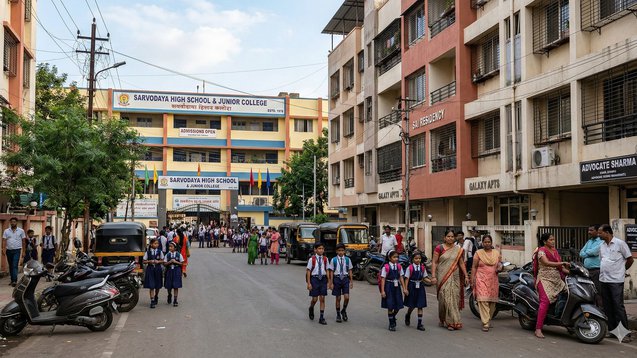
Introduction:
People start their property assessments by using numerical data which includes their financial budget and their EMI payments and their carpet area and their maintenance charges. The decision framework shifts when children become part of the situation. The question now stands at more than just asking whether we can afford the house. The question now involves determining whether this house will meet the daily needs of our child. People consider school proximity when making residential decisions because it serves as one of their most important lifestyle factors. Families in major metropolitan areas such as Mumbai and Bengaluru and in emerging cities like Pune and Noida now prioritize access to high-quality educational institutions more than they value clubhouse amenities and expensive building features. We will examine this effect through detailed research.
1. The Compounding Effect of Daily Commute
The single extended journey to work creates no issues. The problem becomes bigger when you multiply the single extended journey to work through the following time periods. The workweek consists of five days. The academic year lasts from October to June. Students must complete their studies for a period of ten to twelve academic years. The total travel time which people spend traveling throughout this period will build up to an enormous amount. In Delhi, traffic jams create a situation where a person needs 45 minutes to travel between two points that should take them less time. A child who travels 90 minutes to school and back home needs to spend almost 300 hours each year on school transportation. The time allocated to this activity takes away time needed for. The individual requires time to perform six different activities. The activities which people practice over multiple years will create their permanent way of living. The area next to your location serves two purposes. The area needs to provide a safe space which protects children's time spent outdoors during their formative years.
2. Psychological Impact on Children
Children thrive on routine stability. Unpredictability emerges because of extended time spent traveling between different locations. The daily transport system faces problems through three different sources. People who need to travel several times between different locations during the day will develop fatigue which affects their ability to focus according to research studies. Children react to long distances differently from their parents who already adapted to driving long distances. The school located near their home provides a base which helps them maintain their emotional balance.
3. Health and Physical Well-Being
Sleep serves as an essential need for children who are still developing. The human body learns to adapt when a child wakes at 5:45 AM to travel to a distant school which starts at 8:00 AM. The body experiences various effects from chronic sleep deprivation which include. The body experiences two different reactions to 5 hours of sleep loss. The first reaction includes. The second reaction involves. The third reaction includes. The fourth reaction embodies. The fifth reaction displays. The body benefits from short distances because they provide. The body requires short breaks to achieve. The body needs rest periods between activities to support its functioning. The body requires time to eat breakfast before starting events. People who experience anxiety because of time constraints will have their worries decreased through this method. Health benefits accumulate silently, but significantly.
4. Parental Work-Life Balance
School proximity doesn’t only affect children it reshapes parental schedules too. Schools require dual-income families to organize their drop-off and pick-up times because both parents need to work. Parents who need to drive their children to school because the school lies beyond walking distance should have access to. Parents who need to drive their children to school should have access to. Parents who need to drive their children to school should have access to. Parents who need to drive their children to school should have access to. Mumbai and Bengaluru experience traffic conditions which transform a 10-kilometer drive into a journey that requires more than one hour during peak traffic times. The process of dropping off students becomes easier when schools exist near their homes. The process of picking up students who experience emergencies becomes easier when schools exist near their homes. The process of work interruptions decreases when schools exist near their homes. The process of running family activities becomes easier to handle because this system creates better efficiency for the entire family.
5. Financial Implications Over Time
The property value estimation process requires families to assess property expenses but they need to consider their future travel costs. The following costs require evaluation: Fuel costs School transport fees Vehicle maintenance Driver salary (if applicable) The total amount will exceed several lakhs which will develop over a ten-year period. In some cases, paying a slightly higher property price in a school-friendly neighbourhood may offset recurring transportation expenses. It becomes a long-term financial equation, not just a short-term decision.
6. Influence on Property Demand and Appreciation
Established schools create consistent demand for properties located in their adjacent neighbourhoods. The reason exists that new families emerge annually into the housing market because they want to obtain similar benefits. The property prices in Noida and Pune's fast-growing urban areas experience stabilization and continuous growth around school districts. The areas attract people who want to settle down because they have established family bonds and they need to move less often and they want to live there for an extended period. The educational infrastructure development process makes neighbourhoods more desirable for investors. School zones continue to attract interest from buyers during market downturns because they maintain better demand than commercial areas.
7. Social Ecosystem and Community Bonding
The research findings demonstrate that school attendance patterns lead to friendship development between students who live near their schools. The research findings demonstrate that group studies become more effective when students work together with their friends who live close by their home. The research findings demonstrate that parents who share their daily activities with others will meet new people through their shared experiences. Children who walk home together or take the same bus route to school create natural friendship groups. Parents establish connections with each other during school activities and school board meetings and when they attend extracurricular events. The neighbourhood develops into a supportive system which provides assistance to its residents. The property receives additional worth through this social system which operates as an invisible asset.
8. Flexibility During Unexpected Situations
Life does not maintain a constant schedule. The children experience sickness. The school events continue until they finish. The weather conditions become more severe. The transportation systems experience failures. Parents can reach the school within a brief period when the school operates in close proximity to their location. The combination of Delhi's traffic unpredictability and long-distance travel creates increased uncertainty for all travelers. The ability to reach a location without needing to travel further reduces the chances of facing logistical issues. The flexible nature of our operations provides us with better protection against potential risks.
9. The Trade-Off: Pricing Premiums
The cost of homes close to prestigious schools increases because of their desirable location. Established educational corridors face increased pricing pressure because of their high demand. The rental prices in metropolitan areas increase for properties located close to top educational institutions. Families must assess school status through two options. The school operates as a permanent institution or it functions as a temporary facility. The area contains multiple high-quality educational institutions that provide access to students. The price difference between two options needs assessment to determine its value based on the time saved during the travel process. The optimal solution between cost and convenience exists when you live 15 minutes from the school yet remain outside its primary attendance area.
10. Long-Term Educational Planning
Parents should look beyond primary education. The question requires an answer about the existence of secondary educational institutions in the area. The area contains facilities that offer educational support through tutoring services. The facility provides students with access to musical and athletic activities and computer programming classes. Strong school networks create educational ecosystems which educational systems develop. A neighbourhood choice which supports academic advancement throughout the years enables students to finish their studies without needing to move. Frequent relocations create problems which disrupt established patterns of both work and home life. The organization of work through early planning shows which tasks require urgent attention.
11. Emotional Reassurance
The emotional bond between students and their schools exists beyond all practical decision-making factors. Parents experience reduced levels of concern because they believe they can maintain contact with their children throughout the day. Parents experience emotional security which causes them to make decisions that extend beyond their financial interests. The psychological benefits of residing close to school serve as the permanent residence for students.
Final Thoughts
School distance from students' homes determines both their time spent traveling and unknown aspects of their school day experience. The study investigates six different areas which include Physical health Emotional stability Academic performance Parental schedules Financial planning Property value Community integration. Site visits create an impressive experience through their luxurious amenities. The actual effects of location become visible during weekday morning hours. The evaluation of property begins with parents projecting their child’s five-year future school schedule. People achieve better selection results when they can visualize their choices instead of following spreadsheet instructions. The benefits of living close to school extend beyond shorter travel times. A residential area provides rights to school access which creates a smoother environment for family activities.
FAQs
1. What is the ideal distance between home and school?
Urban areas achieve their best travel efficiency when people need between 10 and 20 minutes to reach their destinations.
2. Does proximity increase property price significantly?
The answer is yes because people value homes that are close to well-known schools located in major urban areas.
3. Is walking distance essential?
People can choose to work from home but they will gain many benefits when their work location is nearby.
4. Can school proximity improve resale value?
Educational infrastructure delivers sustained educational demand which results in permanent property value increase.
5. Should I prioritize school first or home first?
Families prefer to find their ideal school first before searching for homes that are close to it.
6. Does proximity matter more in metros than smaller towns?
The answer is yes because metropolitan areas experience more traffic jams and unpredictable travel times than smaller towns.
Read more about property matters with our specialists and browse the latest property listings on Property Aaj. Download the app from the Play Store and App Store now for easy buying, selling, and renting!