Introduction
The COVID-19 pandemic irrevocably altered the Indian work life, with hybrid work likely to represent its most permanent effect. Rather than the full-time in-office model or full-time remote position that was defined prior to the pandemic, the business world today has chosen hybridity. The arrival of hybrid work has already had a monumental influence on commercial property across the subcontinent, and has had an outsized impact on the leading commercial regions of Maharashtra, including Mumbai, Pune, Thane, Navi Mumbai, and Nagpur.
With businesses seriously reconsidering their office space requirements, commercial real estate developers and investors have had to recalibrate to engage with demand—to even better consider hybrid workplaces moving forward. Certainly hybrid work is influencing office space solutions, but it is influencing rental, site influence, and investment fundamentals as well. Please see below a deeper dive on hybrid work influencing commercial property strategies in Maharashtra.
What Is Hybrid Work?
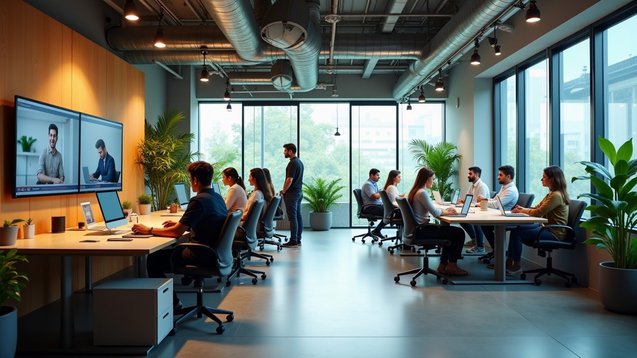
Hybrid work combines remote work with in-office presence. For example:
Employees may work 3 days from the office and 2 days from home.
Teams may rotate office presence to reduce crowding.
Some companies adopt flexible hours and hot-desking instead of fixed seats.
This flexible model has become popular with IT, finance, consulting, and startups—sectors that have a strong presence in Maharashtra.
How Hybrid Work Is Affecting Commercial Real Estate
Reduced Demand for Large Office Spaces
Earlier, companies leased big office floors in hubs like Bandra-Kurla Complex (BKC) in Mumbai or Hinjewadi in Pune. With hybrid models, many firms are downsizing to smaller offices, focusing on quality over quantity.Rise of Flexible Leasing
Businesses no longer want long-term lock-in periods. Instead, short-term and flexible leases are gaining traction in commercial hubs like Powai, Aundh, and Navi Mumbai’s Vashi.Growth of Co-Working Spaces
Hybrid work fuels demand for co-working spaces where employees can drop in as needed. Cities like Pune and Thane have seen a surge in demand for shared workspaces near residential zones.Shift Towards Decentralized Offices
Instead of one big HQ in South Mumbai or central Pune, companies are opening smaller satellite offices in suburbs like Andheri, Wakad, or Kharadi, closer to where employees live.Demand for Tech-Enabled Offices
Hybrid work requires smart infrastructure—fast internet, video conferencing facilities, and digital access systems. Developers are now investing in tech-enabled commercial properties.
Impact on Maharashtra’s Major Cities
Mumbai
Traditional CBDs like Nariman Point are losing some shine.
Growth is visible in suburban hubs like Andheri, Powai, and Navi Mumbai.
Co-working operators are expanding rapidly to cater to hybrid work demand.
Pune
IT corridors like Hinjewadi, Baner, and Kharadi are witnessing demand for smaller office spaces and flexible leasing.
Many companies are adopting a hub-and-spoke model with smaller offices spread across the city.
Nagpur
As a growing Tier-2 city, Nagpur is seeing demand for affordable, hybrid-ready offices around Civil Lines and MIHAN.
Startups and logistics companies prefer flexible spaces over long-term rentals.
Nashik
With its expanding education and manufacturing sectors, College Road and Gangapur Road areas are emerging as hybrid-friendly commercial zones.
Thane & Navi Mumbai
These cities are benefiting as firms shift offices closer to residential areas.
Vashi, Airoli, and Ghodbunder Road are witnessing increased interest for hybrid setups.
Opportunities for Investors and Developers
Redevelopment of Old Office Buildings
Aging office complexes in South Mumbai or central Pune can be converted into co-working or hybrid-ready spaces.Focus on Smaller, Flexible Units
Instead of massive office floors, developers can build compact, modular spaces suited for hybrid tenants.Growth in Co-Living + Co-Working Models
Demand for properties that combine residential and flexible office facilities is rising in areas like Hinjewadi, Baner, and Powai.Long-Term Value Creation
Even though hybrid reduces space per company, the sheer number of businesses adopting hybrid ensures steady long-term demand.
Challenges in the Hybrid Era
Vacancy Rates: Large corporate towers face rising vacancies.
Revenue Fluctuations: Shorter leases bring uncertainty for landlords.
Redesign Costs: Making properties hybrid-ready requires investment in design, IT, and sustainability.
Competition from Co-Working Brands: Players like WeWork and SmartWorks are capturing demand.
How Property Aaj Helps
Finding the right hybrid-ready office space can be challenging. Platforms like Property Aaj (https://www.propertyaaj.com) simplify the process by offering verified commercial property listings across Maharashtra. Whether it’s a flexible co-working desk in Pune, a satellite office in Navi Mumbai, or an IT-enabled workspace in Nagpur, Property Aaj connects businesses and investors with the best options.
For developers, Property Aaj also serves as a platform to showcase hybrid-ready projects, helping them reach the right tenant base.
The Future of Hybrid Work in Maharashtra
Hybrid as the Default Model
More companies hypothetically would adopt hybrid as a permanent model by 2030.Additional Growth will be in the Suburbs
Just like other suburban areas of the country, the office supply and demand will emanate from suburban areas of the region, specifically from Mumbai, Pune, and Thane.Sustainable, Green Workspaces
Hybrid tenants lean toward sustainable, energy-efficient structures. Developers will have to work green certifications into their development to win the business.Technology Driven Leasing
Using technology platforms like Property Aaj will be a substantial core of the transparent and flexible leasing process.
Conclusion
Hybrid has generated enormous shifts in how companies consider their office spaces. Companies no longer consider only the size of space but where do they want the space to be, how flexible the space is and the use of technology both as an employee and to enhance their office space proposition. For employees, hybrid work provides shorter commutes and improved work-life balance. For developers and investors this creates new opportunities on how we redistributed and reimagined commercial properties.
As a region in Maharashtra moves from office spaces in Mumbai’s corporate centers and Pune’s IT city to Nagpur’s future-choice areas, they will have produced new prospects across commercial real estate. With easy access to platforms like Property Aaj ( https://www.propertyaaj.com ) the new office ecosystem seems very much manageable.
FAQs
1. What is hybrid work, and what does it do to demand for commercial property?
Hybrid workplace is a combination of office-based work delivered on-site and remote-based work delivered off-site alongside areas in between. Hybrid work is changing the way we use office space; it reduces the demand for monolithic mega-offices and offers a good opportunity for flexible, tech-enabled spaces.
2. Which sub-warehousing locations in Maharashtra are being positively impacted by hybrid work?
Andheri, Powai and Navi Mumbai are the three top stations in Maharashtra, with others in a slightly questioning but expected positive light: Hinjewadi, Baner, Kharadi, Civil Lines Nagpur, and Vashi.
3. How are developers responding to hybrid work?
The world's developers of office workplaces are actively responding by getting into small, flexible office units, creating flexibility in terms of lease models, and a hybrid-ready design with smart infrastructure.
4. Is hybrid work threatening the unique value of commercial real estate?
Not necessarily. While monumental big tower office buildings are facing significant vacancies, small flexible spaces are seeing huge demand. Lots of much needed supply.
5. Is co-working a necessary element in hybrid enabled workplaces?
Co-working in a hybrid enabled workplace offers great flexibility and convenience, including terms of time, cost, space and ways of working. It's an essential cog in the wheel of a highly technologically enabled hybrid office ecosystem.
6. How can Property Aaj assist a business find hybrid enabled offices?
Property Aaj has verified listings and insights for businesses looking for hybrid enabled commercial properties in Maharashtra.
Read more about property matters with our specialists and browse the latest property listings on Property Aaj. Download the app from the Play Store and App Store now for easy buying, selling, and renting!