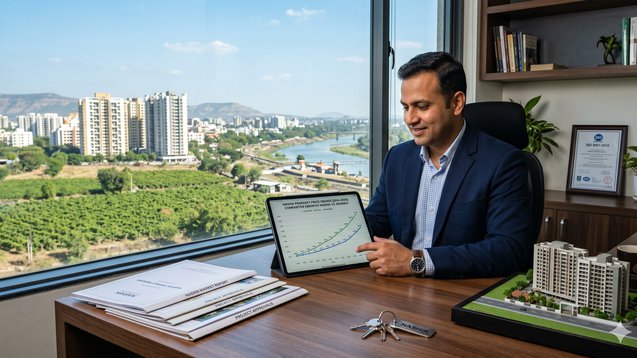
Introduction
The Indian real estate market in 2026 has expanded beyond its previous boundaries which only included the "Big Eight" metropolitan areas. The city of Mumbai and the city of Bengaluru together with the city of Gurugram maintain their status as expensive locations. Investors together with homebuyers now direct their attention towards Tier 2 "growth engines" which include cities that provide better transportation systems and more comfortable living conditions together with potential property value increases. Nashik has established itself as a leading city among these options. Nashik has developed from its previous status as a city with extensive vineyards and religious sites into a rapidly expanding construction development area. The city has transformed from a quiet retirement destination into an essential part of the Mumbai-Pune-Nashik "Golden Triangle" which has developed during the past ten years. We have collected thousands of data points at Property Aaj (https://www.propertyaaj.com) which demonstrate that Nashik's real estate market follows a unique pattern that results from demand and market forces instead of temporary market fluctuations. This article analyzes property price developments in Nashik during the past ten years (2016-2026) while comparing these trends to nationwide price trends which will enable you to forecast upcoming market developments.
The Baseline: Nashik’s Real Estate Market in 2016
The 2026 peak requires analysis of the 2016 floor to achieve proper understanding. The real estate market in Nashik reached its most challenging state when the Indian property market started its post-demonetization decline. Property rates in prime areas like Gangapur Road reached their peak between ₹3,500 and ₹4,200 per sq. ft. The local market mostly served end-users who wanted homes and retirees from Mumbai who needed second residences. The suburban areas of Mumbai experienced property price increases which reached more than ₹15,000 per sq. ft. The price gap between products remained extremely large yet Nashik's infrastructure development continued through its "work in progress" phase. City planners created the Samruddhi Expressway as a proposed project while main city roads struggled with their connectivity problems. The establishment of the Delhi-Mumbai Industrial Corridor (DMIC) nodes near the city created a base for upcoming urban development work.
2017–2019: The RERA and GST Transition
The Indian real estate industry experienced its most significant changes between 2017 and 2019. The Real Estate (Regulation and Development) Act (RERA) and the Goods and Services Tax (GST) together established essential sector transparency through their enforcement. The market underwent a "cleansing" process which removed non-serious developers while project deliveries became the main method for buyers to assess trustworthiness. The property market in Nashik experienced annual price growth between 2017 and 2020 which reached 3 to 5 percent. Nashik maintained a healthy market because its supply levels remained balanced while Tier 1 cities experienced price stagnation from excessive inventory. Buyers began to prefer "branded" local developers. The upper-middle class started choosing Indira Nagar and Govind Nagar as their main residential areas which resulted in property rates reaching ₹4,500 per sq. ft.
The Pandemic Shift: 2020–2022 and the "Reverse Migration"
The COVID-19 pandemic created an acceleration of development for Indian Tier 2 cities. The introduction of "Work from Home" (WFH) technology made it unnecessary for people in Mumbai and Bengaluru to live near their workplaces. Nashik became a popular destination for "lifestyle migration" because of its better air quality and comfortable weather and its location near Mumbai. Residents in Nashik between 2020 and 2022 started to prefer bigger homes. People needed extra rooms for home offices while they required open spaces for their wellness activities. The rise in prices for gated communities happened because buyers started to change their purchasing habits. The property Aaj website at https://www.propertyaaj.com documented that between 2021 and 2022 premium properties in Nashik experienced 15-20% value growth which exceeded the performance of various traditional Tier 1 residential areas that faced high population density and lockdown restrictions.
2023–2025: Infrastructure as the Primary Driver
The pandemic delivered its initial force to the world while infrastructure created its permanent attraction. The Hindu Hrudaysamrat Balasaheb Thackeray Maharashtra Samruddhi Mahamarg (Mumbai-Nagpur Expressway) reached its complete operation which transformed Nashik's transportation system and its ability to connect with other areas. The Thane-Nashik Highway expansion together with the Nashik Ring Road project announcement brought additional benefits to the city's outer regions. Nashik's average property rates exceeded the ₹5,000 per sq. ft. mark by late 2025. Gangapur Road micro-markets now charged between ₹6,500 and ₹7,000 per sq. ft. while Pathardi Phata and Adgaon developed at a rate above 10% during the year. The "investor class" emerged in Nashik during this time as Mumbai and Pune buyers discovered that Tier 2 land would become the next goldmine for 2026.
The 2026 Snapshot: Current Rates and Market Dynamics
Nashik's real estate market shows its current state in April 2026 through its limited project supply and its high natural market demand. The latest data shows that the citywide average asking price stands at about ₹5,049 per sq. ft. which has increased by 11.36% since the previous year. The average value shows micro-market areas exhibit different market conditions:
Pan-India Comparison: Tier 2 Stability vs. Tier 1 Saturation
The pan-India market evaluation of Nashik shows definite market patterns which become evident through our examination of the city. The current situation in Mumbai shows that its residents from Tier 1 cities now experience "affordability fatigue." The current housing situation shows that home loan interest rates have become stable but property prices have reached their highest point which creates unaffordable conditions for buyers in the metro core. The development of Tier 3 cities and their satellite towns emerged from this situation. Nashik sits in a "sweet spot" which enables it to compete with other Tier 2 cities through its superior position to Nagpur and Aurangabad. The city provides access to MMR economic zone through its Mumbai location which enables entry at a 70% lower price point. At Property Aaj (https://www.propertyaaj.com) we assist investors who discover that Nashik rental yield which reaches 3 to4% today proves to be more stable than the 2% returns which investors obtain from luxury areas in South Delhi and Worli. Nashik growth depends on genuine job creation and population growth which makes it less vulnerable to speculative Tier 3 market bubble dangers.
Buyer Psychology: The Shift Toward Transparency and Design
The pan-India market evaluation of Nashik shows definite market patterns which become evident through our examination of the city. The current situation in Mumbai shows that its residents from Tier 1 cities now experience "affordability fatigue." The current housing situation shows that home loan interest rates have become stable but property prices have reached their highest point which creates unaffordable conditions for buyers in the metro core. The development of Tier 3 cities and their satellite towns emerged from this situation. Nashik sits in a "sweet spot" which enables it to compete with other Tier 2 cities through its superior position to Nagpur and Aurangabad. The city provides access to MMR economic zone through its Mumbai location which enables entry at a 70% lower price point. At Property Aaj (https://www.propertyaaj.com) we assist investors who discover that Nashik rental yield which reaches 3-4% today proves to be more stable than the 2% returns which investors obtain from luxury areas in South Delhi and Worli. Nashik growth depends on genuine job creation and population growth which makes it less vulnerable to speculative Tier 3 market bubble dangers.
Rental Trends and the "Floating Population"
The Nashik rental market has experienced continuous growth because industrial development in the city has advanced in a silent yet powerful way. The growth of the Ambad and Satpur MIDC zones together with new technology and logistics companies has resulted in more engineers and managers and consultants entering the area. The current rental prices for a 2BHK apartment in Pathardi Phata and Govind Nagar start from ₹15,000 and reach up to ₹22,000 based on the available facilities. The current price represents a major increase compared to 2016 when the same apartment would have rented for only ₹8,000. Nashik provides investors with an appealing opportunity for "Buy-to-Let" investments. Nashik provides a more equitable rental return which enables homeowners to use their rental income for repaying their mortgage through the "Price-to-Rent" ratio that exists in Tier 1 cities.
Legal and Financial Factors: Stamp Duty and RERA 2.0
Legal factors serve as the fundamental components which support all real estate investment activities. The MahaRERA framework in Maharashtra has developed into "RERA 2.0" which requires more thorough reporting while providing faster solutions to public complaints. The new regulations have created a path which allows out-of-city investors to purchase properties in Nashik with greater confidence. The different rates of stamp duty create an additional factor which affects the situation. The government provides special discounts for women who buy homes and for people who purchase homes through affordable housing programs even though the standard stamp duty in Maharashtra remains between 6 and 7 percent. The home loan market in 2026 indicates that borrowers will prefer "Green Loans" which provide banks with lower interest rates for properties that possess eco-friendly certifications. Developers in Nashik are using this opportunity to create projects which include solar energy systems and rainwater collection systems and waste management facilities to increase their properties' appeal for contemporary buyers.
Appreciation Potential: What Does the Next Decade Hold?
Nashik has experienced a price increase which started from an average market rate of ₹3,500 per square foot and has reached a value above ₹5,000 per square foot after ten years. Although this investment does not demonstrate the "explosive" 10x growth which certain crypto-assets show, it provides investors with a secure wealth creation opportunity which generates returns of 45-55% over ten years. The Indian middle class depends on real estate as their most effective protection against rising prices in a nation that faces high inflation. The upcoming decade from 2026 until 2036 will bring better opportunities for price growth than the current decade. Nashik will achieve "Metro-City" status through its development projects which include the Pune-Nashik Semi-High-Speed Rail and the Ozar Airport upgrade into an international cargo and passenger hub and the ongoing ₹1 lakh crore infrastructure transformation project. Nashik Development Project (https://www.propertyaaj.com) investors should follow the recommended investment strategy which designates Nashik as an active "Growth Phase" development. The organization has entered its value-building phase after completing its speculative period.
Conclusion
The disciplined growth process which Nashik employed during its last decade of development proved to be effective. The city has maintained its distinct identity by avoiding both the haphazard development of Mumbai and the traffic congestion which characterizes Pune. The city developed a sustainable urban framework through its utilization of three elements which included its climatic conditions and cultural heritage and transportation links. The city demonstrated that Tier 2 markets form the essential foundation of Indian real estate success through its evolution from basic housing in 2016 to modern design-driven gated communities which will launch in 2026. Rising property prices have created conditions which limit access to affordable housing because of demand from a larger workforce and better infrastructure. Nashik provides two distinctive advantages to end-users who want optimal living conditions and investors who want consistent value growth. Real estate success depends on two fundamental components which involve waiting for the right moment to make your move. Those who invest in Nashik today will gain success in the upcoming urban transformation process which will take place across India. Property Aaj (https://www.propertyaaj.com) provides detailed insights about micro-markets through its verified property listings.
Frequently Asked Questions (FAQs)
1. Which areas in Nashik have seen the highest appreciation in the last 10 years?
The premium status of Gangapur Road and College Road together with their limited land supply, makes these two streets the permanent leaders of property value growth. The Nashik-Pune Road belt and Pathardi Phata emerging hotspots have experienced major growth through highway connectivity improvements and industrial development in nearby MIDC zones which resulted in more than 60 percent growth during the past ten years.
2. Is Nashik still considered an "affordable" market compared to Pune and Mumbai?
Yes, absolutely. The average rate in Nashik remains between ₹5,000 and ₹5,500, because Mumbai suburbs will reach ₹20,000 per square foot and Pune prime areas will reach ₹10,000 in 2026. In Nashik, people can purchase a luxury 3BHK home located inside a gated community for the same price as a small 1BHK unit found in a faraway Mumbai suburban area.
3. What is the typical rental yield an investor can expect in Nashik in 2026?
Nashik rental yields currently range between 3 percent and 4.2 percent. The residential rental yield exceeds 2-3% which represents the national standard for most Tier 1 cities. The railway station area (Nashik Road) and industrial hub (Ambad) locations provide the best rental potential, because they attract many working people who need parking space and rental availability.
4. How has RERA changed the way people buy homes in Nashik over the past ten years?
RERA has done away with the risk of projects being delayed that used to be a big problem before 2017. Now buyers can see how projects are going in time. They know exactly how big the rooms are and their money is safe in a separate account. In Nashik this means that buyers have more power than developers so only good projects that are finished on time can succeed.
5. What big infrastructure projects will make property prices in Nashik go up over the five years?
There are a few projects that will make a difference. The Samruddhi Expressway is already open and the new Nashik-Pune Semi-High-Speed Rail link is coming soon. The Ozar Airport is also getting bigger.. The "Smart City" areas and the Nashik Ring Road will open up new land for homes and offices which will make prices go up in those areas.
6. Should I buy a plot of land or an apartment in Nashik to get returns on my investment?
Generally plots of land go up in value over a long time like ten years or more because there is only so much land available.. They do not bring in any money right away and there is a risk that someone might try to take the land or it might not be safe. Apartments in communities are a safer bet you can rent them out right away and you can sell them quickly if you need to. A lot of investors on Property Aaj prefer to have a mix of both plots and apartments to balance out their investments.
Read more about property matters with our specialists and browse the latest property listings on Property Aaj. Download the app from the Play Store and App Store now for easy buying, selling, and renting!