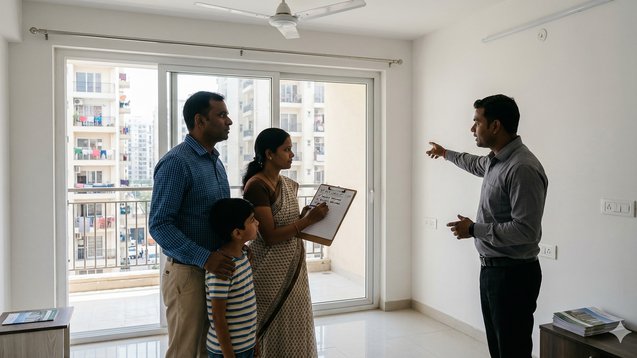
The 3-Visit Rule Before Finalizing a Property
The decision to purchase a house in India requires multiple days of consideration. The home buying process requires homeowners to maintain a savings account while holding discussions with their relatives and obtaining loan approvals and conducting legal investigations, which often requires them to spend multiple years on their home buying project. Many people make property purchases after only one successful property tour, which establishes their first impression of the property. The combination of a well-arranged sample flat and a convincing sales representative and a time-limited promotion creates a sense of urgency. The question at hand refers to which amount needs commitment between ₹50 lakhs and ₹1 crore and amounts beyond that value. The most self-assured customers I encountered during my work in Tier 1 and Tier 2 and Tier 3 markets followed what I refer to as the 3-Visit Rule. The rule requires customers to visit a property three times before they make their final decision about its purchase. The first visit serves as a way to experience emotions. The second visit enables observers to conduct research. The observer needs to assess actual conditions through their third visit. This method ensures that you will make a satisfactory choice whether you search for a Bengaluru apartment or an Ahmedabad villa or a Tier 3 town developed land. Real estate value extends beyond its measurement in square footage and its assessment through price per square foot. People assess their living space based on environmental factors and noise levels and access to public transportation and their neighbourhood's activities and water resources and their ability to sustain their lifestyle throughout their life. The following section will explain how the 3-Visit Rule helps you avoid costly errors.
Visit One: How You Feel About a Home Matters
When you first see a home you might fall in love with it. That's okay. You go into a sample with good lighting. The balcony view is nice. The amenities look great. In cities like Mumbai or Hyderabad you see fancy clubhouses and good security systems. In cities like Jaipur or Coimbatore you might like the big spaces for a lower price. Some projects in towns offer more land and quiet areas. On this visit think about how you feel.
Does the home seem right for you?
Is it good for your family's size?
Does it get sunlight?
Can you imagine living?
But keep in mind. The first visit is meant to impress you. The people selling homes know how buyers think. They show you what they want you to see. So it's okay to feel excited after the visit... But don't pay a deposit yet. Before you decide, make a list of 2-3 homes. Compare them on websites like <a href="https://www.propertyaaj.com">Property Aaj</a>. You can check prices, amenities and area details easily. The first visit is about what could be. Not, about making a decision.
The Analytical Inspection at Visit Two
The second visit is where emotion takes a back seat. You need to prepare yourself with proper equipment for your upcoming visit. You need to bring a checklist for your upcoming visit. Your first visit to the site should occur at a different time than your second visit which should happen during the evening. Multiple hours during the day show different patterns of urban activity. In Tier 1 metros, traffic congestion during peak hours can double commute time. The 20-minute noon drive turns into a 50-minute evening commute at 6 pm. You will see commercial activities in Tier 2 cities which you previously did not notice. In Tier 3 towns, you might observe infrastructure gaps like unpaved internal roads or water tanker dependency. The assessment tests for:
Noise pollution
Water delivery pressure
People wait time for lifts
Accessibility of parking facilities
Sun exposure and heat transmission through buildings
Residents at the site should be interviewed by researchers regarding their equipment which is ready to be used. Residents should be asked direct questions about maintenance problems and water supply reliability. The RERA project registration system needs to be checked for project development status and ongoing construction work at all under-construction sites. RERA implementation shows minor differences between states yet it has improved transparency throughout the country. The verification of timelines needs to be conducted. The second visit transforms attraction into informed assessment.
The third visit establishes actual testing which demonstrates its real-life influence.
The third visit needs to create actual life experiences. The facility needs to be tested during its busiest times. The family members who will use the space need to be present for evaluation. The evaluation needs to take place during monsoon season because it helps assess waterlogging risk which is critical for Mumbai and Chennai and Guwahati. People in Tier 1 cities need to monitor common areas because they experience crowded conditions. The project requires assessment of future development in Tier 2 cities which surround the area.
Are there any empty properties which will transform into commercial buildings?
The assessment of infrastructure development speed needs to include road construction and hospital building and school establishment in Tier 3 towns. The assessment needs to include a new evaluation of financial accessibility.
Your loan eligibility has changed, correct?
The interest rates maintain their current level right?
You can spend between 35 and 40 percent of your monthly income on your EMI payment right?
Different states impose different stamp duty and registration costs. The final acquisition costs require detailed calculation. The third visit should bring reduced excitement to visitors. The property maintains its value after detailed examination which creates a reliable indicator.
Tier 1 Cities. Why One Visit Is Risky
The Delhi NCR and Mumbai and Bengaluru metropolitan areas show how micro-location affects all aspects of their operations. The project appears to be premium but its outside area shows traffic problems and unexpected construction work. Different floor levels and building orientation determine how high-rise apartments receive sunlight. The demand for rental properties changes according to different sections of the area. A building near metro access in Hyderabad may command strong rental yield, while one 1 km away struggles. Investors who want to make capital investments in Tier 1 markets must make high-value investment choices. The expenses of making errors require more financial resources to fix. The three visits let you record actual demand and occupancy rates and identify the specific types of incoming residents who will move in — young professionals and families and investors. The need for caution increases as prices reach elevated levels.
Tier 2 Cities are really great because they are affordable and the prices might go up.
Tier 2 Cities like Indore, Nagpur, Surat and Lucknow are getting bigger fast. For Tier 2 Cities to really grow they need good infrastructure like new highways, industrial parks and IT corridors. When you visit Tier 2 Cities for the third time you should check if these infrastructure projects are really happening. Do not just believe what the people selling the properties say. Look at the notices from the city government. Talk to the people who have shops in the area. See the road widening work for yourself. People who buy properties in Tier 2 Cities often do it because they think the price will go up. This is an idea but only if the infrastructure projects are going to be finished on time. You can find information on the Property Aaj website at https://www.propertyaaj.com to compare what is happening in different areas before you make a decision.
Tier 3 Markets: Community and Essentials Matter More
The primary need for Tier 3 markets exists because community needs and essential services require fulfilment. The people who purchase property in Tier 3 cities do so because of their preferred lifestyle instead of their financial investment plans. Your third visit needs to assess essential services which include:
Water supply reliability
Power backup
Healthcare facilities which can be reached by walking
Grocery and daily convenience
Small operational problems in social infrastructure areas which have not yet completed their development stage will lead to more serious problems that people face every day. People who buy properties in Tier 3 towns display a buying pattern which shows they look for their family needs over their personal preferences. The price growth occurs at a gradual pace but maintains its constant upward trend. The three visits will help you find essential requirements which you might miss because of your excitement about the low price per square foot. Organizations use affordable solutions to cover their operational deficiencies. The truth comes to light through multiple visits.
Legal and Documentation Checks When You Visit
The 3-Visit Rule is not about physically going there. It is also about following a process. During your third visit ask for copies of:
Title deed
RERA registration certificate
Approved building plans
Occupancy certificate (for properties that're ready)
RERA websites vary from state to state but they show project status and complaint history. For properties that are still being built make sure the construction progress matches what you are paying. Getting pre-approved for a home loan also gives you power when negotiating. Three visits give you time to do these checks without rushing because of offers that are only available, for a short time.
Negotiation Power Improves With Multiple Visits
Here's something interesting:
buyers who visit times negotiate better.
They look serious but not desperate.
Sales teams know impulse buyers can be pushed.
Buyers who think carefully earn respect.
By the visit you know:
pricing trends
how much inventory is left unsold
what's happening with competition
If a project is selling at a moderate pace you might be able to negotiate the price. Get extra benefits like:
no extra charges for floor rise
a free modular kitchen
Use time to your advantage.
Before you make your decision check similar listings on Property Aaj to make sure you're not paying too much.
The Emotional Balance: Trust Your Gut. But Verify
After you go to a place three times something changes. You are not excited anymore, you are calm and quiet. When you are calm you make better decisions about real estate.
Do you still like the property after you look at it carefully?
Do you think you can handle the problems?
Does the plan for paying for it feel okay, not too expensive?
If the answer is yes then you can go ahead. Do it with confidence. If you still have doubts then it is better to leave it. The real estate market in India is really big. It includes cities like Tier 1 metros, new cities like Tier 2 hubs and small towns like Tier 3 towns that are growing. There are chances to buy property. Feeling sad, about what you chose's not necessary.
Conclusion: Three Visits, One Confident Decision
The 3-Visit Rule exists to help people make important life choices with better decision-making abilities. The first visit shows you the love of your life. The second visit requires you to conduct an investigation. The third visit allows you to experience actual life situations. Market conditions show different results throughout India. The various states of India have distinct differences in their pricing systems, infrastructure development, rental market patterns, and legal information accessibility. Human behaviour remains constant through time. People tend to move quickly when they experience urgent circumstances. Three planned visits to your business site decrease emotional bias while increasing your ability to negotiate and safeguarding your investment over time. You should combine on-site property inspections with property research from Property Aaj during your property assessment throughout India to make a decision based on comprehensive knowledge from both actual experience and research findings. The home should create a state of calmness which eliminates any possibility of having doubts.
FAQs
1. Is it really necessary to visit a property three times before buying?
Yes, especially for high-value purchases. The first visit fails to disclose all traffic patterns and noise levels and neighbourhood activity that require assessment during multiple times of the day. It decreases the possibility of making unplanned buying choices.
2. Should I follow the 3-Visit Rule for under-construction projects?
Absolutely. The assessment should proceed with location evaluation and evaluation of nearby facilities and construction progress at various stages. The RERA registration and construction milestones need careful verification.
3. How much time should I keep between visits?
The ideal time between two visits for a person should range from three days to ten days. The period provides you with sufficient time to assess different options and review financial information and verify documents while maintaining your ability to negotiate.
4. Does this rule apply to Tier 3 cities as well?
The answer is yes because essential services and infrastructure deficiencies in smaller towns require more detailed examination. Multiple visits help assess long-term livability more realistically.
5. Can I negotiate better if I visit multiple times?
The answer is yes because repeated visits show your serious intentions while they provide you information about stock availability. The information you gain through multiple visits improves your ability to negotiate.
6. What should I do when I still feel confused after visiting three times?
The situation requires a break because real estate choices need to provide complete assurance instead of making you feel compelled. You should evaluate comparable properties and determine your financial comfort level before making any further progress.