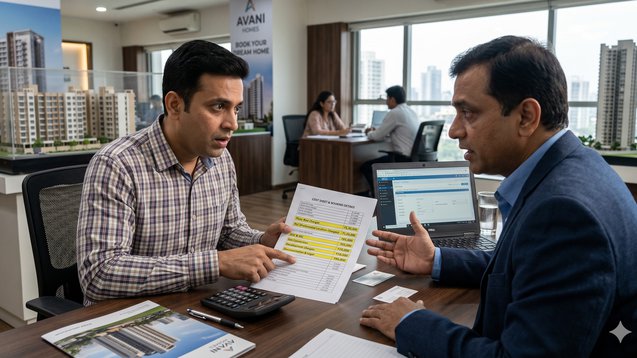
Hidden Charges Builders Don’t Tell You About
Introduction:
When you decide to purchase property in India, the first figure which attracts your focus is the fundamental cost. The price appears to be reasonable yet it sometimes shows an appealing quality. You establish your financial limits then assess your capacity to obtain loans while imagining your upcoming life in that residence. The unexpected development occurs when multiple extra costs begin to emerge thus the complete expenses exceed all initial projections. This situation presents problems for Indian homebuyers who want to purchase either a luxury apartment in Mumbai or a standard flat in Nashik or a low-cost residence in a Tier 3 town. Builders rarely present the full financial picture upfront. The actual expenses remain hidden because the developers choose to disclose some information later while they keep some details secret through small print. Take a simple example. The total expenses for a ₹60 lakh flat will increase to between ₹70 and 75 lakh after all additional charges have been calculated. The financial gap between two pricing options creates major economic difficulties for new homebuyers who enter the property market. The Property Aaj platform (https://www.propertyaaj.com) assists users in collecting information about properties but your primary advantage remains your understanding of the market. The hidden charges exist as operational costs which require our examination through straightforward methods to establish their expected value and required preparations.
Preferential Location Charges are something we should know about when we are buying a house.
We have all seen that the flats on the corner or the ones that face the park are more expensive. This is because of the Preferential Location Charges. The people who build houses charge money for the houses that are in a better position. This means that if you have a view of the garden or a balcony that faces the road you will have to pay money. Even if you are close to things like a clubhouse you will have to pay more. In cities the Preferential Location Charges can be very high because a lot of people want to live there. The cities are also very crowded. In cities the Preferential Location Charges are becoming more common. This is because the people who build houses are trying to sell us a kind of lifestyle. For example if you are buying a flat in Pune and it has a view of the garden you might have to pay ₹200 to ₹500 more for each foot. This is more than what you would pay for a flat. So what should we do when we are buying a house? We should ask the builder if we have to pay the Preferential Location Charges and how they calculate it. Sometimes the extra money we pay does not make sense because the flat is not that much better.
Floor Rise Charges: The Higher You Go, The More You Pay
This is another classic add-on. Builders charge extra for apartments on higher floors, typically starting from the 3rd or 5th floor onwards. Floor rise charges serve as a cost element which burdens residents in metropolitan areas such as Bengaluru and Gurgaon who choose to live in high-rise buildings. The smaller cities experience reduced effects but new construction projects still demonstrate their presence. For example, if the floor rise charge is ₹50 per sq ft per floor, a 1,000 sq ft flat on the 10th floor could cost ₹3.5 lakh more than one on the 3rd floor. Tip: You should assess whether the advantages of improved sightlines and decreased sound levels provide sufficient value to justify the additional expense
Clubhouse and Amenity Charges
Modern residential projects heavily promote lifestyle amenities clubhouses, gyms, swimming pools, landscaped gardens. But these amenities do not come as part of the basic package. Builders require customers to pay extra fees when they want to use these facilities. In Tier 1 cities, this charge can run into lakhs, especially in premium projects. In Tier 2 cities, it’s becoming standard practice even for mid-range housing. Reality check: You need to evaluate how frequently you will make use of these amenities. Many buyers pay for facilities they rarely use. Platforms like Property Aaj (https://www.propertyaaj.com) allow you to compare projects and understand whether these charges align with market norms.
Parking Charges: Not Always Included
Often assumed but not guaranteed, sometimes parking fees aren’t included in the price you agreed to pay; this can happen for various reasons such as location. Most metro areas sell you additional space for parking after the home sale has occurred, whether it be covered, garage or multiple-socket parking; this can cost an additional ₹2-10 lacs or more, depending on the metro area metro size and density. For Tier 2 & Tier 3 cities, most homeowners will have access to free on-street parking spaces but will also pay an additional amount for a covered parking space if desired. A general guideline that exists under law is parking spaces define legally permitted characteristics but there is considerable variation in how this applies to prices charged for these parking spaces. In any case before entering into any agreement relating to the purchase of a dwelling you need to verify both the quantity and price of parking spaces available/ included in the contract.
Maintenance Charges (Advance Maintenance)
Maintenance Charges, which is also known as Advance Maintenance is something that builders usually ask for when you move into your home. They want you to pay for 1 or 2 years of maintenance upfront. This money is used for taking care of the areas, security and basic services that you need. In cities like Mumbai or Hyderabad the maintenance charges can be very high because these projects have a lot of amenities. In smaller cities the charges are lower. However you still have to pay them. For example if the monthly maintenance charge is ₹4 per foot and you have a 1,000 square foot flat then you have to pay ₹4,000 every month. That is ₹48,000, per year which you have to pay in advance for Maintenance Charges.
Legal and Documentation Charges
Builders demand additional payments for legal documentation and agreement drafting and processing fees even though you are purchasing the property. The individual charges appear minor yet their total cost accumulates. The first tier cities maintain fixed pricing systems while the second and third tier markets show significant price differences based on builder selection. What to do: The developer should provide a complete cost breakdown because this test shows their trustworthiness. You can verify the information through Property Aaj (https://www.propertyaaj.com) listings which provide enhanced understanding.
GST and Government Charges
Goods and Services Tax applies to properties that are still being built. The GST rates depend on the type of property and what the government decides. There are also charges like stamp duty and registration fees that you must pay. These charges are different, in each state. For example:
Maharashtra: The total charges are 5 to 7 percent.
Karnataka: The range is similar.
Some states give discounts to women who buy properties. People often forget to include these charges when planning their budget even though they are not secret.
Power Backup, Water, and Infrastructure Charges
Builders are allowed to charge separate fees for essential facilities which include:
Power backup systems
Water connection
Sewage treatment plants
In Tier 1 cities, these items get combined into one package but the final bill shows them as separate components. The absence of municipal backing in developing areas results in increased infrastructure expenses. Advice: You need to know which items come with your purchase and which items require additional payment. Your living experience will depend on the quality of the infrastructure present.
Cost of Customization and Interior Modifications
Some builders allow customization options for various items such as floor coverings, cupboards, and kitchen cabinets. However, these items are not normally included in your basic purchase price. The costs of customizing or modifying items on your new property can be significant, particularly with high-end projects. In lower-cost homes, the cost of basic options can be outrageous. For example: For example, the cost of a modular kitchen upgrade can be between ₹1 lakh and ₹2 lakh depending on the specifications requested.
Delayed Possession Charges (Indirect Cost)
Delayed Possession Charges are like a cost that you do not see at first.. They can really affect your money. If the builder is late with giving you the house you will have to pay rent and EMI at the time. This can be a problem. Even though RERA is making builders more responsible, delays still happen, in smaller cities, like Tier 2 and Tier 3 cities. What to check: Make sure the agreement says what will happen if the builder is late and that you get some money back if they are.
Corpus Fund and Society Charges
When you get the keys to your home the builder will ask you for a Corpus Fund. This Corpus Fund is for taking care of the building and making a Society. The Corpus Fund is something you pay once but it can be a lot of money. It can be ₹50,000 or it can be ₹2 lakh or even more. In housing societies, with gates the Corpus Fund is really helpful because it helps keep the roads and other important things in good condition for a long time and that is why we need a Corpus Fund.
Conclusion:
The price tag on the house may not be as simple as it first appears. Hidden fees are not always hidden; however, in many cases, they are not made clear either. Ultimately, having knowledge of all the costs associated with purchasing a home will help you to avoid a stressful financial outcome compared to purchasing the same home without any prior knowledge of the cost. Regardless of whether you are buying in a Tier 1 metropolitan area or a small town, the same principle applies: get a complete breakdown of what it will cost you to buy a home. Do your research on each of the costs on the itemized list you receive, and then compare that list to other builders’ costs for the same itemized list. There are some internet sites, such as Property Aaj, which can assist you by providing additional transparency for home buyers. However, even with the internet tools available to buyers today, you will ultimately be responsible for being diligent about the accuracy of the information provided to you by your builder. At the end of the day, you don’t want to just purchase a house, you want to purchase a house without any surprises.
FAQs
1. What are the most common hidden charges in Indian real estate?
The common charges for real estate properties include parking fees and maintenance deposits and clubhouse charges and floor rise charges and PLC. These expenses have the potential to raise total property expenses to substantial levels.
2. Are hidden charges legal in India?
Yes, Most charges become legal when their details receive proper disclosure according to Indian law. The issue arises when they are not communicated clearly upfront.
3. How can I avoid paying unnecessary charges?
Always request a detailed cost sheet and compare multiple projects. The process also allows for negotiation in certain situations according to the contract terms.
4. Do all builders charge PLC and floor rise fees?
The practice exists in modern developments yet it appears most frequently in metropolitan areas and Tier 2 cities.
5. Are maintenance charges refundable?
Advance maintenance payments remain non-refundable because they function as maintenance funds for building upkeep.
6. Should I rely only on the builder’s cost estimate?
The accuracy of your information requires verification from both independent sources and the website Property Aaj which you can access at httpswww.propertyaaj.com.