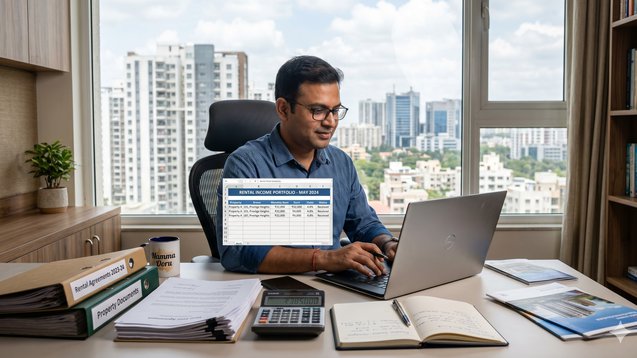
How to Earn Passive Income from Real Estate
Introduction:
Indians invest in real estate because they seek stable income which provides them predictable cash flow. Not everyone is chasing quick profits or flipping properties. Many simply want a reliable monthly cash flow that grows over time. That’s where passive income from real estate comes into play. But let’s be honest for a moment. Property passive income requires active management which people must maintain throughout time. The process needs proper planning from the initial stage because people must select appropriate property and location and rental methods. The system has the ability to produce enduring financial security when used correctly. The system becomes an ongoing problem when used incorrectly. India demonstrates different regional patterns because its various regions operate with distinct characteristics. The major cities of Bengaluru and Mumbai experience high rental demand which comes at expensive entry fees. The cities of Indore and Jaipur in Tier 2 show investors attractive yields which exceed their expectations. The third-tier towns provide businesses with dependable rental income streams even though property values increase at a slower rate. What steps should you take to generate passive income through property investments? We will explain the process through practical examples which operate successfully in the current Indian market.
Understanding What Passive Income Really Means in Real Estate
Before we start talking about strategies we need to be clear about what we're getting into. Passive income from estate usually comes in two forms:
Rental income which is the money you get every month
Capital appreciation which is the money you get after a long time
Most people only think about the rent they get.. The real benefit of passive income from real estate is when you have both rental income and capital appreciation. For example a 2BHK in a developing area of Pune might get you ₹15,000 every month as rent. This is okay, but not great.. If the area develops well the value of your property could be twice as much in 8 to 10 years. In cities like Tier 1 cities the rent you get is usually lower, around 2 to 3 percent but the value of the property can go up a lot. In cities like Tier 2 cities you can get around 4 to 6 percent rent, which is good for people who want to make money from rent. The main thing is to be clear about what you want: are you trying to make money with passive income from real estate or are you trying to make wealth for later with passive income, from real estate?
Rental Apartments, The Most Reliable Income Source
This is the most straightforward approach and still one of the most effective. Purchasing a residential property and leasing it to tenants generates consistent monthly revenue. The cities of Bengaluru, Hyderabad, and Pune experience high rental demand because IT professionals work in those areas. The demand for housing has increased in Tier 2 cities like Lucknow and Coimbatore because of their expanding job markets and growing educational institutions. A buyer purchases a ₹45 lakh 2BHK in a suburban area. The monthly rent between ₹12,000 and ₹18,000 enables tenants to pay most of their monthly loan repayments. The trick is location selection. The distance from offices and schools and hospitals and transport hubs determines how much people want to rent a property. Property Aaj (https://www.propertyaaj.com) provides platforms which enable you to find rental-friendly areas throughout different cities, thus enhancing the accuracy of your investment prediction.
Commercial Properties. Higher Returns, Higher Risk
If you want rental income you should think about commercial real estate. Shops, offices and small retail spaces can give you money. Sometimes 6-8% each year. In cities small shops in busy areas can make a lot of money. These areas are usually near where people live or near buses and trains. There's a problem though. If people don't want to rent you might have spaces for a long time. In cities it's hard to get in because prices are high and lots of people want to invest. In cities it depends on how well the local economy is doing. This is a choice if you know the market and are okay with taking a bit more risk, with commercial properties. You need to understand that commercial properties can be tricky.
Co-Living and Shared Rentals Maximizing Yield
The following section contains the first major development of the project. You can use the property as a rental unit by giving individual rooms to multiple tenants instead of renting it to one family. The practice exists as a standard method of operation in Bengaluru and Pune and Gurgaon. The 3BHK unit generates more profit through three working professionals than it does through renting to one family. The system has started to develop around educational institutions and commercial centers in Tier 2 cities.
The advantage? Higher returns.
The disadvantage? Increased operational responsibilities.
The practice enables investors to achieve more passive income by delegating property management to co-living companies. The rental strategy will succeed if it is implemented correctly because it generates better results than standard rental methods.
Short-Term Rentals and Airbnb-Style Income
Tourism-driven locations provide another opportunity for generating passive income through their tourism-based business activities. The holiday destination properties which include Goa and Lonavala outskirts and Himachal regions allow property owners to earn money through their short-term rental business operations. The daily rental rates of short-term rentals exceed those of standard long-term rental agreements. The business generates seasonal revenue because peak months produce high profits whereas the off-season period experiences low customer demand. The business model operates effectively through Tier 1 cities which contain business travel centers. The system functions in Tier 2 and Tier 3 areas when tourism levels increase. The investment choice operates effectively for investors who accept variable earnings and need to manage their business operations.
Long-lasting Gain through Real Estate Development
Plots may not have monthly rents associated with them, but they are essential to building passive wealth. Over time land becomes more valuable (especially in developing areas). In cities such as Nagpur/ Ahmedabad / and Lucknow; due to infrastructure developments such as highways and development of industrial districts, land values have risen dramatically over the past several years, as well as numerous other cities. In tier 3 towns, you may have to invest less money in order to purchase a plot. This type of investment takes time for you to see a return on your investment however the returns will be very high compared to other investments with higher risk but much lower return. Therefore consider this investment as a good investment that does not produce a "silent income".
REITs Passive Income Without Property Management
REITs offer people who want passive income streams without needing to manage their own real estate properties. Some people prefer to avoid managing rental properties because they do not want to handle tenant problems and building maintenance work and legal documentation needs. Real Estate Investment Trusts (REITs) provide a solution to this problem. Through REITs, you can invest in commercial real estate because they let you receive rental income from office buildings and shopping centers without needing to possess physical assets. The popularity of REITs is increasing in India because urban investors show growing interest in these investment vehicles. The assets provide investors the ability to buy and sell them like stocks while their value stays lower than what direct property ownership requires. People find it easier to manage their investments because they can achieve tax advantages through their ownership of direct property.
Choosing The Right City for Passive Income
The city you choose is very important. It is not just about the city itself. In cities you should look at small areas that have a lot of new jobs. A lot of people want to rent homes in these areas. The money you can make from renting is not very high. In cities you can get a good balance. You can get money from renting and your home might also increase in value. In smaller towns you should look at areas that have a steady demand for homes. This can be near government offices or schools or local shops. People who want to buy or rent homes think differently in cities. People in cities want homes that are convenient and have a nice lifestyle while people in smaller cities just want homes that are affordable and have enough space. You can use websites, like Property Aaj to see what is happening in cities and find the right place to invest in a home. You can visit their website at https://www.propertyaaj.com.
Utilizing Financial Resources Wisely in Order to Maximize Returns:
Many investors do not use leverage (borrowing funds) for investments; however, when done correctly, using leverage may actually lead to higher returns than not using it. If you have enough rental income to offset most or all of the payment on a mortgage (EMI), this means you are building an asset (property) with some funds borrowed. This is very common in major metropolitan areas (tier-one) where properties are very expensive; however, this may be less common in secondary markets (tier-two) since the prices are lower and can be managed more comfortably on an EMI basis. Do not take on too much debt as an investment; however, be sure you have enough money to service the debt payment even if there is no income received because of a vacancy. A traditionally conservative, balanced approach to borrowing is the most successful strategy.
Making Things Safe and Steady
Passive income is only good if you can control the risks. If you have problems with tenants, big repair bills and trouble with the law it can hurt your income. Smart investors do these things:
They pick properties that they know are good
They save money for emergencies
They check tenants carefully
They keep all their papers in order
You can use websites like Property Aaj (https://www.propertyaaj.com) to help make things safer. They show you properties that're real and give you information about what is happening in the area. It is better to have income than to try to get a lot of money all at once. Property Aaj and other similar websites can really help with this. Getting income from Property Aaj is what smart investors like about it.
Conclusion:
Real estate investors in India generate passive income through consistent decision making based on research rather than following short term market movements. Every option, which includes rental apartments located in developing suburban areas and small commercial shops situated in busy marketplaces and REIT investments, provides its unique benefits. The actual inquiry revolves around selecting options which match your personal financial objectives and your way of living. Rental properties hold the key to generating consistent monthly cash flow. Investors should create a combination of rental income and property value growth for their long-term investment strategy. REITs and managed rental models provide users with simple investment options which require less effort to handle. The Indian real estate market provides investment possibilities throughout Tier 1, Tier 2 and Tier 3 cities which require you to make proper selection. Property Aaj (https://www.propertyaaj.com) serves as a trustworthy platform which helps you make better decisions through its information resources. True passive income requires people to put in active work during their initial stage which helps them develop future financial benefits through their investments.
FAQs
1. What is the best way to earn passive income from real estate in India?
Rental properties serve as the most dependable and standard method to generate income through real estate. The rental earnings from commercial spaces and co-living models depend on the specific location and market demand for those properties.
2.Which cities provide the most profitable rental income possibilities?
The Tier 2 cities in India deliver greater rental returns than Tier 1 cities, which provide superior property value growth over time. Your investment objective determines which option you should select.
3. Is real estate truly passive income?
The statement lacks accuracy because real estate generates consistent revenue yet requires some management work. The income stream becomes mostly passive for investors who establish proper systems or choose to delegate their operations.
4. Are REITs a good alternative to property investment?
Yes, especially for those who want lower investment and no management hassle. The company offers investors two main benefits through its distribution of dividends and its ability to sell shares on the stock market.
5. How money do I need to start earning from renting out a property?
It really depends on the city you're in. If you are in a city you can start with ₹30–50 lakhs.. In big cities like metros it costs more to get started.
6. What are the risks I should think about with income from real estate?
There are risks to consider. One is that the property might be empty for a while. You might also have problems with tenants. Then there are costs, for maintenance and legal issues. If you plan carefully and choose investments you can reduce these risks.