Introduction
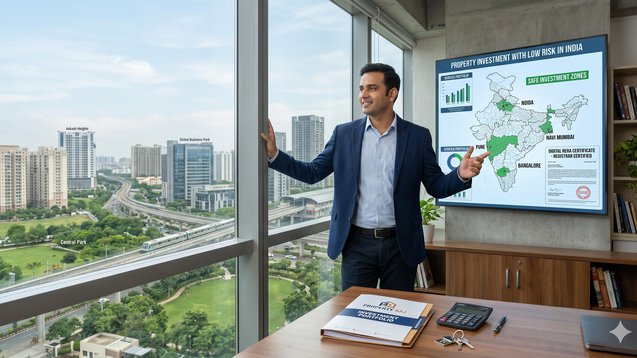
The Indian real estate market functions as a high-stakes chess match in which both experienced investors and new homebuyers must use their skills to overcome its difficult challenges. The year 2026 marks a new period which has ended the speculative "Wild West" times that existed during the early 2000s. People use real estate today to create permanent family wealth which protects their monetary assets while generating steady financial gains. Major metropolitan areas experience price increases while various "emerging hotspots" receive daily promotional claims which create difficulties for you to identify the actual market trends. The process of low-risk investing in India requires you to select assets which possess a strong "moat" protection. RERA operates as the official regulatory authority which controls market development activities at Property Aaj (https://www.propertyaaj.com) which we have observed from its beginning until now. The infrastructure development which has occurred in Tier 2 cities like Indore and Kochi now enables them to match Tier 1 cities regarding their better infrastructure capabilities. The secret to low-risk property investment in India lies in a balanced approach: combining the stability of established micro-markets with the growth potential of developing suburbs. This guide serves as a resource which enables you to develop an "investor's lens" that will help you identify secure investment locations throughout India. The process of constructing secure permanent wealth through Indian soil requires us to investigate its operational elements.
The Golden Rule: Stick to RERA-Compliant Grade-A Developers
The Indian real estate sector faced its biggest threat from project delays during earlier times. RERA implementation has reduced risks for 2026 but the danger still exists. The safest choice for an investor involves choosing developers who maintain perfect project delivery records. The importance of this matter stems from how Grade-A developers who operate through major national companies such as Godrej Tata and DLF deliver more than just apartments to customers. These companies have access to institutional funding which ensures their projects maintain smooth cash flow operations. When you invest in a branded project, you spend extra money but use it as protection against legal disputes and project delays. Branded developers in Tier 1 cities such as Mumbai and Bengaluru charge 15-20% more than local developers, yet branded projects provide superior resale value. Who do you believe will sell their property more rapidly between the Tata apartment and the Sunrise Builders apartment? A brand name provides protection for investors when they sell their products in secondary markets.
The "Path of Progress" Strategy: Follow the Metro and Highways
Ready-to-Move vs. Under-Construction: Balancing Risk and Reward
A "Ready-to-Move-In" (RTMI) property serves as the most secure investment option in India. The reason for this statement exists because the property shows its complete value. The property provides total protection because it has no construction hazards and its balcony view safety remains dependable and the customer saves money because they do not have to pay GST charges. The 2026 mature market environment has reduced the price difference between under-construction and ready homes which makes RTMI highly appealing to risk-averse investors. The under-construction projects by top-tier builders still offer investors early-bird appreciation. The project needs to establish its "Possession Timeline." A project that is 70% complete offers building security because more than half of the work exists because the project still has construction activities. The website Property Aaj (https://www.propertyaaj.com) directs users to find projects which have completed their "topping out" ceremony. The property costs more than its initial launch price yet you have removed three years of "will-it-happen" anxiety. RTMI serves as the only safe investment option for Tier 3 cities because their developer quality does not guarantee security.
The Tier 2 Renaissance: High Stability at Lower Entry Points
People should choose Tier 2 cities as an alternative when the ₹2 crore entry fee for Mumbai and Gurugram proves too expensive for them. Chandigarh and Ahmedabad and Kochi have developed into areas that provide stable living conditions for their residents. The locations provide excellent living conditions together with extensive IT and manufacturing employment opportunities but their main advantage lies in their affordable entry costs. The purchase of a prime 3BHK property in Indore at ₹80 lakhs presents fewer risks compared to acquiring a small studio apartment in a Mumbai suburb which costs the same amount. The buyer psychology in Tier 2 cities is rooted in "End-Use." People actually live in these homes; they aren't just empty shells held by speculators. This approach helps to maintain a vibrant rental market. The hybrid work model will cause many professionals to return to their hometowns in 2026 while they continue to demand Tier 1 rental standards. The process of "reverse migration" has established a minimum property valuation for smaller cities because it guarantees that your investment is supported by actual local market demand instead of market speculation.
Commercial Real Estate: The Yield Play through REITs
The term "Real Estate" refers to a flat or a plot of land according to most people. But the lowest-risk entry into high-value property today isn't a physical home it’s a Real Estate Investment Trust (REIT). You can purchase a REIT "unit" which owns the office space but you need at least ₹10 lakhs to invest because you cannot buy an office space in Bengaluru's Embassy Manyata. This is the ultimate low-risk move for someone who wants exposure to Indian real estate without the "legal headache" of managing tenants and property taxes.Indian REITs operate under strict regulations which require them to pass 90% of their taxable earnings to their shareholders. The company possesses Grade-A commercial properties which are used by international corporations including Google and Amazon and Microsoft. The rental income generated from this asset provides more stable cash flow compared to typical residential properties. A tenant in a residential unit can vacate their room at any time while a multinational company has signed a 9-year lease for the REIT-owned office space. The 2026 investment model allows investors to create a "set-and-forget" strategy that requires no active work.
Legal Due Diligence: The "Silent" Risk Mitigator
The existence of a "clouded title" prohibits all attempts to establish property value through infrastructure development. The most common low-risk mistake is skipping a thorough legal check. Indian land titles still maintain their presumptive nature which exists until proven otherwise. The law requires you to trace property ownership back to 30-year boundaries. Has the land been converted from agricultural to non-agricultural (NA)? Is there a clear "Encumbrance Certificate"?The legal requirements in different states show major differences from each other. The calculation method for "Stamp Duty" in Maharashtra uses different procedures than "Circle Rates" operate in Delhi. The majority of states in 2026 have adopted "Digital Title Deeds" but manual verification processes remain the primary method. Property Aaj (https://www.propertyaaj.com) recommends that clients should hire an independent lawyer who works outside Builder services to check the "Title Search Report." The legal report establishes a foundation which supports low-risk investment activities. The absence of this document makes your activities resemble gambling instead of investing.
The Resilience of Affordable Housing
The affordable housing segment in India maintains its status as "recession-proof" because it survives all economic downturns. The government’s "Housing for All" initiative has created a permanent supply-demand imbalance in properties that cost less than ₹50 lakh. People require basic housing throughout all economic conditions which include times of economic growth and periods of economic stagnation. The Affordable housing segment presents minimal risk to investors who seek rental income. In Tier 1 areas beyond main cities such as Karjat (MMR) and Sohna (NCR) developers from established companies develop affordable housing projects which achieve high occupancy rates. The Indian middle class maintains continuous demand for affordable flats which stand in contrast to luxury apartments that remain vacant during economic downturns. First-time buyers can enter the market because they face low entry prices and government interest subsidies while they enjoy high exit liquidity. The market for ₹35 lakh flats remains active at all times but the same cannot be said about ₹5 crore penthouse properties.
Plots vs. Apartments: Which is Riskier in 2026?
The principle "Land is gold" has existed since ancient times, but in 2026 land without a fence becomes a liability. The dangers which affect developed plots include "encroachment" and "title disputes." The existence of "Branded Plotted Developments" has transformed the industry. Many large developers now sell "RERA-registered plots" within gated communities. The combination enables land to appreciate at a high rate while providing security that comes with an apartment complex. The plot investment in a Tier 3 city may provide 20% annual returns but presents high danger for investors who do not reside near the property. The Tier 1 city apartment provides security through immediate rental income although its value increases at a lower rate of 6-8%. We suggest branded plots located in satellite towns as the best investment option for investors who want to minimize their risk. You can experience land-ownership rights without worrying about unauthorized construction activities on your plot during your absence. This method represents the contemporary approach to landownership in India.
Home Loan Trends: Using Debt to Lower Your Risk
The process of obtaining a home loan actually decreases your investment risk according to the research that studies this relationship. The bank requires its legal department to perform extensive evaluations which determine whether the project receives loan approval. The financial institution which designates a project as "APF" (Approved Project Finance) through its authorization process works to protect its funding interests. The banking system presents "flexible" repayment methods to its customers because interest rates reached their stable point during the year 2026. The home loan operates as a secondary auditor for investors who want to take minimum investment risks. You should reject the project because the bank denied it. The tax advantages from Section 24 and 80C still provide direct interest rate reductions which decrease the "effective" interest rate according to the current tax benefits. The method of using bank funds to acquire a secure asset enables you to stay protected while building wealth because it keeps your personal financial risk at its lowest point.
Rental Yields: The "Real" Income of Real Estate
The rental returns from residential properties in India have remained low at 2 to 3 percent until 2026. The yield from student housing and co-living spaces and senior living facilities has reached 4 to 6 percent. These residential assets function as specialized housing which serves particular demographic groups. Investors can purchase properties close to major university hubs and IT corridors and transform them into co-living spaces which provide them with low-risk investment opportunities that generate monthly cash flow. The "Student-Tenant" has established itself as a permanent presence in Pune and Manipal and Greater Noida. The students need to be near their college which makes them uninterested in market changes. You can achieve property occupancy which lasts without interruption by focusing on these "high-demand clusters." High occupancy serves as the most effective method to minimize risks associated with rental homes. At Property Aaj (https://www.propertyaaj.com) we recommend that investors first examine the "Micro-Market Demand" before they assess the "Floor Plan." The 1BHK apartment located in a college hub area provides more security as an investment than the 3BHK apartment located in a quiet residential area.
Conclusion: The Future of Your Investment
The process of making a secure property investment in India continues for a long time because it requires ongoing dedication. The process demands two essential qualities which include discipline to avoid "get-rich-quick" schemes and the ability to wait for infrastructure development to reach its full potential. Your decision to concentrate on Grade-A developers RERA compliance and transit-oriented corridors demonstrates that you are making an excellent choice which will support India's economic development. The essential requirement for both a high-yielding REIT investment and a ready-to-move apartment purchase and a branded plot acquisition on the outskirts of a Tier 2 city is that you must keep yourself updated and protected through legal channels. The most dependable and material asset class in Indian portfolios remains real estate. The demand for high-quality residential properties and commercial office spaces will grow as the nation progresses toward its $5 trillion economic goal. Use Property Aaj (https://www.propertyaaj.com) as a platform to monitor micro-market developments while evaluating different alternatives yet your ultimate choice should depend on data and thorough investigation. The safest investment in property acquisition lies in the property which you have investigated the most thoroughly. Wishing you successful investment ventures!
FAQs
1. Is it safe to invest in under-construction projects in 2026?
Yes, but only if the project is RERA-registered and developed by a Grade-A builder with a proven track record. But for minimizing risk, opt for projects, having completed at least 50-60% construction. Never buy “pre-launches” from unknown developers – this is where the highest risk of delay and litigation lies.
2. How do I verify the "legal health" of a property independently?
Always ask for the “Title Search Report” (TSR) for the last 30 years and the “Encumbrance Certificate” (EC). Also, check whether the project has a valid ‘Commencement Certificate’ (CC) and whether the land is certified ‘NA’ (Non-Agricultural). Hiring an independent lawyer to verify these documents with the matching files held by the local sub-registrar is highly recommended.
3. Why are Tier 2 cities considered lower risk than Tier 1 for small investors?
The second-tier cities have lower entry prices leading to less dependence on massive loans to over-leverage oneself. Second, there is a higher “real” demand from local residents, which keeps the rental and resale market sane. Some Tier 1 micro-markets can be observed to be drawn into speculative bubbles that are prone to price corrections.
4. What is the minimum amount needed to start a low-risk real estate investment?
The minimum investment requirement for entering a low-risk real estate investment starts at ₹10,000 and extends to ₹25,000 through REITs which use Real Estate Investment Trusts and through Fractional Ownership platforms. The minimum investment requirement for low-risk affordable housing in satellite towns or Tier 2 cities begins at ₹25 lakhs and reaches up to ₹35 lakhs.
5. Does RERA guarantee that I will get my flat on time?
RERA establishes building delivery requirements which builders must fulfill but the law does not provide absolute delivery guarantees. The law requires builders to face severe penalties when they fail to deliver projects on time while builders must maintain 70 percent of project funds in escrow accounts. The law prohibits developers from using your funds for different projects which leads to a major decrease in project delay hazards. The official RERA website should be used to verify the developers complete history of past projects.
6. How does "Infrastructure" help in reducing investment risk?
Infrastructure projects such as metros and highways and airports create ongoing demand that persists throughout their entire operational lifespan. People will continue to choose residential locations near metro stations and major expressways because this tendency exists. Your investment maintains its value because intrinsic demand establishes a minimum property price.
Read more about property matters with our specialists and browse the latest property listings on Property Aaj. Download the app from the Play Store and App Store now for easy buying, selling, and renting!