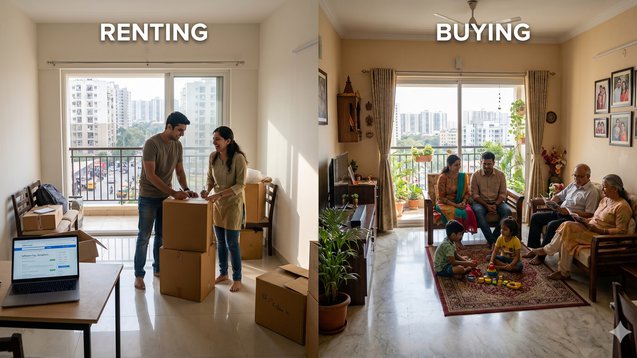
Renting vs Buying, Lifestyle Comparison
Introduction:
The question of whether people should rent their homes or buy them will produce different answers from each of ten Indian people who will present their arguments as valid. The financial aspect of this decision needs to be combined with its personal dimension which originates from lifestyle choices and career paths and family expectations and emotional comfort needs. The high property expenses in Mumbai and Bengaluru and Delhi have forced residents to rent properties as their only viable housing option. The residents of Indore and Nagpur and Coimbatore still view home ownership as a typical life achievement. The real question requires you to determine which present-day solution matches your current way of life more than your future financial objectives. A rental agreement will provide an IT worker from Pune with the flexible housing option that he needs. The family in Jaipur will choose to purchase a home because they require permanent housing. Both options present valid solutions. The essential point requires you to identify all advantages and disadvantages which exist between two choices. Property Aaj (https://www.propertyaaj.com) enables users to search for properties across various cities and different budget ranges and multiple property categories which helps buyers and tenants reach better decision-making. The comparison between renting and buying requires us to assess both aspects because our decision needs to include various financial elements between EMI payments and rent expenses. Your choice of lifestyle determines your decision.
The Flexibility Factor measures the balance between Freedom and Commitment.
The primary distinction between renting and buying a property creates a fundamental difference in lifestyle flexibility between these two housing options. Renting allows you to live anywhere because your lease agreement does not restrict your residence. You can move to a different city for better job opportunities or relocate to work or find a better place to live without having to sell a property. This which enables people to change jobs easily through their current location work becomes essential for residents of Tier 1 cities. A marketing professional who moves from Gurgaon to Bangalore will find that renting enables them to transition between the two locations without obstacles. Buying a property requires customers to make a permanent commitment that lasts throughout their entire life. Your ability to move freely around your business area decreases after you make an investment. The process of selling property requires extensive work because it takes multiple steps to complete while also decreasing your selling price. People in Tier 2 and Tier 3 cities need less flexibility than their counterparts in other locations because they have different work patterns. People in these areas whose work experience lasts for multiple years choose to purchase homes instead of renting them. People should reflect on this question: Do you see your life as dynamic and evolving-or stable and rooted?
Financial Lifestyle, Monthly Cash Flow vs Asset Building
The discussion about money connects to our examination of how people live their lives. The process of renting requires people to pay less money than other housing options which require large initial payments. The rental agreement requires you to pay a deposit and monthly rent, which allows you to use your remaining funds for investments and travel expenses and improving your standard of living. The cost of renting in cities such as Hyderabad and Pune remains much lower than the equivalent EMI payment for the same property. The process of purchasing a property requires buyers to pay substantial initial expenses which include the down payment and registration and stamp duty fees that differ by state including Maharashtra and Karnataka and Tamil Nadu and the monthly EMI payments. The situation presents two opposing viewpoints. Every EMI payment contributes towards property ownership while rent payments do not result in any ownership rights. The financial situation of Tier 1 cities makes renting more affordable for residents because the rental yields only reach 2 to 3 percent. The cost of real estate in Tier 2 cities makes purchasing property more affordable to homebuyers. The website Property Aaj (https://www.propertyaaj.com) provides users with tools and insights that enable them to compare EMI and rental costs across different cities by demonstrating clear results which go beyond common assumptions.
Emotional Security of Lifestyle Stability Depends on Adaptability.
The experience of owning a home brings people deep comfort. The property serves as more than an asset because it provides permanent security. Families with children often prefer homeownership because it creates a stable environment for their children. The children can remain in their current school because they do not need to move between educational institutions. You can build community connections because you will know your neighbours and experience a feeling of being established in your neighbourhood. Renting enables people to adjust their living situations according to their changing requirements. Renters have the right to relocate when their landlord raises rent or when their present neighbourhood no longer meets their requirements or when their personal circumstances change. Emotional ownership exists in Tier 3 cities at a higher level than in other areas. Homeownership represents a major accomplishment which people consider an essential milestone in life. People in Tier 1 cities choose practical solutions because they consider those options more valuable than emotional connections. The decision between two options requires you to choose between two different values. Choose between establishing permanent connections or seeking to explore new opportunities.
Prime versus affordable ownership: The location advantage
One practical and realistic way to look at renting is that renting gives you access to a location where, due to its price, you may not be able to own property there. For example, in Mumbai, renting property in Bandra and Powai is much more achievable than purchasing property in either place; similarly in Bangalore, many types of professionals find renting in Indiranagar to be very realistic, but ownership of a property there is likely outside their financial means. Purchasing property generally forces the buyer to consider purchasing property in peripheral locations due to lower prices than in prime locations. Consequently, buyers in peripheral locations will face much longer commutes to their employment than owners of property in prime locations but offer larger square footage than do properties in prime areas. In tier 2 cities, the performance gap between prime location and peripheral location is not nearly as far apart as compared to tier 1 cities, making the ability to purchase property in prime locations more realistic than in tier 1 cities. You can use Property Aaj (https://www.propertyaaj.com) to see how location affects rental and purchase decisions between different cities.
Maintenance & Responsibility, Ease vs Control
The process of renting a property requires minimal effort from tenants. The tenant needs to contact the landlord whenever a problem occurs. Most major repairs which need to be done at your home do not require you to handle them yourself. Homeownership differs from other types of ownership. You are responsible for all upkeep tasks which include maintenance work and repair needs together with society expenses and property tax payments. The total expenses will continue to increase throughout time. The right of ownership brings you full authority over your property. You have the power to renovate your house through redesign work and personal design choices. You can change your kitchen design and remove a wall without needing to request any approvals. People who live in Tier 1 cities find that renting provides them with more advantages than ownership responsibilities. The residents of Tier 2 and Tier 3 cities who possess larger homes which their families control view maintenance tasks as a demonstration of their ownership pride.
Investment Perspective, Appreciation vs Liquidity
People in India view property purchases as permanent investment decisions. The majority of cases demonstrate that this approach functions effectively. The developing areas of Pune and Ahmedabad and Lucknow show continuous property value growth through their property market expansion. Real estate markets do not provide quick asset conversion options because property transactions require extended periods for completion. Renting allows you to invest your savings in multiple options including stocks and mutual funds and business ventures which provide better liquidity and higher potential returns. People find home buying attractive because home loan interest rates and tax benefits from Sections 80C and 24 and RERA regulations create favourable conditions for property acquisition. The question therefore asks whether you prefer to lock your funds into an asset or use those funds for multiple investment opportunities.
Social Perception Ownership Status vs Modern Thinking
The Indian population maintains its traditional belief that home ownership remains the most important social status. People consider home ownership as an achievement that provides them with both financial security and social responsibility. The expectation of home ownership exists in many Tier 2 and Tier 3 cities as a common requirement that people must fulfil after reaching specific life stages. The belief system which exists in Tier 1 cities today has started to change. The younger workforce now chooses to rent their homes because they want to experience more things while having the freedom to manage their money. The situation does not present any correct option or any incorrect option. People need to make their choices about life matters without following what society expects from them. Platforms like Property Aaj (https://www.propertyaaj.com) are helping shift the conversation from emotional decisions to informed ones.
Temporary vs Permanent Upgrades to Your Way of Life
Upgrading your way of life via renting can happen instantly. If you just got promoted, move to a much nicer building. Just looking for a shorter drive to work? Change to a different rental apartment, hopefully closer to work. When you purchase in the real estate market, your present and future situation must be considered to successfully upgrade your place of residence. You will need to know how many people will live in your home, if children will go to school, and where you will work at the time of purchase. Renting can allow you to adjust to the rapid changes in cities experiencing tremendous growth (Bangalore and Gurgaon). Meanwhile, traditional cities that have experienced slow periods of growth can be more suited for purchasing an upgrade.
Rental Trends vs Ownership Trends in India
The demand for rental properties in metropolitan areas is increasing because of three factors which include migration and job availability and rising property costs. Co-living spaces and managed rentals are gaining popularity as main rental options for customers. Rental markets in Tier 2 cities are expanding yet they continue to lack proper organization. People prefer to purchase homes because they find housing costs within their financial range. People in Tier 3 cities view renting as a short-term solution but they consider property ownership to be their ultimate objective. The understanding of these trends between different rental locations and ownership markets requires researchers to use Property Aaj as their main resource which shows complete rental and ownership data throughout India.
When you think about buying a house you have to consider the financial parts of it.
Buying a house involves a lot of checks. You need to make sure the title is clear the builder is registered with RERA. They are credible. You also need to take care of the documentation. The stamp duty is different in places, like Maharashtra and Karnataka and this affects the total cost. Renting a house is simpler from a point of view.. You still need to have a proper agreement that says what the rent is, how much deposit you need to pay and what the rules are if you want to leave the house. Home loans are easier to get but the interest rate you get and whether you are eligible for a loan depend on how stable your income is. So while it is easier to start renting a house, buying a house requires you to be more careful and do your research.. It is good for you, in the long run because buying a house has long-term benefits.
Conclusions
Renting versus buying is an individual choice based on your current lifestyle/future goals & financial situation. You should rent if you want flexibility (low deposit), if you want to be able to change your home quickly, or if you want to rent in a tier 1 city; however, if you prefer stability, ownership, or a long-term investment, then you should probably purchase property, particularly in tier 2 or tier 3 cities. The best thing to do is to take your time; before making a decision, assess your job situation, whether you’re financially prepared for the purchase, and your overall life plans. At the end of the day, the "best" decision is the one that’s right for you, not whether or not it meets someone else’s expectations. And if you’re trying to figure out where to get assistance in finding comparisons, resources, and options throughout India, check out Property Aaj (https://www.propertyaaj.com).
FAQs
1. Is it better to rent or buy a house in India right now?
Your financial situation and your city determine the answer to this question. The high property costs of metro cities make renting more feasible than buying a home. Buying a home in Tier 2 cities provides better financial advantages because of its lower costs and long-term benefits.
2. How do I decide between EMI and rent?
You need to compare your monthly rent with potential EMI but you should also consider maintenance and taxes and your ability to move freely. The decision should include more than just numerical data because you need to consider your future requirements.
3. Does renting mean wasting money?
Not necessarily. People pay rent because they want the ability to move and the hassle-free experience. Renting properties becomes financially smart when you make profitable investments with your savings.
4. Are home loans a good idea for first-time buyers?
People should consider home loans as a beneficial option when they possess stable income and plan to stay in one location for an extended period. Tax advantages combined with property value increases make this investment beneficial.
5. How do Tier 1 and Tier 2 cities differ in this decision?
The high living expenses of Tier 1 cities create a need for people to rent places because they require mobility. People in Tier 2 cities prefer to buy homes because they can afford them and they want to create permanent living situations.
6. Can I switch from renting to buying later?
Absolutely. Many people choose to rent their first home until they achieve better financial circumstances and define their future life goals.