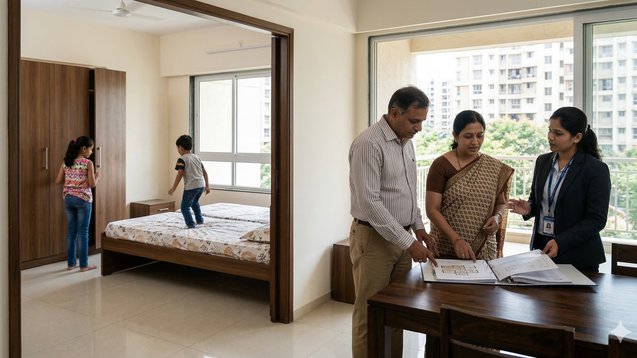
Introduction:
The process of buying a home requires more than financial evaluation. The purchase involves more than buying the physical structure of the building. You are choosing the location where your children will take their first steps and your family will observe festivals and your children will study during the night and your family will create memories which will last through the years. The process of selecting a home demands deeper evaluation because basic price comparisons between different homes do not provide sufficient information. Family priorities throughout India are undergoing transformation. The Tier 1 cities of Mumbai and Bengaluru and Delhi NCR offer both limited available space and advanced infrastructure facilities. Buyers in Tier 2 cities such as Pune and Lucknow and Coimbatore typically receive bigger residences which come with developing modern facilities. The third level cities provide cost-effective options, but they sometimes lack developed community facilities. The process of managing size requirements and location choices and future requirements and budget limitations becomes overwhelming for you. This guide will support you in making a practical decision which will give you confidence and maintain your trust for the future.
Understanding Your Family’s Future Needs
Many buyers make the mistake of buying for today. A young couple with one toddler may feel a 2BHK is more than enough. The answer to this question depends on what will happen in five years. The needs for space will change rapidly because of a second child and visiting parents and work-from-home requirements and home-based business operations. You should ask yourself simple questions that have a significant impact. Will both children need separate rooms later? Do you require a study or flexible workspace? Is elderly-friendly design important? The high property prices and stamp duty costs make future upgrades to Tier 1 cities expensive for residents. In Tier 2 and Tier 3 cities, moving up might be easier, but shifting schools and social networks can disrupt family stability. A home should provide people with enough space to live their lives. People will save more money in the future when they choose a larger space that uses smart design instead of moving every few years to new locations. You should plan for the future but you should not buy more than you need for your future needs.
Choosing the Right Location Within the City
The location of a home becomes the primary factor which families need to consider more than any other homebuyer group. The decision process for working professionals who have no children will depend mostly on their commute duration. Families consider schools and hospitals and parks and daily convenience as equally important elements for their needs. Established suburbs that provide metro access and high-quality schools maintain their value for resale purposes in metropolitan areas. The emerging corridors which exist near highways and ring roads in Tier 2 cities provide potential for property value growth while lacking current educational facilities. Central areas in Tier 3 cities offer affordable housing options which residents can access but services develop at a slower pace. You should explore the area multiple times throughout the day. The area maintains safety during nighttime hours. Are grocery stores located within walking distance of the area? Are children able to play without any safety concerns? The brochure information holds less value than the actual details which need to be shown. Property Aaj (https://www.propertyaaj.com) provides families with property filtering options based on their preferred location and required building features which enables them to assess actual functional value beyond cost.
Prioritising Schools, Healthcare, and Daily Infrastructure
The need for essential school access becomes mandatory when children arrive in a family. Property values rise substantially when Tier 1 cities offer proximity to recognized CBSE and ICSE schools. The daily travel burden needs assessment before making your decision about the trade-off. Educational institutions in Tier 2 cities which establish their presence as academic centers provide families with affordable educational choices. Parents in Tier 3 cities need to assess the educational standards of schools which operate in their vicinity. The public needs equal access to healthcare services which stands as a fundamental requirement. The existence of a recognized medical facility within 5 to 10 kilometers brings peace of mind to patients. The requirement becomes more crucial for families who have senior citizens living with them. The daily experience of people depends on the availability of dependable water services and electrical power and waste management systems and well-maintained roads. A project which requires slightly higher expenses will deliver superior civic services which will save people from enduring multiple years of dissatisfaction.
Evaluating Space, Layout, and Practical Design
Space evaluation needs to focus on both layout and functional design assessment. People achieve comfort through various methods which extend beyond square footage. A properly designed 1200 square foot house provides open space. The design should include systems which allow fresh air to enter and natural light to enter and areas for storage and a kitchen which operates efficiently. The establishment of storage solutions stands as a necessity which needs implementation in every room of the house. Families in Tier 1 cities are moving toward smaller 3BHK apartments which meet their requirements. The design of properties in Tier 2 and Tier 3 markets includes extended balconies and dedicated utility spaces and compact study areas. You should utilize these products to your highest capacity as long as your financial situation permits. People need to assess their need for upcoming alterations. The ability to establish the ability to transform spaces into different functions brings long-term asset value benefits.
Assessing Safety and Community Environment
Children develop their full potential through interaction with their communities. Modern Indian families prefer gated communities which provide security systems and shared amenities and playgrounds. Various maintenance expenses affiliated with gated townships in metropolitan areas combine to create higher financial obligations. Integrated projects which provide clubhouse and park facilities at affordable prices have become popular in Tier 2 cities. Families living in Tier 3 towns need to evaluate neighborhood security because independent houses remain the primary housing option. Security features which include CCTV and access control and fire safety compliance and emergency exits exist as essential requirements. Property Aaj (https://www.propertyaaj.com) provides a list of verified residential projects which display safety features for families to use in their comparison shopping process.
Understanding Budget Beyond EMI
Many families calculate affordability based purely on EMI. That is risky. Consider stamp duty differences across states. Maharashtra and Karnataka have different rates compared to Uttar Pradesh or Tamil Nadu. Registration charges and GST on under-construction properties and maintenance deposits must be included in expenses. Home loan sizes increase in Tier 1 cities because residents earn higher incomes. Banks assess two types of buyers according to project approvals because Tier 2 and Tier 3 buyers access smaller loan amounts. You must maintain your emergency fund after making your reservation. Parents face costs which arise unexpectedly for their children's education and health and extracurricular activities.
Balancing Appreciation Potential with Stability
The family buyer base requires more than investment purposes because they seek home ownership. The property market assessment needs appreciation potential because it serves as essential information. The value of a property located in a developing corridor with future metro links and commercial centers will experience substantial growth. The Tier 1 cities offer steady property value growth which progresses at a gradual pace. The expansion of infrastructure in Tier 2 cities creates better opportunities for property value growth than existing market conditions. Tier 3 cities experience extreme price changes when industrial projects get announced, but those cities display greater price fluctuations. Choose locations which maintain infrastructure development progress while their social services already provide complete operational capacity. Property Aaj (https://www.propertyaaj.com) provides insights into different micro-markets across India, helping families evaluate long-term value trends.
Checking Legal Compliance and RERA Registration
Legal due diligence holds essential importance. The RERA authority operates differently in every Indian state, which leads to different levels of compliance. All under-construction projects must undergo RERA registration verification before they begin construction. Regulatory enforcement in Tier 1 cities operates at higher levels than other cities. The enforcement policies in Tier 2 and Tier 3 cities depend on the regulations of each respective state. The process for ready-to-move homes requires you to obtain land title documents, building plan approvals, and occupancy certificates. The documentation process requires more than verbal agreements. You need to request documented evidence. The decision to buy a house represents an important choice that people make for their entire life. The process of spending less money on legal matters brings about several years of stressful situations.
Thinking About Rental Flexibility
The need to rent property arises due to job transfers and business shifts and children moving abroad. The demand for rental properties in residential areas close to IT parks and industrial zones and universities shows greater market strength. Rental income from Tier 1 cities shows moderate returns which maintain a steady performance. The second-tier cities of India currently experience high rental demand due to incoming residents. Select a property type and location which will attract multiple tenants.
Conclusion
The process of selecting a suitable home for a growing family requires finding an ideal balance. The current needs of the family must receive equal weight to their future requirements. The family must strike a balance between their available funds and their desired expenses. The family must find a location which meets their space requirements. The family must reach a decision which fulfills their emotional needs and their practical requirements. The same basic rules apply to home buying throughout India which includes metro areas and Tier 2 cities with rapid growth and Tier 3 towns that are just starting to develop. People should evaluate property based on its infrastructure and safety features and its ability to provide flexible options and its legal framework and its capacity to support long-term financial security. Buyers should take their time to explore several properties before making an informed decision through thorough comparison. The home establishes the daily activities which define your family life. The home transforms into a stable residence which supports family development and creates valuable memories when people select their furniture through a methodical procedure. People should make their evaluations through the trusted platform of Property Aaj (https://www.propertyaaj.com). This platform helps users find property solutions while letting them confidently evaluate different options.
FAQs
1. Is a 2BHK sufficient for a growing family in India?
A well-designed 2BHK home will meet your needs during the first year of your life because you have one child and no work-from-home responsibilities. A spacious 3BHK home becomes necessary when you expect to have your second child and need to create a workspace because it provides more space for your family to grow in metropolitan areas where future home expansions will cost you more.
2. Should families prefer ready-to-move or under-construction homes?
Families should go for Ready-to-move homes that provide instant access for inspection while eliminating the possibility of construction delays.
3. How important is proximity to schools?
Children who travel long distances to school create daily stress for their parents. People who live near reputed schools experience better daily routines which help them achieve higher property resale values.
4. Are gated communities worth higher maintenance costs?
Yes. Gated communities enable families to maintain their safety because they provide secure areas where children and elderly members of the family can play and meet other people.
5. Do Tier 2 cities offer better value for growing families?
Yes. Tier 2 cities often provide larger homes at lower prices with improving infrastructure. However, career opportunities and lifestyle preferences should also be considered before deciding.
6. How can Property Aaj help in choosing the right home?
According to Property Aaj (https://www.propertyaaj.com) verified listings and locality filters together with comparison tools enable families to assess their space requirements and budget limits and essential amenities which results in better decision-making throughout their property search.
Read more about property matters with our specialists and browse the latest property listings on Property Aaj. Download the app from the Play Store and App Store now for easy buying, selling, and renting!