Introduction: Convenience You Notice Every Single Day
The residential project you enter requires clients to use lifts which serve as an essential system that people tend to disregard. Buyers evaluate the flat through its layout and view and amenities since they believe that all people
will have the same lift access to the property. The most crucial aspect of your daily activities in a high-rise building relates to how well you can use the lift system. The system determines your work departure time and your grocery delivery process and your elderly family members and children experience comfort at home. Mumbai, Bangalore and Gurgaon serve as the main cities of Tier 1 urban areas where people use vertical space and operate elevators throughout the entire day. The development of high-rise buildings in Tier 2 cities such as Pune, Indore and Lucknow requires proper lift system design which should receive the same level of importance as other architectural components. The construction of new projects in Tier 3 towns leads to taller buildings which create a need for better lift system design. A poorly chosen unit leads to extended waiting periods which result in full elevators and daily disruptions. A flat located at a suitable position inside the tower provides you with an efficient method to move around the building. The process of understanding lift accessibility requires more than lift calculations because it demands correct unit selection within the building.
What Lift Accessibility Really Means in Practice
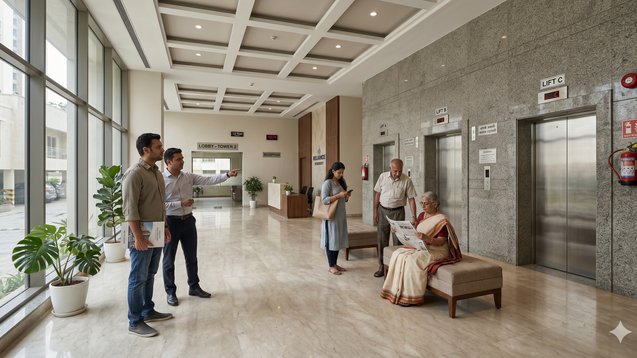
Lift accessibility is determined by the existence of lifts in a building. The system evaluates your flat door access to lift services and measures the speed of lift arrival and the level of lift usage during busy times. The experience of two flats located in the same tower building depends on their distance from the lift lobby. The lift core area enables residents to reach their destinations more quickly but results in increased interruptions from other people and sounds. People who stay in units that are located farther from the building entrance will experience greater privacy but need to walk longer distances and perform extra physical activities throughout their daily activities. The balance between convenience and comfort becomes important here. Visitors to Property Aaj (https://www.propertyaaj.com) should examine floor plans because they need to understand their unit's lift access which differs across different units.
Number of Lifts vs Number of Flats Per Floor
Lift accessibility depends on the number of lifts available for each flat. In high-density towers, residents experience longer waiting times because multiple units rely on the same lift system during busy morning and evening periods. A properly built tower needs to establish an equal lift-to-density ratio which enables elevators to handle their busiest times without producing long waiting periods. The ratio becomes essential for Tier 1 cities which contain very tall buildings that have high population density. The restricted lift capacity on buildings in Tier 2 and Tier 3 cities becomes a problem when residents from multiple flats try to use the existing lifts. During site visits, buyers tend to ignore this particular aspect, yet it transforms into a significant element of everyday life after the building reaches full occupancy.
Proximity to Lift Lobby: Convenience vs Noise Trade-Off
The choice of a unit located near the lift lobby provides multiple benefits. The lift is accessible from your location which becomes crucial during peak times and when you need to transport heavy objects. The daily activities of elderly residents and families with young children become easier through this feature. The benefits of being nearby come with accompanying disadvantages. People who wait in lift lobbies create noise disturbances which affect units that stand next to these active areas because of ongoing movements and door operations. The presence of ongoing activities in the area makes it hard to maintain complete privacy. The best unit arrangement occurs when spaces between the lift and operating areas are maintained at a distance which stays between excessive closeness and excessive separation.
Impact of Floor Level on Lift Dependency
Your choice of flooring material determines your need to use elevators throughout the day. Residents on lower floors may have the option of using stairs occasionally especially during short trips or power outages. The system enables users to access elevators without becoming entirely dependent on them. Elevators serve as the sole efficient means of transportation for users on upper levels. Your daily schedule experiences major disruptions because
of any operational delays or equipment failures or maintenance needs. In Tier 1 cities where buildings reach heights between 20 and 30 floors this dependency becomes even more apparent.
You can maintain seamless movement during busy times by selecting the appropriate floor height and elevator system combination.
Peak Hour Experience: The Real Test of Accessibility
The actual performance of the lift system during busy times serves as the main measure of how accessible a building is. The peak demand times occur during the morning when residents leave for work or school and during the evening when they come back home. In poorly planned towers, this can lead to long waiting times and crowded lifts. The building usage situation changes when all people occupy the space although lifts seem to work properly during the building's empty state. The system needs testing because its performance must be evaluated under conditions when multiple residents will use it at the same time. The factor gains additional significance in high-density projects because multiple users share the same infrastructure resources.
Separate Service Lifts: An Underrated Advantage
Modern residential projects often include separate service lifts for tasks like moving goods and shifting furniture and handling maintenance work. The separation between passenger lifts and service areas prevents passenger lift congestion which leads to better operational performance. In buildings without service lifts, all activities share the same system, which can slow down movement and increase waiting time. Society members especially face this problem because their building needs regular deliveries and maintenance work. When checking listings on Property Aaj (https://www.propertyaaj.com), it is worth confirming whether the project includes dedicated service lifts and how they are integrated into the layout.
Tower Density and Its Effect on Lift Usage
Elevator accessibility depends on tower design which determines its overall density. The demand for elevators in tall buildings increases as more units are built on each floor. Peak periods of heavy usage lead to delays in elevator service which operates with multiple lifts. The lower-density towers enable residents to use the same lifts which results in faster and smoother travel between floors. The system provides an improved daily experience because it decreases stress levels during peak operational times. The high density of Tier 1 cities becomes permanent but improved lift planning will enhance their operational efficiency. In Tier 2 and Tier 3 cities, buyers have more flexibility to choose projects with balanced density.
Importance of Maintenance and Backup Systems
Lift accessibility requires two components which are both design and operational maintenance and system dependability. Well-maintained lifts operate without problems and experience less operational downtime whereas systems that receive insufficient maintenance create ongoing service interruptions. All facilities need backup power systems as essential infrastructure. Lifts must maintain their operational state during power outages without any service interruptions. This situation becomes vital for high-rise structures because their design prohibits users from using stairs.The project delivers constant operational performance through its comprehensive maintenance systems which also create superior living conditions for residents.
Real-Life Comfort: Who Benefits the Most
The need for lift accessibility impacts all people yet it holds greater value for specific communities. Elderly family members require immediate access to facilities which need to operate without waiting delays. Parents with young children benefit from shorter walking distances and less crowded lifts. Professionals who work under time constraints require efficient service throughout their busiest times. People experience less daily stress because smoother lift access improves their routine while it brings them higher life satisfaction. The factor begins as a minor element which develops into a major component over time.
How to Evaluate Lift Accessibility Before Buying
The assessment of lift accessibility needs examination of both the built environment and the existing facilities. The floor plan shows the distance from your unit to the lift lobby. The evaluation needs to establish both the total lift capacity and the total number of units which lifts will serve. The lift lobby dimensions show how pedestrian traffic flows throughout the space. The site visit should take place during peak times because this will provide the most accurate information about actual site usage. Inquire about how maintenance work is conducted and what backup power systems are in place. The system performance assessment will start to take shape through these minor assessments which will measure building occupancy. The website Property Aaj (https://www.propertyaaj.com) enables users to compare different projects while discovering which towers provide superior design and accessibility features.
Conclusion: Small Detail, Big Daily Impact
The lift accessibility of a location operates as an unseen element which influences your daily activities. The system determines your movement patterns while measuring your waiting duration and assessing your daily comfort level. The system first creates the most crucial element which property visitors will discover after they start using the space. A well-chosen unit with good lift access offers convenience, efficiency, and peace of mind. A poorly chosen one can lead to daily frustration that no amount of amenities can compensate for. Take time to study this particular aspect which requires you to investigate beyond its visible characteristics. The website Property Aaj (https://www.propertyaaj.com) enables users to evaluate different choices which helps them to make better choices. The definition of a good home extends beyond your place of residence because it determines your living experience in that space.
FAQs
1. Why is lift accessibility important in apartments?
The two elements of waiting time and movement ease and daily convenience need to be examined because they have their most significant impact at high-rise buildings.
2. Should I choose a flat close to the lift?
The close distance provides easy access, but it creates a balance problem because it brings two disadvantages: noisy conditions and lost privacy.
3. How many lifts are enough for a tower?
The number of required lifts depends on the total flat and floor count, yet proper elevator ratios need to be maintained to prevent lengthy waiting times.
4. Do higher floors face more lift issues?
The complete lift dependency of upper floor residents makes lift accessibility critical for their needs.
5. What is a service lift?
The system operates through an extra lift, which functions as a dedicated service lift for transporting goods and performing maintenance tasks, thus decreasing passenger lift traffic.
6. Can lift issues affect resale value?
The presence of poor lift accessibility leads to two consequences: it decreases buyer interest and it reduces the future value of the property.
Read more about property matters with our specialists and browse the latest property listings on Property Aaj. Download the app from the Play Store and App Store now for easy buying, selling, and renting!