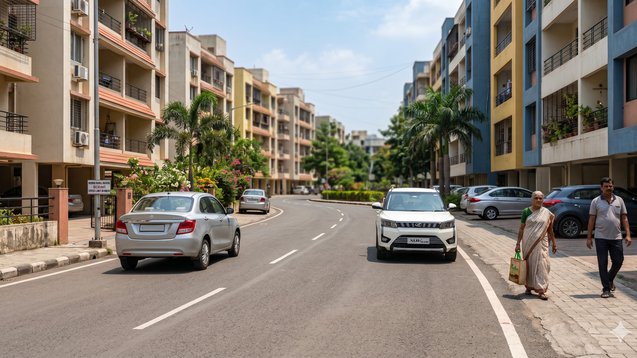
Introduction: The Detail That Quietly Affects Your Daily Movement
The first thing which you will observe during your residential project visit will be the apartment space together with the available amenities and the general appearance of the residential area. People consider internal roads as essential but they expect these roads to function properly without any problems. The design and width of streets control the entire street network system because they determine how people will experience their daily activities on those streets. Think about it. Your daily activities depend on these internal roads which you use for work commuting and homecoming and delivering packages and moving around the community. When roads become narrow and designers fail to create proper pathways and traffic flows create high vehicle volume then drivers will experience difficulties during parking and driving their car through the street. The development of internal roads in Mumbai Bengaluru and Gurgaon requires more space because these cities experience high property costs and multiple building projects. The development of road systems in Pune and Jaipur and Lucknow has reached a better stage but still faces some development challenges. Although there is ample land in Tier 3 towns the standard of urban design shows significant differences. Buyers need to understand that internal roads function as more than driving paths because they determine all aspects which affect emergency response times and personal safety and which affect residents life quality. We will explain the process of evaluating internal road width by using practical techniques which will help you reach your final decision.
Why Internal Road Width Matters More Than It Appears
The internal roads present adequate capacity for a site visit assessment however their actual performance evaluation starts when the community operates at complete capacity with all residents and vehicles and all daily activities established. The society faces two major problems because narrow roads create street congestion and block two-way traffic and lead to excessive noise and street confusion and increase the risk of small crashes. Well-designed wide roads enable vehicles to move freely while drivers find it easy to park their vehicles which creates a peaceful driving experience. The construction of larger projects needs this aspect because multiple families will use the same internal systems and facilities throughout the entire project. The internal movement system of the society needs to be discovered through internal project research which should extend beyond visual analysis when users visit Property Aaj (https://www.propertyaaj.com) projects.
Understanding Ideal Road Width for Residential Societies
The assessment of road adequacy requires practical benchmarks because no single standard exists that all projects must follow. The minimum street width needs to accommodate two vehicles who must pass each other without difficulty. The design requires extra space which must accommodate pedestrians. The design needs to provide sufficient space which enables people to move through. The design needs to provide more space for pedestrians to walk. Residents can access visitor parking through sidewalks which connect them to the paths. High-quality projects include wider road designs which incorporate extra space for planting areas and sidewalks and visitor parking. The design process for budget projects and high-density projects requires narrow roadways because it provides more space for construction work. The Tier 1 cities face greater challenges about land use because residents must make trade-offs. The execution quality remains different because developers in Tier 2 and Tier 3 cities have more building options. The actual width of the road needs assessment because it determines how users experience the road space during their journey.
Two-Way Traffic vs Single-Lane Movement
The simplest method to assess internal road effectiveness uses two-way traffic operation as its evaluation standard. The well-designed societies enable two cars to travel through their space without needing to reduce their driving speed. The area provides space for vehicles to stop temporarily which they can use without interrupting traffic flow. The poorly designed layout requires one vehicle to wait until the other vehicle completes its passage. The system requires all movements to obtain permission from traffic controllers. Peak hours create maximum traffic congestion problems. The problem becomes extremely apparent in Tier 1 cities because they experience high vehicle traffic. The problem remains unimportant in Tier 2 and Tier 3 cities until their vehicle ownership rates start to rise. Your visit should focus on peak usage times which occur during the morning office rush and evening return periods. The actual value of road width becomes evident at that time.
Impact of On-Road Parking on Usable Width
The parking situation on internal roads reduces their effective width even when the roads seem to have wide dimensions. The following parking patterns exist in numerous communities: Residents park vehicles along the road. Visitor parking spills into common areas. Temporary parking blocks movement. The design creates a situation where road space gets used less efficiently which leads to traffic jams that occur in well-planned areas. The problem occurs in Tier 1 cities because their parking space remains insufficient to meet demand. Tier 2 cities experience better parking management systems but still face problems with parking areas that exceed their capacity. Road usability in Tier 3 towns gets affected by the informal parking practices that residents use. Every property evaluation needs to determine whether the society provides: Dedicated visitor parking. The parking areas need to have visible boundaries. The parking system requires active enforcement of its rules. The system maintains internal road operations because it prevents partial road blockage.
Turning Radius and Corner Design
The design of roads at their intersections needs more than just their width because their intersection design needs to be considered. Sharp or narrow turns create driving challenges which become more challenging when drivers operate larger vehicles such as SUVs. Drivers experience frustration from poorly designed corners because they require multiple adjustments to reach their destination. A well-planned society requires three design elements which include parking lots and building entrances and intersections which need to have wide and smooth corner design. The design allows vehicles to execute turns without needing to back up into the street. The design enables traffic to move through the area without any interruptions. Compact projects in Tier 1 cities face difficulties because their space needs to be used for turning vehicles. Better land availability in Tier 2 and Tier 3 cities enables developers to create smoother building layouts although not all developers choose to make use of this advantage. The observation of vehicle movement at corners needs to be studied during your visit. The method provides an easy way to evaluate how good the design works.
Pedestrian Safety and Walkability
The internal roads serve as vehicle pathways which operate as common areas that residents use for walking purposes. The design of successful communities includes: The design of successful communities includes: The design of successful communities includes: The design of successful communities includes dedicated walking spaces which include sidewalks. The design of successful communities includes dedicated walking spaces which include sidewalks. Speed breakers control vehicle speed The system uses clear markers to provide safety The system uses clear markers to provide safety The system uses clear markers to provide safety The system uses clear markers to provide safety. In poorly planned ones:
Pedestrians share the same narrow road with vehicles
Safety risks increase
Movement feels uncomfortable.
The design of modern projects in Tier 1 and Tier 2 cities now requires designers to create walkable environments. The concept is still developing in Tier 3 towns. A wider road with proper pedestrian space creates a safer and more pleasant living environment.
Emergency Access: A Critical but Ignored Factor
The primary reason that roads require proper width exists to enable emergency vehicles to access roadways. Fire trucks and ambulances and service vehicles require adequate space to drive into and move throughout the community. The narrow roads create two problems because they prevent emergency responders from reaching their destinations and they create dangerous situations during emergency situations. Many cities enforce fire safety regulations which establish minimum road width requirements for high-rise structures. The actual implementation of these regulations will show differences between their established standards and their actual application. The project evaluation process requires two assessment points. The project requires assessment of whether large vehicles can access all areas. The project requires assessment of whether all buildings have sufficient space between them. The item you need will not become part of your routine work schedule. Your need for this item will arise during situations when its use becomes vital.
Impact on Daily Convenience and Stress Levels
Your daily experience of stress or relaxation depends on how internal road design functions. A well-organized society enables drivers to experience smooth driving and parking facilities which enable them to move about the area without any unexpected interruptions. A poorly organized system leads to two problems which include daily traffic interruptions and minor disputes about spatial territory. The combination of these tiny experiences which occur throughout your day creates a significant impact on your total contentment with the property. The combination of these tiny experiences which occur throughout your day creates a significant impact on your total contentment with the property.
Comparing Tier 1, Tier 2, and Tier 3 City Planning Trends
The developers of Tier 1 cities design their internal road systems with narrower widths because land prices remain high and buildings occupy most of the area. Developers focus on maximising sellable area, which sometimes reduces common infrastructure space. The newer projects in Tier 2 cities achieve better density and livability balance through their development work. Road widths are generally more comfortable but planning quality varies between developers. The built-up areas of Tier 3 towns provide more space than other areas yet their planned development processes do not operate at all times. Roads may be wide but they need to establish both proper organization and management systems. Property evaluation requires understanding different location attributes which help you estimate property worth.
Using Floor Plans and Site Visits Together
The process of evaluating internal road width needs both visual assessment and practical evaluation methods. Floor plans provide a basic understanding of road design but they fail to show actual street usability. A road that looks wide on paper may feel narrow when vehicles are parked or when multiple cars move simultaneously. The process of using Property Aaj (https://www.propertyaaj.com) requires users to select projects based on layout before they visit sites for validation. The process of observing walking patterns requires us to walk through the area and make visual assessments for our current standing.
Conclusion: A Smooth Society Starts With Well-Planned Roads
The essential infrastructure of all residential communities relies on their internal street systems. Your home connects to parking spaces and all available amenities through these internal roadways. Residents who select flats in societies that feature properly designed street systems gain safe access to their homes. The design of the roadways provides residents with three benefits which include safe access to their homes and construction of their future development. You should not consider this matter as something less important than everything else. You must observe this matter during your scheduled visit. The assessment should include both actual activities and unoccupied areas. People should compare projects through reputable sites such as Property Aaj (https://www.propertyaaj.com) to help them make educated project choices.Your complete comfort at home begins with the perfect movement path which you need to follow whenever you want to leave and enter your community.
FAQs
1. What is the ideal internal road width in a society?
The road design should enable cars to drive in both directions while providing space for people to walk. The practical use of a space depends more on how people use it than on its specific dimensions.
2.Why do some societies feel congested despite wide roads?
The combination of on-street parking and ineffective traffic control systems leads to decreased street area which results in traffic congestion.
3. Is road width more important in larger projects?
The correct road dimensions become necessary for proper vehicle operation because larger communities generate higher traffic volumes than smaller ones.
4. How can I check road usability during a site visit?
You need to track how vehicles move through the area while observing their turning requirements together with expected traffic patterns that occur during peak hours of the day.
5. Does road width affect property value?
The combination of enhanced infrastructure and better traffic flow results in improved bikeability which makes properties more appealing to potential buyers.
6. Are wider roads safer?
The design elements help to decrease accidents while enabling faster emergency response and providing drivers and pedestrians with a safer street space.
Read more about property matters with our specialists and browse the latest property listings on Property Aaj. Download the app from the Play Store and App Store now for easy buying, selling, and renting!