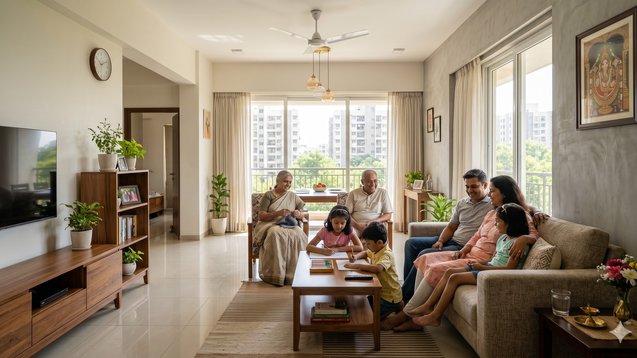
Vastu and Family Harmony Explained
Introduction:
In India people choose to buy or construct homes because they want to establish places that foster connections while their daily activities proceed without disruption. Vastu Shastra provides guidance to Indian families because it helps them create their desired home environment. The system serves as a flexible guideline which enables people to attain household equilibrium through positive energy and peaceful living conditions. The concept of Vastu-compliant homes appears during family discussions about their housing needs in various situations which include nuclear families who move into small Mumbai apartments and joint families who relocate to large Lucknow residences and first-time homebuyers who assess houses in Nashik. The concept of Vastu compliance during which family members create their daily routines requires explanation. The answer exists between two extremes. The connection between Vastu and family harmony will be explored in this blog through practical analysis which includes layout design and psychological aspects together with market developments and current city life in all three tiers of Indian cities which include Tier 1 cities and Tier 2 cities and Tier 3 cities.
The Connection Between Vastu and Family Life Needs to Be Explained.
Vastu Shastra defines its principles through the requirement to match human habitation with fundamental elements of nature which include light and air and space and energy movement. The way people live their daily lives in their homes will be determined by their understanding of Vastu Shastra. A small house which lacks proper ventilation will create difficulties for people who need to perform their daily activities. A home which has proper organization and sufficient ventilation creates a peaceful atmosphere. In Bangalore residents usually choose to live in apartments which makes them less concerned about Vastu compliance in their home search. Homebuyers search for properties which create a feeling of comfort and satisfaction. The feeling results from both effective design and Vastu elements which are hidden within the space. Tier 2 cities see their homebuyers actively connect Vastu to peaceful existence because they believe that choosing the correct home design will lead to better relationships between people. Vastu does not directly dictate how families interact with one another but it creates the circumstances which shape those interactions.
The Role of Space Planning in Reducing Daily Stress
One of the practical parts of Vastu is planning your home's layout. This is where it really helps to create harmony in your family. For example:
A tidy entrance makes an impression and sets a positive tone
A kitchen in a spot makes cooking easier
A bedroom in a spot helps you rest and have privacy
In busy cities like Delhi, where families have to balance work, travel and personal life, even small mistakes in home design can cause daily stress. Now think about a home that is planned with care, where you can move around easily. There is confusion, fewer interruptions and your daily routine is smoother. When looking at homes on Property Aaj buyers are paying attention to floor plans. They want to know not how much space there is, but how that space helps with daily life. Because at the end of the day peace at home often starts with how you can live in it.
The Importance of Bedrooms for Family Cohesiveness
Comfort is important in keeping families together and functioning well. Vastu strongly recommends the placement of bedrooms, with the most significant being the master bedroom, located in the southwest quadrant. Although it may seem very traditional (or even antiquated), this location has tremendous value related to both safety and privacy. Today, in Tier 1 cities such as Hyderabad, there is usually a lack of privacy due to the highly dense nature of an average-sized apartment. Many families find the cost of the apartment layout does not fit the ideal arrangement. In contrast, countries that are classified as Tier 2, such as Indore, have a much larger area of residential layouts available; thus, it makes it much easier to locate bedroom arrangements in accordance with Vastu principles and comfort. It has been avowed by experienced observers that when family members have individual areas to live in comfort, there is a marked reduction in family conflict. Thus, while Vastu will provide you with direction, it has additional benefit in creating the right amount of balance between your shared and individual spaces.
The Kitchen: More Than Just a Functional Area
The Indian kitchen serves as more than a cooking space because it functions as the emotional core of the home. The space serves as a home base for family members because it allows them to talk with each other and create their daily schedules while waiting for family members to return from work. Vastu recommends placing the kitchen in the south-east direction which people associate with the fire element. The practice of cooking shows benefits which extend beyond traditional methods by providing better airflow systems and increased thermal control. Pune residents prefer modern apartments which create kitchen spaces that take up less room. The kitchen space needs only to adjust two elements because these changes will create visible improvements. The kitchen design serves as the main factor that family members using Property Aaj need to evaluate because it affects their daily comfort. A well-designed kitchen creates an efficient work environment which helps families manage their hectic morning schedule while enabling them to maintain orderly home spaces
Natural Light and Ventilation: The Silent Mood Influencers
If there is one area that is wholly compatible with Vastu and modern architecture it is natural light and ventilation. Having adequate sunlight in the home creates positive energy and enhances the amount of positive energy in the space, while also reducing dampness, enhancing indoor air quality and having a direct effect on mood. In large urban centres, such as Mumbai that are constructed with limited space, adequate day lighting within a home is one of the most crucial factors for determining comfort level for families. In Tier 3 areas where single-family homes have more of a prominence; home buyers typically place a higher priority on the amount of open space (airflow), sometimes even higher than they do certain amenities. When considering properties on Property Aaj it is essential to take into consideration placement of windows as well as ventilation because a well-lit, airy home is aesthetically pleasing, but also provides a high level of comfort when occupied.
Common Areas and Family Interaction
Families use the living room space to watch television and receive visitors and spend time together. The North and East directions according to Vastu serve as ideal locations for placement but actual space design depends on its ability to create a welcoming atmosphere. The design of living rooms in Ahmedabad homes which host regular family gatherings serves as a key element for maintaining social balance. A comfortable and spacious living room space creates opportunities for social interaction while a small and dimly lit area prevents people from connecting with each other. Modern buyers are increasingly looking beyond direction and focusing on usability. The design of a home which promotes natural social interaction enables people to develop better relationships without needing active efforts.
Differences in Family Perception of Vastu by Tier
While Vastu is involved in creating harmony within families, the extent of this involvement varies considerably across India. Families living in Tier 1 cities tend to see things more from an angle of practicality and so they don’t expect perfect Vastu but focus on what is most comfortable for them and effective for their lives. In Tier 2 cities (e.g. Nashik) there appears to be a blend of two perspectives - emotional comfort and contemporary lifestyle. Families residing in small towns in Tiers 3 & 4 typically incorporate Vastu into their decision-making to a much higher degree than people from larger metropolitan areas. These families will place more emphasis on Vastu than they will on either (i) geographical location; or (ii) price. Differences found throughout the different tiers reflects one’s lifestyle; their level of exposure to contemporary lifestyles; and various components of their culture that continue today. With this knowledge, families can make purchasing decisions that are in alignment with their belief systems while also being sensible from an environmental standpoint.
Financial Stress vs Emotional Comfort
Many buyers fail to recognize that excessive focus on Vastu requirements creates financial difficulties. In Gurgaon Vastu-compliant homes which exist in central areas demand higher prices than other properties. The need for complete compliance results in budget overextension which creates permanent financial difficulties. Family relationships experience negative effects from financial difficulties. What method has better intelligence? The solution requires establishing equilibrium between requirements. Begin with a house selection that fits your monetary capabilities and then try to implement Vastu standards within that framework. The website Property Aaj enables users to evaluate multiple options while they search for solutions to their problems. People achieve peace of mind when they have financial security and they know their right direction.
Modern Vastu: Flexibility Over Perfection
Today Vastu standards receive new definitions from current buyers. Buyers require Vastu standards to allow them flexibility instead of requiring them to follow fixed rules. For example:
The system enables users to change their furniture arrangements
The system uses colour to create space balance
The system helps users to achieve better lighting and ventilation
The "practical Vastu" method has become standard practice in cities such as Bangalore.
The system enables families to improve their homes by making small changes which create positive energy while keeping all their property options intact. The change improves Vastu accessibility for contemporary real estate applications while maintaining its traditional value.
Conclusion
Vastu and family harmony are closely connected but not in a mystical, all-or-nothing way. At its core, Vastu encourages better design, balanced spaces, and thoughtful living. These factors naturally support a calmer, more harmonious home environment. Across India whether in Tier 1 metros or smaller towns buyers continue to value Vastu because it offers emotional reassurance and a sense of control in a complex decision-making process. But the smartest approach is balance. Your primary focus should be the elements which directly impact your daily existence which include space and light and privacy and financial safety. Vastu should function as your fundamental design principle which you should not treat as an absolute design constraint. With your balanced mindset from Property Aaj, you can discover properties which match your personal style and support your relationships when you search for homes on their website. A family creates a harmonious home environment through their comfortable living practices which exist beyond the physical boundaries of its walls.
FAQs
1. Can Vastu really improve family harmony?
Vastu elements create environmental effects which determine how people will interact with each other. A home design that includes optimal illumination and airflow together with a practical space arrangement will help users to experience reduced stress levels while better connecting with each other throughout their daily activities.
2. Is Vastu more important than layout and design?
No. In fact, good design often aligns with Vastu principles naturally. Designers should create functional spaces while using Vastu elements as secondary advantages.
3. Do modern apartments follow Vastu strictly?
Rarely. Urban apartment buildings typically implement partial Vastu-compliant designs because their available space restricts complete Vastu implementation. Buyers usually adapt with practical adjustments.
4. Should I reject a property if it’s not fully Vastu-compliant?
Not necessarily. Minor Vastu issues can usually be fixed when a property meets the essential requirements of location and budget and layout design.
5. Does Vastu have greater significance in smaller cities than in bigger urban areas?
Yes, generally. Tier 2 and Tier 3 cities place more emotional importance on Vastu compared to metro cities.
6. Can Vastu influence the resale value of a property?
In many markets, yes. Vastu-compliant homes attract more buyers in non-metro areas which makes these properties easier to sell.