Vastu for Commercial Property, Shops & Offices
Introduction:
In India, commercial real estate buyers concentrate their attention on three key factors which include property location and customer traffic and potential rental income because these factors determine business operational success. Entrepreneurs and investors maintain discreet interest in Vastu Shastra as an additional aspect which they evaluate. The Vastu principles which apply to successful shops and offices exist in hidden ways throughout retail areas in Mumbai and corporate offices in Gurgaon. The Indian business environment requires people to use both traditional beliefs and practical reasoning when making their business decisions thus Vastu maintains its current value. Customers come to shops because owners use Vastu to create a welcoming atmosphere which helps them run their business operations. Office buyers use Vastu to evaluate their potential productivity at work while assessing their business stability and capacity for future growth. The design requirements for commercial spaces in Tier 1 cities restrict architects from creating spaces which meet all Vastu design standards because they need to optimize space accessibility. The decision-making process requires people to understand Vastu assessment methods which need a practical approach that maintains essential decision-making elements.
Why Vastu Matters in Commercial Spaces
The answer to whether Vastu has real significance for commercial real estate depends on which perspective you choose to adopt. In India, the answer is usually yes but there is a need for additional information. Entrepreneurs use Vastu to create an environment which helps them focus on their work while engaging customers and generating revenue. Business owners in Mumbai and Bangalore base their decisions on Vastu but treat it as a secondary factor which they choose to ignore when evaluating business locations. Vastu has more power to shape decisions in Indore and Lucknow than it does in smaller towns. The truth remains that a shop located in a busy area will achieve better sales than a shop which obeys all Vastu rules but exists in a vacant location. Vastu should function as an element that supports operations rather than an element that restricts them.
Entrance Direction: The Most Critical Factor
The entrance direction stands as the primary Vastu element that holds the highest significance in commercial properties. North-facing entrances lead to financial prosperity while east-facing entrances create opportunities for personal development and business expansion. The retail industry can use west-facing properties as effective operational spaces while south-facing entrances require careful assessment to determine their actual impact. The search for a property with perfect directional alignment becomes impossible in Delhi NCR because of its high-demand market situation. A property evaluation should begin by assessing road visibility and accessibility and signage options instead of using directional data to determine its value. A shop located in a top market area with a west-facing entrance will achieve exceptional results.
Layout and Space Utilization.
The success of a commercial space depends on its ability to achieve maximum operational efficiency. The Vastu system requires the north-east section to remain empty of objects while the south and west areas store heavy materials. The actual space requirements of retail outlets in Tier 1 cities make it impossible to achieve perfect zoning arrangements. The business owner needs to create an operational space that supports customer movement throughout the establishment while enabling people with disabilities to access all areas. A clothing store in Bangalore should place its entrance display according to Vastu principles because this will attract more customers than traditional display methods. Vastu should function as a supporting framework which protects building design while establishing operational requirements.
Location of Cash Counter and Mental Control Over Money
The most frequently discussed subject regarding commercial VASTU has been the location of the cash counter. Traditional guidance for the positioning of cash counters includes ideally locating them in either the southwest or south, with the owner of the cash counter facing towards the north or east when performing any transactions through the cash counter. Symbolically, such locations are considered to represent the control of such financial instruments and are indicative of an uninterrupted flow of cash. While most Tier 2 & 3 shop owners tend to adhere to these principles more strictly than do shop owners who operate in Tier 1 cities, the same basic principles are applied where feasible in Tier 1 cities; however, in determining the optimum location for a cash counter in relation to a shop's success, it is necessary to also take into consideration elements related to the general safety, visibility, and ease of operation at the cash counter. Thus, when a cash counter is not situated in such a manner that it interrupts the flow of traffic through the shop, or creates an inconvenience for customers walking through the store or attempting to transact through the cash counter, even a cash counter that is "correctly" located according to the principles of VASTU may operate with a substantial negative influence on a company’s profits.
Office Layout and Employee Productivity
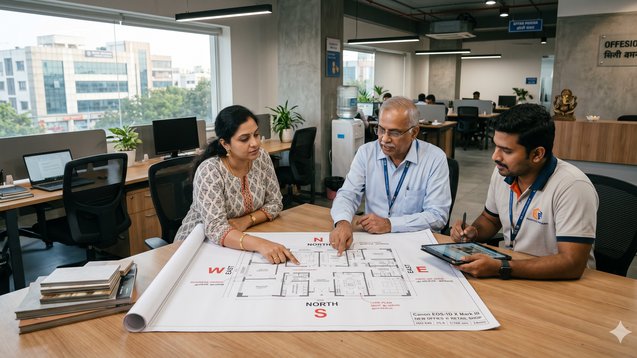
The Vastu design system which people use in office spaces needs to be tested because it shows links between work efficiency and team cooperation and the complete work environment. Common recommendations include placing the boss’s cabin in the south-west, having employees face north or east while working, and keeping the north-east area open. Modern offices in Hyderabad and Pune include design elements which naturally create Vastu compliance through their open-plan layouts and contemporary design elements. The design requirements for corporate offices in metropolitan areas include ergonomic solutions and adequate lighting and areas for team collaboration. Vastu can assist these elements but it must not become the dominant force. A workspace which combines design comfort and operational efficiency will outperform a space that follows Vastu rules but restricts user experience.
Lighting, Ventilation and Energy Flow
When we talk about Vastu and modern design one thing they have in common is. Ventilation. Natural light and good airflow are really good for the people who work there. They make employees work better and customers like it. It also helps to save energy. In Vastu people think that light from the north and east is good.. Really what matters is that the space is well lit and has good airflow. In cities like Tier 1 cities you see a lot of buildings with glass fronts and open spaces. Now smaller cities like Tier 2 cities are doing the same thing in their new commercial buildings. Thinking too much about which direction the light is coming from, people who are buying should think about how comfortable the space is, how easy it is to use and what the overall feeling of the space is. Lighting and ventilation are important for Energy Flow so people should focus on these things when they are looking at a space.
Location vs Vastu: What Should You Prioritize?
The buyers face their most common difficulty when they must choose between location and Vastu. Commercial real estate needs to prioritize location above all other aspects. A shop located in a high-traffic area between Mumbai and Delhi will generate more revenue than a Vastu-compliant store that exists in a less desirable area. The buyers in Tier 2 cities prefer to find an equal balance between both factors while Tier 3 cities give Vastu greater importance for their decision-making. Business growth needs to take priority as the main rule for business success while Vastu should be used to enhance personal comfort. The most successful investors are those who manage to balance both.
Before You Think About Vastu
You need to make sure the property is legal. People who want to buy should check if the property can be used for business, make sure the property title is clear and get all the papers from the local government. In places like Maharashtra new projects have to follow Maharajah rules, which makes things more transparent and safer.. When you are buying a commercial property that someone else used before you have to be even more careful. If a property is great with Vastu but has problems it can be a bad investment that costs a lot. You can use websites, like Property Aaj to find properties that have been checked and reduce the chance of problems.
Rental Trends and Investment Perspective
Investors should focus on rental trends and returns because Vastu is not essential for their investment needs. In Tier 1 cities, rental demand is primarily driven by location and business activity, with Vastu playing a relatively minor role. Vastu influences tenant preferences in Tier 2 cities and it also affects the speed at which properties get leased. In Tier 3 cities, it can have a more direct impact on demand. Tenants across all markets seek affordable housing options which provide good visibility and easy access instead of requiring complete Vastu compliance. The expected returns from a Vastu-perfect property will not materialize if someone pays too much for it without considering these assessments.
Common Mistakes to Avoid
There are several common mistakes that buyers should be cautious about. The first mistake occurs when buyers reject properties because of their directional orientation. The second mistake occurs when buyers neglect to evaluate how building designs function. The third mistake occurs when buyers pay excessive amounts for Vastu compliance. The fourth mistake occurs when buyers fail to conduct necessary legal examinations. A buyer would lose a valuable retail shop because he refused to enter through its front door. The only way to prevent these expensive errors requires people to establish an even distribution between their competing needs.
How to Evaluate Commercial Properties Smartly
The evaluation process becomes much more effective when organizations use a structured approach to their work. Start by assessing the location and footfall because these two factors exist as essential components for business success. The next step requires you to check all legal documentation and approvals in order to confirm that your investment remains protected. First, assess the spatial design and functionality of the area, which you will then assess through key Vastu elements that include entrance and internal design. The decision-making process requires people to examine different choices before selecting their final option. Property Aaj and similar platforms simplify the verification process through their provision of certified property listings and comprehensive property information.
Conclusion:
As a means of providing insight into the successes of commercial real estate transactions from a Vastu perspective, Vastu will be useful to aid your decision-making process in conjunction with logical and practical choices. The fast-paced world of commercial real estate has changed dramatically over the last 10 years, especially in Tier 1 urban centers. The factors of location, visibility, and usability have an overwhelming impact upon determining whether a commercial property is successful. Vastu may aid your decision-making process by providing assistance; however, it should not limit your available options. By adhering to the primary Vastu components/systems of your property (tangible), while continuing to have the willingness to create an acceptable amount of flexibility for other configurations (intangible), you will achieve the best possible balance. Establishing fundamental Vastu principles within Tier 2/Tier 3 city environments will not only increase buyer confidence in purchasing your property, but also increase the resale value of your property. Ultimately, the overall success of any commercial real estate business venture is more dependent upon sound strategies, quality of service provided, and effectiveness of execution, than it is upon direction alone. Well-thought-out planning and educated actions will provide you with the best possible results.
FAQs
1. Which direction is best for shops according to Vastu?
Shops should face north and east as their primary direction, though west-facing shops can still succeed based on their particular location.
2. Does Vastu affect business success?
The system has power to shape mental states and physical spaces, but actual business results depend on location and operational methods.
3. Is south-facing commercial property bad?
The answer is no because effective operation requires proper design planning.
4. Should I prioritize Vastu or location?
Commercial real estate requires location to serve as the primary factor which businesses should prioritize.
5. Can Vastu issues be corrected in offices?
Offices need structural changes for essential work, while layout and interior adjustments only require minor changes.
6. How can I find good commercial properties?
Use trusted platforms like Property Aaj and evaluate multiple factors before deciding.