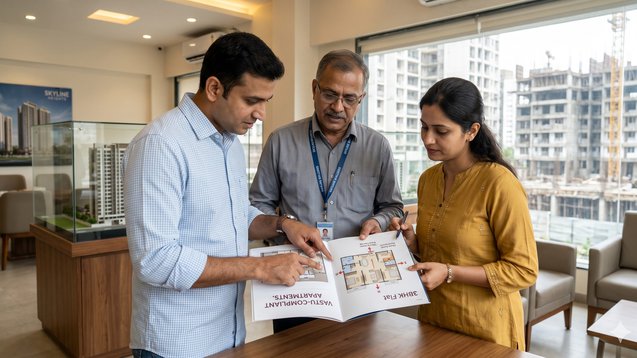
Should Builders Be Trusted on Vastu Claims?
Introduction:
The phrase "Vastu-compliant homes" has become a common expression which people use at every new residential project launch in India. The statement provides comfort because Vastu functions as a traditional practice which brings Indian buyers peace of mind and prosperity. But here’s the real question: should you blindly trust what builders claim about Vastu? In 2026, real estate marketing will become sharper than ever. Builders understand buyer psychology well because they operate in a country where emotional and cultural factors control property decisions. The term "Vastu-compliant" exists as a marketing tool which builders use to sell houses although its actual definition varies between genuine and imprecise applications. The question becomes important when you evaluate your options between a high-end Mumbai apartment and a mid-range Pune project and a standalone residence in a Tier 3 city. Your financial investment creates an emotional connection which keeps you committed for multiple years. The guide will explain how builders use Vastu claims while showing the trustworthy parts and the untrustworthy areas and the self-assessment methods for evaluation. This tool helps you distinguish between marketing content and actual information when you search Property Aaj listings and explore project sites.
What Do Builders Mean by “Vastu-Compliant”?
Let’s start with clarity because this is where most confusion begins. When builders say a project is “Vastu-compliant,” they usually don't mean perfect adherence to traditional Vastu principles. Instead, they refer to partial alignment with key aspects like entrance direction, kitchen placement, or general layout flow. The strict Vastu requirements for all units in large apartment projects create unworkable challenges for developers in Tier 1 cities. The fixed land parcels and Floor Space Index (FSI) requirements and architectural restrictions make it impossible to achieve Vastu compliance. This creates different orientation patterns which exist throughout the entire building. What actions do builders take? The builders select the units with the most Vastu compliance and they promote the building as a Vastu-compliant development. Tier 2 cities offer better Vastu compliance because of their larger land parcels and their more adaptable urban development standards. Builders in Tier 3 towns place Vastu as a higher priority because customer interest in their constructions is greater. The takeaway is simple: “Vastu-compliant” is often a flexible term. The statement lacks certification. The term functions as a marketing tool which requires extensive research.
Marketing vs Reality: Where the Gap Lies
Vastu functions as a design principle but people use it more for marketing purposes. Think about it. The builder makes an impossible claim when he markets his project as "100% Vastu-compliant homes" because the project includes multiple tower orientations and different unit layouts and compact planning elements. Space optimization stands as the main focus for builders who work in Tier 1 cities which include Bangalore and Delhi NCR. Builders try to create maximum sellable space because they want to increase their profits. The process requires strict Vastu alignment to stop being important for builders who need to follow their project requirements. The gap between marketing and actual conditions exists in Tier 2 markets but it remains less wide than in other markets. The layout claims in Tier 3 cities stay more accurate because buyers require specific details about the actual layouts. A common scenario occurs when a buyer books a flat because of a brochure claim but later discovers that the actual kitchen placement and entrance direction differ from what he expected. The marketing materials and sales presentations provide dangerous information about products. You need to check layout plans according to your own methods.
Why Builders Highlight Vastu in the First Place
Builders don’t push Vastu claims randomly; it's driven by demand. Across India, a large percentage of buyers still consider Vastu important. Buyers in metro cities prefer to stay away from major "doshas" while they search for their ideal home. The builder industry uses Vastu as a marketing tool to enhance project attractiveness. The buyer pool expands because of this practice. The practice adds value to Tier 1 cities. The practice serves as a major selling advantage in Tier 2 cities. The practice directly affects sales speed in Tier 3 towns. Psychological factors influence people. A buyer choosing between two similar properties may lean toward the one labelled "Vastu-compliant" even if the difference is minor. Builders use Vastu as a business strategy because it helps them succeed. The statement contains true information but requires thoughtful analysis for proper understanding.
Can You Really Trust What Builders Say?
The truth is, you should not trust them completely. You should trust them. Also check what they say is true. Builders who are well known and have done work in the past are usually more honest. They may not say that everything is perfect. They will clearly tell you which things are in line with Vastu. Small builders or those who are not well known in areas where there are many builders may say things that are not true to get people to buy from them. In places where the government watches over builders like Maharajah Vastu is not something that can be enforced by law. The people in charge like Maharajah focus on making sure builders follow the rules, meet deadlines and tell the truth. Not on whether they follow Vastu rules. So if a builder says something that's not clear or is open to interpretation you do not have strong legal options. This is why you need to check things for yourself. You should see what builders say about Vastu as a guide not as a promise. The builders will say what they think about Vastu. You should still check the Vastu claims for yourself because the builders may not always be right about the Vastu claims.
Important Vastu principles to consider when building your new home.
Do not rely on builders for everything; do some of your own practical checks. First, check what direction the entrance points to. The preferred entrances are north or east; while west-facing entrances work in some circumstances if the layout allows for it. Next, check where the kitchen is located. It is best that it is not located in the north-east corner. Check where the bedrooms are, paying particular attention to where the master bedroom is located. Check the amount of natural light and make sure that the windows are positioned to allow adequate ventilation. The amount of natural light and the ability to ventilate the house usually follow the Vastu principles. You may not get everything perfect when searching for properties in compact apartments. That is acceptable. Your goal should be to minimize the major issues; you do not need to strive for perfection. When you are searching through the Property Aaj site, filter the properties based on their layouts and compare layouts before putting your faith in one property based on only one assertion.
Tier-Wise Differences in Builder Credibility
Different city tiers lead to variations in builder credibility which affects their Vastu practices. In Tier 1 cities, large developers usually follow standardized processes. Their structured claims depend on their design limitations yet their assertions maintain organized form. In Tier 2 cities, there’s a mix. Some builders are highly transparent, while others rely heavily on marketing. The local builders in Tier 3 towns show more authentic Vastu practices although their legal documentation and actual business operations might not be as transparent. This situation establishes an appealing trade-off. Metropolitan areas allow users to make slight Vastu compromises which result in improved infrastructure and enhanced legal protection. Smaller towns provide superior Vastu alignment yet residents must verify their necessary approvals and required documentation. Smart buyers understand this balance.
Does Vastu affect prices and resale?
Yes, but not in the same way. Location and connectivity are what drive prices in Tier 1 cities. Vastu may add a small amount to the price, but it almost never makes a deal fall through. Vastu can affect both the price and the speed of resale in Tier 2 markets. A property that is well-aligned may get more buyers. It can have a big effect on demand in Tier 3 towns. For instance, two similar apartments in a Tier 2 city, one facing northeast and the other facing south, may get different levels of interest from buyers. But here's the thing: paying too much for Vastu doesn't always mean you'll get better returns. Location, infrastructure, and market demand are still more important. So don't make Vastu the main reason you invest.
Legal Safety versus Vastu: Don't Make This Mistake
Many buyers make errors here. They pay a lot of attention to Vastu. Forget to check the legal side. You should always verify:
RERA registration
property title
Approvals and permissions
A property that is legally risky but has perfect Vastu is much worse than one that is legally sound but has small Vastu issues. Websites, like Property Aaj can help you find properties, which reduces the risk. Think about the future. Having clear legal documents protects your investment. Vastu helps with your comfort.
Practical Buyer Approach in 2026
Smart buyers currently evaluate properties through Vastu standards instead of rejecting them completely. They evaluate context. They continue with their evaluation process when the property has strong location and layout and pricing and only shows minor deviation from standard requirements. They need to revaluate the situation when major issues arise which disrupt their comfort and decrease their property's value. A buyer in Bangalore might accept a west-facing flat in a prime tech corridor. A buyer in Jaipur might prioritize Vastu more strongly. Both decisions are valid because they reflect different priorities. The key is awareness. People should not trust everything. People should not reject everything.
How to Check Builder Claims in a Smart Way
So, how do you really check Vastu claims? Look at the floor plan first, not just the brochure. If you can, go to the site. Understand orientation in a physical way. Ask questions that are specific:
Which way does the main door go?
Where is the kitchen located?
What about light and air flow?
If you need to, talk to an independent Vastu expert instead of the one the builder suggests. You should also look at a few different projects. Don't make a choice based on just one visit. Property Aaj can help you compare different options next to each other. Putting in a little work now can save you from long-term regret.
conclusion:
So, can you trust builders when they talk about Vastu? Yes, but be careful. Most builders don’t lie outright, but they often present Vastu in a way that supports their sales narrative. That's normal; that's how marketing works. As a buyer, you need to go a step further. Know what "Vastu-compliant" really means. Check important details. Include practical things like location, legal safety, and long-term value. Flexibility is very important in Tier 1 cities. Balance is best in Tier 2 markets. In Tier 3 towns, Vastu may be more important, but not if it makes the law less clear. A good property isn't just about where it is at the end of the day. It's about how lovable, safe, and growth-friendly it is. Believe in the builder, but trust your own judgment even more.
FAQs
1. Are all builder claims about Vastu misleading?
Most builders successfully implement fundamental Vastu principles in their projects. The industry uses the term Vastu-compliant for multiple applications which requires construction professionals to establish their specific compliance level.
2. Can I legally challenge a builder for false Vastu claims?
Most cases end with a negative answer. RERA regulations do not recognize Vastu as an officially regulated parameter. Vastu verification exists outside the Maharajah authorities' operational focus which centers on project authorization and task execution.
3. How important is Vastu in Tier 1 cities like Mumbai or Bangalore?
Vastu building design exists as a secondary requirement in Tier 1 cities. Buyers prioritize location, connectivity, and price. The property maintains a strong overall assessment which allows minor deviations to pass as acceptable.
4. Should I hire a Vastu consultant before buying?
An independent expert who specializes in Vastu should be consulted when Vastu holds significant value for you and your family. The program delivers transparent information which proves superior to builder statements while assuring complete customer satisfaction.
5. Does Vastu affect resale value?
Yes, especially in Tier 2 and Tier 3 cities where buyer sentiment is stronger. The effect of Vastu in Tier 1 cities exists at a lower level when compared to the significance of location and infrastructure.
6. What’s the safest approach while evaluating Vastu?
Major factors include entrance design and building layout and air circulation design. Property owners should not reject properties because of small problems which need to be fixed but should maintain their assessment of the value. Balance is essential for successful decision-making.