Introduction
Selling property in Delhi—be it a builder's floor in Janakpuri, an apartment in Vasant Kunj, or a bungalow in South Extension—invokes more than merely identifying the right buyer. Arguably the most critical (and least discussed) part of a property sale is being aware of the taxes involved.
Having knowledge of tax implications beforehand saves you from unwanted deductions, penalties, or delay in receiving your payment. It also enables you to manage your money smartly, particularly if you are reinvesting in another property or preparing for retirement.
In this article, we'll guide you through the most important tax norms all property sellers need to know in Delhi. Whether it's your first sale or you're a seasoned investor, this article—based on advice by Property Aaj (https://www.propertyaaj.com)—will assist you in making smart, stress-free choices.
Understanding the Types of Taxes on Property Sales
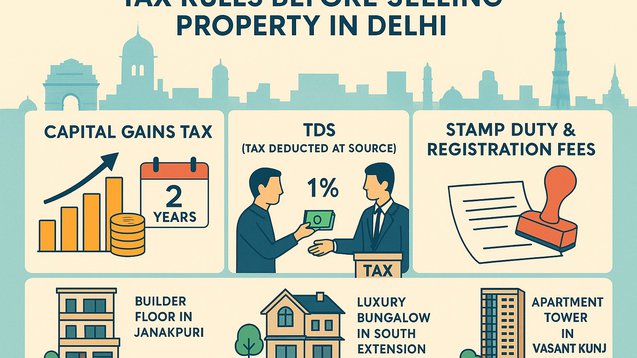
When you sell a property in Delhi, there are mainly three types of taxes you may have to deal with:
Capital Gains Tax (Short-Term or Long-Term)
TDS (Tax Deducted at Source)
Stamp Duty and Registration Fees (for buyers, but indirectly affect negotiations)
Let’s understand each in detail, and how they apply specifically to localities like Rohini, Saket, or Connaught Place.
Capital Gains Tax: The Fundamental Tax You'll Pay as a Seller
This is the most significant tax on selling property in Delhi. The government taxes the profit you gain from the sale—that is, the excess of your selling price over your property's purchase price (after accounting for inflation).
There are two kinds of capital gains:
1. Short-Term Capital Gains (STCG)
Applies when: You sell the property within 2 years of buying.
Tax rate: You add STCG to your income and pay tax as per your income tax slab (5%, 20%, or 30%).
Example:
You purchased a flat in Dwarka in 2023 and sold it in 2025. You have a profit of ₹10 lakhs. If you are in the 30% tax slab, you'll have to pay ₹3 lakhs as STCG.
Tip: If selling within two years from purchase, it may be advantageous to delay sale till after the 24-month period to avoid paying taxes.
2. Long-Term Capital Gains (LTCG)
Applies when: You sell your property after 2 years of holding.
Tax rate: A flat 20% on the indexed gains (after adjusting for inflation using CII—Cost Inflation Index).
Benefits:
You get the advantage of inflation indexation (this reduces your taxable profit).
You can claim exemptions under Sections 54, 54EC, or 54F by reinvesting your capital gain.
Example:
You bought a builder's floor in Karol Bagh in 2010 for ₹50 lakhs and sold it in 2025 for ₹1.5 crore. After indexation, your gain might reduce to ₹70 lakhs instead of ₹1 crore. Your tax would be 20% of ₹70 lakhs = ₹14 lakhs.
How to Save LTCG Tax Legally
The Indian tax system offers ways to avoid paying LTCG tax, provided you reinvest the gains:
Section 54 – Reinvestment in Residential Property
You must invest the capital gain (not the full sale amount) in another residential property in India.
The new property must be purchased within 2 years or constructed within 3 years of the sale.
You must not sell the new property for at least 3 years.
This is a popular method for sellers in South Delhi or East Delhi looking to upgrade to larger homes or shift to Gurgaon.
Section 54EC – Investment in Capital Gain Bonds
Instead of buying property, you can invest in NHAI or REC bonds.
Maximum investment limit: ₹50 lakhs.
Lock-in period: 5 years.
These bonds are ideal for sellers in areas like Rohini or Janakpuri who don’t want to reinvest in property immediately.
TDS (Tax Deducted at Source): What You Must Know
When a buyer purchases a property in Delhi for more than ₹50 lakhs, they are legally required to deduct 1% TDS from the total sale amount and deposit it with the Income Tax Department.
Seller's Responsibility:
Make sure the buyer deducts this amount and provides you with Form 16B.
This TDS will show in your Form 26AS and can be adjusted against your capital gains tax.
Example:
If you sell a flat in Vasant Kunj for ₹1 crore, the buyer must deduct ₹1 lakh as TDS and pay you ₹99 lakhs. The deducted ₹1 lakh will be counted when you file your tax return.
What If You Have a Home Loan on the Property?
If you’ve taken a home loan for the property being sold, you must:
Close the loan before or during the sale process.
Obtain a loan closure certificate and NOC from the bank.
Buyers will typically insist on clear title ownership, especially in high-value areas like Saket or Connaught Place.
Proceeds from the sale can also be used to repay the loan, but the transaction should be handled carefully, often through an escrow arrangement between the bank, seller, and buyer.
Advance Tax on Capital Gains
In case your capital gain is substantial (for instance, you sold a property in Sunder Nagar or Golf Links), and tax is due, you might have to pay advance tax in installments to prevent interest charges.
Advance tax is payable in four installments—June 15, Sept 15, Dec 15, and March 15. Non-payment of advance tax attracts interest under Sections 234B and 234C.
Selling Inherited Property? Tax Still Applies
If you’re selling a property you inherited—say a bungalow in South Extension or Karol Bagh—you will still be liable for capital gains tax.
The twist is:
The holding period is counted from the date the previous owner bought it.
The purchase price is also the original price paid by the previous owner, not zero.
You can still claim LTCG exemptions as a seller of inherited property.
Joint Sales of Properties: Tax Regulations Apply Independent
In case of jointly owned property—e.g., brothers or spouses—each one of them pays capital gain tax only on his share of the profit.
This is typical for family properties in Lajpat Nagar, Janakpuri, or Tilak Nagar.
Tip: Ensure that every seller's PAN is included in the sale deed and TDS certificate (Form 16B) to ensure ease of reporting.
What If You Sell at a Loss?
Yes, it happens—especially in stressed micro-markets or urgent sales. If you sell a property at a loss, you may be able to:
Set off the short-term capital loss against any short-term or long-term capital gains in the same year.
Carry forward the long-term capital loss for up to 8 years, to be adjusted against future LTCG.
Important Paperwork for Tax Filing
To handle tax filing smoothly after the sale of property, maintain these documents:
Sale deed
Purchase deed
Capital gain calculation sheet (with CII index)
Home loan closure letter (if any)
Form 16B (for TDS)
Proof of reinvestment (new property or 54EC bonds)
Cost of improvement bills (if claiming renovations)
Conclusion: Plan Your Sale with Tax in Mind
Selling property in Delhi is a big financial transaction. Whether it's an apartment in Saket, a builder's floor in Janakpuri, or a lavish house in South Extension, knowing the tax implications can save you lakhs.
A carefully planned sale not only safeguards your profit but also keeps you in full compliance with tax laws on income. If you are planning to list your property, utilize websites such as Property Aaj (https://www.propertyaaj.com) that match you with serious buyers while offering you the option to showcase your paperwork and compliance preparedness.
Don't let tax issues appear after the sale—plan ahead, price wisely, and sell confidently.
FAQs
1. Do I need to pay tax on the wholesale price or only the profit?
You need to pay tax only on the profit, i.e., capital gains, not the entire sale price.
2. Can I escape paying tax by purchasing another house?
Yes. If you invest your capital gain in another residential house within the stipulated time under Section 54, you can seek complete exemption from LTCG tax.
3. What is TDS rule for selling properties worth more than ₹50 lakhs?
The buyer needs to deduct 1% TDS and pay it to the government. The same will be credited in your PAN and can be utilized while filling your return.
4. I am selling a flat that was inherited by me. Do I pay tax nonetheless?
Yes. Even if you inherited it, you will have to pay capital gains tax, though you are entitled to long-term status in case the original owner possessed it for over 2 years.
5. Can I utilize sale proceeds for repayment of my home loan?
Yes, and a lot of people do. Just make sure that the buyer and your bank tie up through a loan closure and NOC process.
6. Is capital gains tax varying for commercial and residential property?
The method of calculation is the same, but Section 54 exemption is only given for residential property. For commercial property, you can consider Section 54EC bonds.
Read more about property matters with our specialists and browse the latest property listings on Property Aaj. Download the app from the Play Store and App Store now for easy buying, selling, and renting!You are logged in as Admin dashboard Dashboard business Basics keyboard_arrow_right Property Types Amenities List Location Location Google Data Cities Language Web Page Web Page Category settings Settings keyboard_arrow_right Users keyboard_arrow_right All Properties keyboard_arrow_right person_add_alt Users Requests maps_home_work Agencies Upgrade Request Mobile Verification All Channel History Contact Us Push Notifications keyboard_arrow_right Logs keyboard_arrow_right Brokers menu Property Aaj Home Web Page Add Add Web Page edit Language English Category Blogs Sub Category Selling Property Title Tax Rules You Must Know Before Selling Property in Delhi Head Tax Rules You Must Know Before Selling Property in Delhi Meta Title Tax Rules You Must Know Before Selling Property in Delhi Meta Description Learn key tax rules before selling property in Delhi, including capital gains, TDS, and exemptions. Plan your sale smartly with Property Aaj guidance." Content Introduction Selling property in Delhi—be it a builder's floor in Janakpuri, an apartment in Vasant Kunj, or a bungalow in South Extension—invokes more than merely identifying the right buyer. Arguably the most critical (and least discussed) part of a property sale is being aware of the taxes involved. Having knowledge of tax implications beforehand saves you from unwanted deductions, penalties, or delay in receiving your payment. It also enables you to manage your money smartly, particularly if you are reinvesting in another property or preparing for retirement. In this article, we'll guide you through the most important tax norms all property sellers need to know in Delhi. Whether it's your first sale or you're a seasoned investor, this article—based on advice by Property Aaj (https://www.propertyaaj.com)—will assist you in making smart, stress-free choices. Understanding the Types of Taxes on Property Sales When you sell a property in Delhi, there are mainly three types of taxes you may have to deal with: Capital Gains Tax (Short-Term or Long-Term) TDS (Tax Deducted at Source) Stamp Duty and Registration Fees (for buyers, but indirectly affect negotiations) Let’s understand each in detail, and how they apply specifically to localities like Rohini, Saket, or Connaught Place. Capital Gains Tax: The Fundamental Tax You'll Pay as a Seller This is the most significant tax on selling property in Delhi. The government taxes the profit you gain from the sale—that is, the excess of your selling price over your property's purchase price (after accounting for inflation). There are two kinds of capital gains: 1. Short-Term Capital Gains (STCG) Applies when: You sell the property within 2 years of buying. Tax rate: You add STCG to your income and pay tax as per your income tax slab (5%, 20%, or 30%). Example: You purchased a flat in Dwarka in 2023 and sold it in 2025. You have a profit of ₹10 lakhs. If you are in the 30% tax slab, you'll have to pay ₹3 lakhs as STCG. Tip: If selling within two years from purchase, it may be advantageous to delay sale till after the 24-month period to avoid paying taxes. 2. Long-Term Capital Gains (LTCG) Applies when: You sell your property after 2 years of holding. Tax rate: A flat 20% on the indexed gains (after adjusting for inflation using CII—Cost Inflation Index). Benefits: You get the advantage of inflation indexation (this reduces your taxable profit). You can claim exemptions under Sections 54, 54EC, or 54F by reinvesting your capital gain. Example: You bought a builder's floor in Karol Bagh in 2010 for ₹50 lakhs and sold it in 2025 for ₹1.5 crore. After indexation, your gain might reduce to ₹70 lakhs instead of ₹1 crore. Your tax would be 20% of ₹70 lakhs = ₹14 lakhs. How to Save LTCG Tax Legally The Indian tax system offers ways to avoid paying LTCG tax, provided you reinvest the gains: Section 54 – Reinvestment in Residential Property You must invest the capital gain (not the full sale amount) in another residential property in India. The new property must be purchased within 2 years or constructed within 3 years of the sale. You must not sell the new property for at least 3 years. This is a popular method for sellers in South Delhi or East Delhi looking to upgrade to larger homes or shift to Gurgaon. Section 54EC – Investment in Capital Gain Bonds Instead of buying property, you can invest in NHAI or REC bonds. Maximum investment limit: ₹50 lakhs. Lock-in period: 5 years. These bonds are ideal for sellers in areas like Rohini or Janakpuri who don’t want to reinvest in property immediately. TDS (Tax Deducted at Source): What You Must Know When a buyer purchases a property in Delhi for more than ₹50 lakhs, they are legally required to deduct 1% TDS from the total sale amount and deposit it with the Income Tax Department. Seller's Responsibility: Make sure the buyer deducts this amount and provides you with Form 16B. This TDS will show in your Form 26AS and can be adjusted against your capital gains tax. Example: If you sell a flat in Vasant Kunj for ₹1 crore, the buyer must deduct ₹1 lakh as TDS and pay you ₹99 lakhs. The deducted ₹1 lakh will be counted when you file your tax return. What If You Have a Home Loan on the Property? If you’ve taken a home loan for the property being sold, you must: Close the loan before or during the sale process. Obtain a loan closure certificate and NOC from the bank. Buyers will typically insist on clear title ownership, especially in high-value areas like Saket or Connaught Place. Proceeds from the sale can also be used to repay the loan, but the transaction should be handled carefully, often through an escrow arrangement between the bank, seller, and buyer. Advance Tax on Capital Gains In case your capital gain is substantial (for instance, you sold a property in Sunder Nagar or Golf Links), and tax is due, you might have to pay advance tax in installments to prevent interest charges. Advance tax is payable in four installments—June 15, Sept 15, Dec 15, and March 15. Non-payment of advance tax attracts interest under Sections 234B and 234C. Selling Inherited Property? Tax Still Applies If you’re selling a property you inherited—say a bungalow in South Extension or Karol Bagh—you will still be liable for capital gains tax. The twist is: The holding period is counted from the date the previous owner bought it. The purchase price is also the original price paid by the previous owner, not zero. You can still claim LTCG exemptions as a seller of inherited property. Joint Sales of Properties: Tax Regulations Apply Independent In case of jointly owned property—e.g., brothers or spouses—each one of them pays capital gain tax only on his share of the profit. This is typical for family properties in Lajpat Nagar, Janakpuri, or Tilak Nagar. Tip: Ensure that every seller's PAN is included in the sale deed and TDS certificate (Form 16B) to ensure ease of reporting. What If You Sell at a Loss? Yes, it happens—especially in stressed micro-markets or urgent sales. If you sell a property at a loss, you may be able to: Set off the short-term capital loss against any short-term or long-term capital gains in the same year. Carry forward the long-term capital loss for up to 8 years, to be adjusted against future LTCG. Important Paperwork for Tax Filing To handle tax filing smoothly after the sale of property, maintain these documents: Sale deed Purchase deed Capital gain calculation sheet (with CII index) Home loan closure letter (if any) Form 16B (for TDS) Proof of reinvestment (new property or 54EC bonds) Cost of improvement bills (if claiming renovations) Conclusion: Plan Your Sale with Tax in Mind Selling property in Delhi is a big financial transaction. Whether it's an apartment in Saket, a builder's floor in Janakpuri, or a lavish house in South Extension, knowing the tax implications can save you lakhs. A carefully planned sale not only safeguards your profit but also keeps you in full compliance with tax laws on income. If you are planning to list your property, utilize websites such as Property Aaj (https://www.propertyaaj.com) that match you with serious buyers while offering you the option to showcase your paperwork and compliance preparedness. Don't let tax issues appear after the sale—plan ahead, price wisely, and sell confidently. FAQs 1. Do I need to pay tax on the wholesale price or only the profit? You need to pay tax only on the profit, i.e., capital gains, not the entire sale price. 2. Can I escape paying tax by purchasing another house? Yes. If you invest your capital gain in another residential house within the stipulated time under Section 54, you can seek complete exemption from LTCG tax. 3. What is TDS rule for selling properties worth more than ₹50 lakhs? The buyer needs to deduct 1% TDS and pay it to the government. The same will be credited in your PAN and can be utilized while filling your return. 4. I am selling a flat that was inherited by me. Do I pay tax nonetheless? Yes. Even if you inherited it, you will have to pay capital gains tax, though you are entitled to long-term status in case the original owner possessed it for over 2 years. 5. Can I utilize sale proceeds for repayment of my home loan? Yes, and a lot of people do. Just make sure that the buyer and your bank tie up through a loan closure and NOC process. 6. Is capital gains tax varying for commercial and residential property? The method of calculation is the same, but Section 54 exemption is only given for residential property. For commercial property, you can consider Section 54EC bonds. Read more about property matters with our specialists and browse the latest property listings on Property Aaj. Download the app from the Play Store and App Store now for easy buying, selling, and renting!
