Introduction
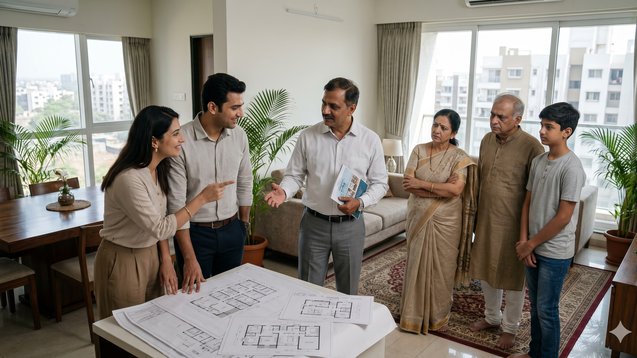
The process of buying a house represents a significant personal achievement. In India, people make home purchase decisions which extend beyond their personal choices. The home buying process for most people, particularly first time buyers includes their entire family network which consists of parents and siblings and spouses and their extended family members. Everyone possesses their own opinions. People possess their own preferences which frequently create conflicts because they do not match with each other. You want to live in a contemporary apartment which provides easy access to your job location while your parents want you to live in a spacious residence which offers peaceful surroundings. Your spouse values amenities and lifestyle choices while you want to maintain a budget and maximize your investment returns. People tend to underestimate how often different viewpoints produce conflicts between them. People experience increased conflict in urban areas which include Mumbai and Delhi and Bengaluru because they must make property purchases that require them to choose between different alternatives. In Pune and Ahmedabad, which are Tier 2 cities, the process of decision-making becomes slower because people have different priorities. The website Property Aaj (https://www.propertyaaj.com) provides users with comparison tools but it fails to address the personal aspects which influence decision-making. A home exists as more than a financial asset because it serves as a communal living area. People need to discover their ideal residence by attaining an equilibrium which enables them to meet their personal needs while fulfilling the expectations of those around them.
Why Property Decisions Become Emotional in Families
The emotional weight of property decisions affects Indian households because they see their homes as more than their physical value. The older generation sees homes as their main source of permanent security which creates financial stability. The property functions as a lifestyle choice that provides both convenience and freedom to younger customers. The existing conflict emerges from two conflicting worldviews which people hold. Parents want to live in huge independent homes located in their old neighborhoods but their child needs to work in Bengaluru so he needs to reach his office. The two views about the situation are equally valid because different life experiences create distinct value systems. The first step to solving conflicts requires people to understand the emotional background of the situation. The post requirements request users to solve the task by converting AI-generated text into a more human-readable format.
Identifying Core Needs vs Personal Preferences
Not all preferences carry equal weight. The essential factors include budget, safety, connectivity, and legal clarity, while personal factors include interior design and view and specific amenities. When conflicts arise, it helps to categorize preferences into “non-negotiables” and “good-to-have.” Parents consider access to hospitals and public transport as essential requirements, while younger buyers view a gym and clubhouse as their personal preference. Families use Property Aaj (https://www.propertyaaj.com) to compare properties and assess how well each option fulfills their various requirements. The structured approach decreases emotional friction.
Balancing Location Preferences Across Generations
The primary point of contention between parties arises from their differing opinions about which location to choose. The younger generation shows a preference for neighborhoods that provide easy access to work centers and social areas whereas their older relatives choose to live in established residential areas which offer peace and quiet. The residents of Mumbai face a decision between two housing options: they must choose between a central area apartment which offers limited space and a suburban home which provides more room to live. The trade-off in Tier 2 cities like Pune presents itself in less severe terms but still exists. The solution requires locating a site which provides both good transport links and a peaceful atmosphere that meets all residential needs.
Budget Discussions: The Hidden Source of Conflict
The hidden cause of most conflicts between people is their financial disputes which they refuse to express. Different family members have different levels of financial risk they are willing to take. Some people will spend extra money to achieve their desired home while others will choose to protect their financial security. In Delhi which has high living expenses even minor budget variations result in major financial reductions. People need to discuss their monetary matters which include EMIs and savings and future expenses in order to establish open financial conversations. Financial knowledge enables people to make decisions based on facts instead of their feelings.
Lifestyle vs Practicality: Finding the Middle Ground
The residential projects of today provide modern lifestyle amenities which include clubhouses and pools and landscaped gardens to attract younger homebuyers. The older family members of a household show greater interest in practical features which include accessibility and maintenance and their knowledge of the local community. The integrated townships of Hyderabad establish a dual approach by providing both essential services and recreational facilities. The objective should focus on finding a property that provides an acceptable balance between the two options.
Space Requirements and Family Structure
The selection of property depends on the family size and family structure of the home buyers. A nuclear family may prefer a compact, efficient layout, while a joint family may require larger spaces and additional rooms. In Tier 3 towns, where land availability is higher, larger homes are more common. In Bengaluru and other cities, buyers need to sacrifice space because of the high real estate prices. The process of discussing present and upcoming spatial needs prevents future disputes between parties.
Future Planning: A Common Ground for Agreement
The future should serve as the primary focus when people try to resolve their disputes.Which career path do you envision for yourself during the next five to ten years?The property will continue to meet your requirements at present time and future point according to your answer.Parents tend to prefer permanent home solutions because they want to stay in one place while younger buyers need to move for their professional development.Through decision-making that supports their future plans, families discover mutual understanding.Through its research Property Aaj (https://www.propertyaaj.com) reveals information about developing regions and their expansion patterns which assist buyers in making future-focused choices.
The Role of Compromise in Property Decisions
No property will satisfy everyone completely. The process requires people to reach common ground through compromises which do not serve as a sign of their weakness. The goal is to ensure that compromises are balanced and do not disproportionately affect one person. The decision to select a smaller residence instead of a larger one will fulfill both budget needs and accessibility requirements because of its superior location.
Using Data and Research to Reduce Conflict
The presence of emotions creates conflicts between people, yet data functions as a tool which provides precise understanding. The evaluation process becomes more impartial through the assessment of multiple properties together with their price patterns and infrastructure growth assessment. Families use Property Aaj (https://www.propertyaaj.com) to search verified listings while they make their selections based on actual data. The method redirects the dialogue from personal viewpoints to established information.
When to Take the Final Call
A decision needs to be reached at a particular moment. The primary buyer and financial contributor should receive more weight in their decision-making process. The requirements and comfort needs of all family members who will reside in the house must become essential considerations for the decision-making process. The decision-making process needs to find an equilibrium between property rights and shared residential spaces.
Conclusion
The process of home buying becomes more difficult in India when family members and personal preferences create a conflict about which property to select. The process needs three elements which include patience and effective communication and the ability to comprehend various viewpoints. Buyers in Tier 1, Tier 2 and Tier 3 cities discover that they achieve better outcomes when they seek equilibrium instead of trying to win their disputes. The platform Property Aaj (httpswww.propertyaaj.com) enables users to research different options and assess their characteristics, yet the family needs to engage in dialogue to accomplish their actual objectives. The ideal residence extends beyond its appearance on paper to become a space where all inhabitants find comfort.
FAQs
1. How do I handle family conflicts that arise during property purchases?
Start with open communication. The team must identify essential and optional elements needed to make their decision. This helps create a balanced decision.
2. Should I choose my personal preferences instead of my family needs?
Your main priorities will take precedence because you are the primary buyer yet you need to consider others who will live in the house.
3. What are common causes of conflict in property decisions?
The most common areas of disagreement exist between location budget space requirements and lifestyle preferences.
4. Can compromise lead to a bad decision?
The answer is no because a balanced compromise produces both practical solutions and sustainable results.
5. How can I make the decision more objective?
The process requires data collection, property comparison and long-term value analysis without using emotional judgment.
6. Where can I compare properties easily?
Property Aaj (https://www.propertyaaj.com) enables users to search verified listings and compare properties throughout India.
Read more about property matters with our specialists and browse the latest property listings on Property Aaj. Download the app from the Play Store and App Store now for easy buying, selling, and renting!