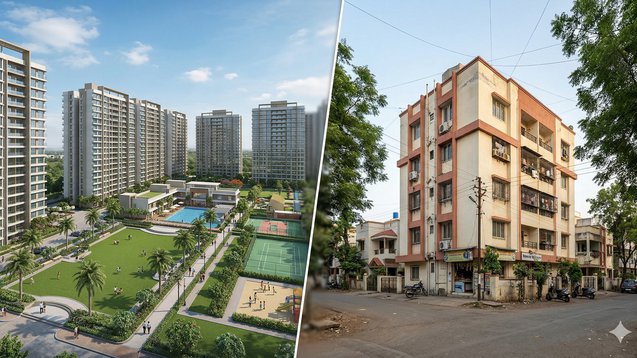
Introduction
Homebuyers face crucial structural decisions when they need to select between two distinct property types which include large townships and small residential communities. The two choices provide different ways to live which affect their financial costs and their future property value development. The Indian real estate market currently shows a growing trend of large integrated townships which developers construct throughout Tier 1 cities in Mumbai Delhi NCR and Bengaluru. The organized land parcels in Indore Lucknow and Coimbatore enable these Tier 2 cities to adopt township-style development. The market for township models is emerging in Tier 3 towns which mainly provide smaller societies and standalone buildings as their existing housing options. Before shortlisting properties on Property Aaj (https://www.propertyaaj.com), the real difference between these two formats must be understood to avoid expensive lifestyle incompatibilities. The following explanation requires us to deliver complete information.
What Is a Large Township?
The master-planned residential development of a large township occupies a vast area of land. The development contains several apartment towers and villa clusters that connect through its network of internal roads and landscaped gardens which include schools and retail shops and clubhouse facilities and sports courts and hospitals. The townships in Tier 1 cities operate as complete residential systems that provide all necessary services to their inhabitants. New integrated townships are being built along highways and emerging corridors which connect different parts of Tier 2 cities. Township projects in Tier 3 towns market themselves as premium lifestyle developments. The project requires extensive work because of its large size and its need for complete design coordination.
Small Society Definition
A small society typically consists of one or a few residential buildings with limited common amenities. The development operates as a residential community which exists within established neighborhood boundaries that separate it from large unoccupied territories. The urban environment of Tier 1 cities contains small societies which operate in their historically developed zones. The residential colonies of Tier 2 cities exist as compact apartment clusters which arrange their buildings around shared spaces. The predominant housing option in Tier 3 towns consists of small-scale societies and independent houses. The key characteristic of the space is its small size which supports close personal relationships.
Lifestyle and Community Experience
The social infrastructure of large townships provides extensive development to their communities. The complex offers multiple amenities which include jogging tracks, swimming pools, gyms, and parks along with retail stores and event spaces. Children who live in areas with higher population density can find friends to play with whenever they want.
Residents of Tier 1 cities benefit from internal township amenities which reduce their need to travel outside the township which leads to time consumption during their daily commutes. Structured community events together with organized layouts provide advantages to Tier 2 cities. The majority of Tier 3 townships deliver better living conditions than standard residential housing options. The presence of many people leads to decreased chances of deep personal connections. People who live in the same area as thousands of others will experience limited personal relationships because they know only a few neighbors. The people who live in small communities develop stronger social bonds with each other. When there are fewer families present, people will interact with each other in a way that creates closer personal connections. The community will need less time to reach a consensus when making decisions. The basic parking and lift access and small open space areas make up the limited amenities which most places offer to their visitors. Base your selection on your preference between large spaces and personal connections.
Amenities and Infrastructure
Townships provide better access to amenities than other areas. The integrated developments in Tier 1 cities combine educational institutions with medical facilities and retail centers and office buildings. The growing trend in Tier 2 townships now shows an expansion of their clubhouse facilities together with their outdoor green spaces. The modern amenities found in Tier 3 projects represent advanced features which older localities do not offer to their residents. Small societies usually provide essential facilities only. The system will not affect you unless you prefer to use public parks and gyms and external clubs. Township living provides better value for residents who require walking distance access to their daily needs. Evaluate whether you will realistically use high-end amenities before paying for them.
Maintenance Costs
The large townships require greater maintenance costs because their common areas are spread over vast areas while their security systems and landscaping needs and staff requirements need to be maintained. In Tier 1 cities, premium townships require substantial monthly maintenance costs. The maintenance expenses in Tier 2 cities show a moderate increase which has started to rise. The initial fees in Tier 3 townships start at lower rates but
will increase as the community develops additional services. Small societies generally have lower maintenance expenses due to limited facilities. You need to evaluate the total cost of ownership which extends beyond the initial purchase price.
Security and Safety
Large townships implement multiple security measures through their gated entrances which require multiple security personnel and use CCTV systems and internal monitoring equipment. The system proves its value in Tier 1 cities which experience high population density and heavy vehicle movement. Towns in Tier 2 and Tier 3 regions use the same approaches to attract family buyers. Small societies may use basic security systems or depend on their residents' knowledge of the area for protection. Established residential neighborhoods use informal social monitoring to make their streets safer. Organized township developments provide their communities with more advanced security systems than other types of security systems.
Location and Connectivity
The construction of substantial townships occurs in urban areas which provide sufficient land resources for development on their borders. First-tier cities experience extended travel durations because of current conditions, but later connectivity will be improved through infrastructure projects. Tier 2 cities also develop townships along expanding highways or bypass roads. Townships in Tier 3 towns exist beyond the conventional boundaries of established market areas. Small communities exist as part of established residential areas which provide easy access to market areas and schools and public transportation facilities. The installation small societies become beneficial when central location holds greater importance than available amenities.
Property Appreciation and Investment Potential
Large townships undergo their development process through multiple scheduled phases. Township early buyers who purchase properties before others will gain from rising property values that result from township infrastructure development. Integrated townships which exist in Tier 1 cities close to future metro stations and expressways demonstrate sustainable growth over extended periods. The early-phase development of corridors through which Tier 2 townships progress provides investors with affordable entry points to acquire properties that will increase in value. The premium prices of Tier 3 townships arise from their restricted availability of land resources. Established, prime neighborhoods with small societies experience continuous property value growth because of their limited land resources. The market for liquidity exhibits unpredictable changes. Township units attract buyers who seek a specific lifestyle while small society units in central areas attract buyers who prioritize their location selection. The historical pricing patterns on Property Aaj (https://www.propertyaaj.com) need to be compared through a detailed process.
Density and Privacy
The urban areas of large towns provide housing for thousands of people who live there. The area becomes lively because of this development yet it decreases the privacy people experience in shared spaces. The quiet atmosphere of small communities with their limited number of apartments creates a feeling of less populated space. The building will have decreased traffic in its elevator system and parking areas and main access points. People who value their personal space and desire low population density should choose small communities for their comfort needs.
Long-Term Governance and Management
The framework for Long-Term Governance and Management operates through two elements. Townships usually establish their administrative systems through designated management organizations and they hire specialized teams for their operational needs. The system maintains organized facility upkeep. However, decision-making becomes complicated because more residents need to be involved in the process. Small societies provide fast decision-making processes. However, they do not possess the ability to handle management operations through professional staff. The standard of governance determines how residents experience their living environment and the worth of their assets.
Who Should Choose a Large Township?
You will find a suitable location in a large township because you need integrated amenities and organized planning. The location meets your requirements because you want gated security and modern infrastructure. The area which you want to stay in needs to be only. The essential corridors for future development will deliver benefits to you in the distant future.
Which People Should Select a Small Society?
A small society may suit you if: You prefer central established neighborhoods. You value lower maintenance costs. You appreciate closer community bonding. You require a peaceful environment for your daily activities.
Conclusion
The selection process between a large township and a small society requires users to assess their lifestyle needs and investment requirements. The township system in Tier 1 cities provides residents with organized living spaces, but it results in extended travel times. The integrated projects of Tier 2 cities are experiencing rapid growth, which is transforming the standard of residential comfort. The residents of Tier 3 towns choose township living as their premium option, while they consider small societies to be their main choice because of their practical locations. Before you make your purchase through Property Aaj (https://www.propertyaaj.com), you need to evaluate your long-term objectives, your commuting requirements, your capacity to pay for maintenance, and your expected lifestyle. A township provides customers with both extensive space and exceptional accessibility. The small society provides residents with both close community ties and beneficial access to their surroundings. The correct selection process requires you to define your future ambitions.
FAQs
1. Do large townships require higher expenses for their development?
The presence of multiple amenities increases their acquisition costs and ongoing maintenance expenses.
2. Do small societies experience slower growth in value?
The central location of a property provides consistent value growth potential for its owners.
3. Do townships provide better security measures than small communities?
The organizations typically maintain additional security resources that complete security protocols.
4. Do families find township living to be their optimal residential choice?
The answer is yes because you prioritize access to parks and schools and community spaces that exist within the development.
5. Do townships charge their residents higher costs for upkeep?
The answer is usually yes because their facilities require more resources and their personnel expenses increase operational requirements.
6. Which investment option provides better returns to investors?
Investors should assess the investment opportunity by evaluating its geographical location and current development status and projected market demand.
Read more about property matters with our specialists and browse the latest property listings on Property Aaj. Download the app from the Play Store and App Store now for easy buying, selling, and renting!