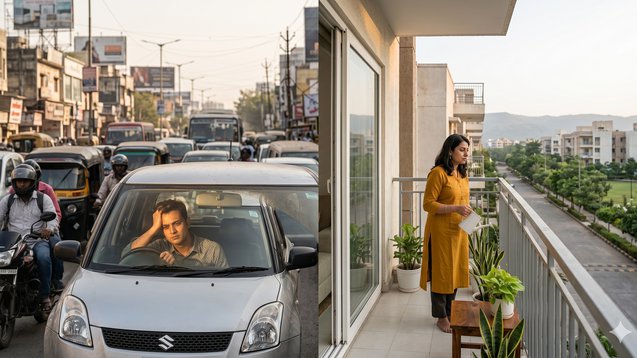
Should You Compromise on Distance From the Workplace?
Introduction
The home search process in India presents home seekers with a crucial decision which requires them to choose between two options. They have to choose between two options which require them to search for homes that either keep them close to their workplace or allow them to maintain their desired space requirements and budget needs. The decision seems obvious yet it creates a significant impact which extends across all aspects of your existence. The need to live in close proximity to work creates higher housing costs for residents of Mumbai and Bengaluru and Delhi NCR because it forces them to accept smaller living spaces. People can afford larger apartments which come with superior facilities or gated community living when they move 10 to 20 kilometers from their current location. The distance between two locations in Tier 2 cities such as Pune and Indore shows less variation yet remains distinct. The residents of Tier 3 towns experience shorter commute times because they must travel shorter distances to reach their work locations which have fewer available job opportunities and essential infrastructure elements. At first, many buyers think, “I can manage the commute.” The time people spend driving through traffic becomes a burden which affects their daily activities and bodily wellness and social connections with others. The essential question involves your location preferences for daily activities which you intend to conduct throughout your day. We will examine this matter through practical analysis which will help you evaluate the advantages and disadvantages of workplace distance reduction.
Why The Distance From Your Workplace Matters More Than You Think
The time you spend commuting is not about traveling from one place to another. It is a commitment you make every single day. In cities like Tier 1 cities it can take a long time to get to work. Sometimes it takes one to two hours to get to your workplace and one to two hours to get home. That is three to four hours of your day spent sitting in traffic or waiting for transport. When you add all these hours up over a year it is a lot of time. In cities like Tier 2 cities the time it takes to get to work is not as long but it is getting longer because the cities are getting bigger. In smaller towns like Tier 3 towns, the distance to your workplace is not too bad but the roads and transport system are not always good so traveling can be tough. The bad effects of a commute are not just about time:
You get very tired
You have time to spend with your family
You do not get much work done
You feel more stressed
When people look for homes on Property Aaj they first think about how much the home costs and how big it's.. Later on the distance from their workplace becomes a big deciding factor. The Distance From Your Workplace is not a number. It affects your whole lifestyle.
The Financial Trade-Off: Space vs Location
People choose to relocate because they need to find cheaper housing options. Urban areas maintain high property value because they contain their main business centers. The same amount of money lets you choose between a small 1BHK apartment close to your job and a large 2BHK apartment located in the distant suburbs. In Tier 2 cities, the price difference exists but is less extreme. Tier 3 towns offer affordable housing which provides residents with multiple options.
The trade-off results in two options:
Pay more for convenience
Save money and gain space
A professional in Bengaluru must decide between two housing options. The two locations create different living experiences. Property Aaj (https://www.propertyaaj.com) displays this pattern through its numerous property listings. The evaluation process needs to determine whether the savings make up for the cost of commuting.
Daily Life Reality: The Hidden Cost of Long Commutes
Here’s where many buyers underestimate the impact. A long commute initially appears to be a minor problem. But over time, it affects:
Sleep patterns
Work-life balance
Time for hobbies or fitness
Overall mental well-being
Imagine leaving home at 8 AM and returning at 8 PM. A person living in a big house with all their needs met will spend which portion of the day inside their home. This situation exists in Tier 1 cities. The situation is becoming more common in Tier 2 cities. The situation occurs in Tier 3 towns but it remains relevant for developing areas. Convenience encompasses both your location and the time you gain back from your daily activities.
Work Trends: Remote, Hybrid, and Changing Needs
The way we work is changing. Remote and hybrid work models have changed how buyers think about distance. For people who work from home three times a week they can choose to live in distant areas without facing any drawbacks. The current urbanization pattern has led people to prefer living in areas outside city centers. In Tier 2 cities, it’s encouraging people to upgrade homes. The process of moving back to their hometowns exists in certain cases throughout Tier 3 towns. The organization has the authority to modify its current work arrangements. The need for office space increases when your work requires you to return to the office for full-time duties. The stability of your work arrangement should guide your choices when you browse options on Property Aaj (https://www.propertyaaj.com).
Infrastructure and Connectivity: The Game Changer
Distance alone does not determine commute time because connectivity serves as the actual metric. A well-connected area with metro access or highways can make a 15 km commute manageable. The poorly connected 8 km route creates an exhausting experience for travelers. Tier 1 cities benefit from improved connectivity because their metro networks and expressways operate more efficiently. Tier 2 cities experience fast infrastructure development which occurs in an uneven fashion. The local planning initiatives determine how towns in Tier 3 achieve their connections.
Before compromising on distance, evaluate:
Road conditions
Public transport availability
Traffic patterns
Future infrastructure projects
Good connectivity enables people to perceive distant locations as nearer than they actually are.
Rental and Resale Perspective
People who invest in properties benefit from locations that provide easy access to workplaces. Properties close to business centers experience continuous demand from tenants who seek rental housing. Tenants in metropolitan areas prefer to handle their daily work because they need to travel shorter distances between their homes and workplaces. Rental yields in Tier 1 cities face significant effects from this specific factor. The factor has become more important in Tier 2 cities. People in Tier 3 towns still consider how far they must travel to important work centers. Developers expect that new construction projects will yield higher property value growth than existing developed properties will produce. The Property Aaj website lets users see property listings which they must evaluate based on their intent to use the property themselves or to make an investment.
Family Considerations: It’s Not Just About You
The process of deciding on purchases for a family requires people to make more difficult choices. Your family schedule gets disrupted by your long commuting times. Family time decreases because your late returning times especially affect children who need your presence. The distance you travel will bring you new benefits which include:
Better schools
Larger homes
Safer environments
Families living in Tier 2 and Tier 3 cities choose to live in larger homes with better outdoor space than they do in closer locations to their workplace. Your family needs will determine which balance works best for you.
Buyer Psychology: Short-Term Comfort vs Long-Term Satisfaction
The primary focus of buyers starts with visible elements which include larger houses and superior features and lower costs. The importance of intangible elements such as commute time increases throughout the day. In Tier 1 cities, experienced buyers often priorities location. The Tier 2 cities display a combination of both approaches. The decision-making process in Tier 3 towns depends primarily on available space. A common regret among buyers is underestimating commute impact. You should ask yourself which thing will become more important to you after one year.
When It Makes Sense to Compromise on Distance
Compromising on distance is an idea when you have a job that lets you work from anywhere or from home.
This is also true when the internet connection is really good.
The price of the place is another thing to think about.
If the difference in price is big it might be worth it.
If the property is going to be valuable for a time that is a good thing too.
In these situations the good things about the place may be more important than the fact that it's far away, from some things.
When You Should Avoid Compromising
You should think twice if:
Your job requires daily commuting
Traffic conditions are unpredictable
You value work-life balance
The time cost outweighs financial savings
In these scenarios, staying closer to work may be the better choice.
Finding the Right Balance
The ideal solution lies between two opposing endpoints of a range. Search for locations which provide:
A reasonable distance to the workplace
A good level of accessibility
Cost-effective services
A standard of living that meets basic requirements
The emerging micro-markets provide a balanced solution to this problem. The website Property Aaj (https://www.propertyaaj.com) provides search options which help you to make better choices.
Conclusion
Should you accept a work location that requires you to move farther away from home? The answer requires careful consideration because it involves complicated factors. People who need to travel to work should expect to pay additional expenses because their travel time will cost them both time and energy and their overall life experience. People who choose to live near their workplace will pay higher costs while dealing with smaller housing options, but they will gain daily access to their work and their personal life needs. Your decision requires you to evaluate your personal habits and work obligations and your future goals. India’s real estate market offers diverse options across all city tiers. You can identify a suitable home with proper planning through Property Aaj (https://www.propertyaaj.com) which allows you to match your current requirements with your future needs. A home needs to function as more than just your arrival point because it must serve as your permanent residence.
FAQs
1. Does living near your job location provide better employment benefits?
The answer is yes because living closer to work reduces commute times and decreases stress while workers achieve better work-life balance.
2. Can I work from home while choosing my own work schedule?
You can work remotely but you should wait until your work situation becomes permanent before choosing your distance work arrangement.
3. Does distance affect property value?
Yes, properties that are close to business areas usually cost more. Rent for more.
4. How do I evaluate commute impact?
When thinking about commuting look at how it takes to get there, what the traffic is, like and how easy it is to get around. Not just how far away it is.
5. Are outskirts good for investment?
Yes, they often offer better appreciation potential, especially with upcoming infrastructure.
6. Can I balance both factors?
Yes, by choosing locations with good connectivity that are not too far from your workplace.