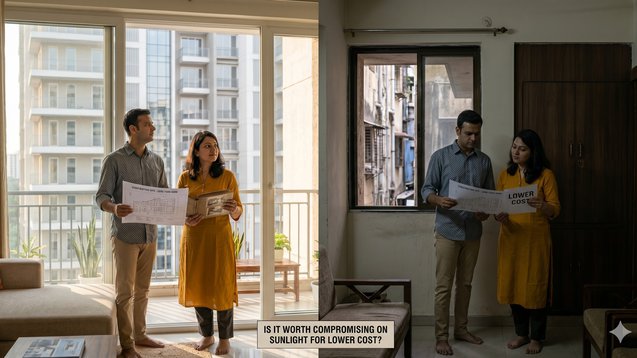
Is It Worth Compromising on Sunlight for Lower Cost?
Introduction
The first time you enter a home the first thing you will notice about the house is the amount of natural light it receives. People experience front rooms that receive direct sunlight because those spaces create an atmosphere which combines friendliness with energetic vitality and cozy warmth. The apartment appears perfect in all aspects except for its insufficient lighting which creates a feeling of confinement. Indian homebuyers encounter a practical problem which requires them to decide between two options which involve different amounts of direct sunlight exposure that affects the home purchase cost. The three major Indian cities of Mumbai, Bengaluru and Delhi NCR charge higher prices for apartments which receive direct sunlight through their east and south facing windows. North-facing homes and tightly packed societies at lower floors provide affordable housing options which lack direct sunlight access. Space planning in Tier 2 cities like Pune and Ahmedabad enables buyers to choose between different home designs which maintain light access throughout the day. The design of independent homes and the distribution of homes in Tier 3 towns create natural light access through their low-density patterns. The initial financial savings from a decision to spend less money on something competes against the future costs which result from no sunlight entering the building. The lack of sunlight still creates an impact on your comfort level which decreases your health condition and energy state and your home value decreases at the time of resale. What is the actual value of this arrangement which we need to make? We will use practical methods to help you select a decision which satisfies your financial requirements and your emotional needs and your physical health requirements.
Why Sunlight Matters More Than You Think
Sunlight is not about how bright a room is, it is about how a home feels and works. Natural light affects a lot of things like
the air we breathe and how well it circulates
how we feel and our mental health
how energy we use
how nice a place looks
In India people have always thought that sunlight is important. Old buildings were designed with open spaces in the middle and doors that face east to get lots of sunlight and fresh air. In new apartments, especially in big cities there is not always enough space for this. When you look at homes on Property Aaj (https://www.propertyaaj.com) you will see that the ones, with lots of sunlight, look really nice in pictures. Sunlight is not something, it is something we need to live well.
The Cost Factor: Why Sunlit Homes Are More Expensive
We need to talk about something that's pretty clear. Why do Sunlit Homes cost more money? In cities it is really just about how many people want something and how much of it is available. There is not a lot of space and a lot of buildings are close together so not many homes get a lot of sunlight. Developers usually charge more for things like
Higher floors because they get more sunlight and fresh air
Homes that face east and south because they get more sunlight
Apartments that're on the corner because they get more sunlight from two sides
In smaller cities people are still willing to pay more for Sunlit Homes but not as much. In smaller towns sunlight is not as important when it comes to how much a home costs because there are not as many buildings. So when you pick a home that does not get much sunlight you are usually saving a pretty big amount of money. The real question is.
What are you giving up when you choose a home with less sunlight?
What are you really losing with Sunlit Homes?
Daily Living Experience: The Hidden Impact
The moment arrives when you must choose for yourself. A home without sufficient sunlight can feel:
The space becomes wet during monsoon season
The space remains dark throughout winter
The space becomes less attractive to visitors
Artificial lighting serves as a partial solution but cannot achieve total replacement of natural light. Imagine you need to spend your entire day inside a space which remains dark even when the sun is shining outside. Your mood and energy levels will experience gradual changes throughout the day. The people in Tier 1 cities who experience extended work hours and daily travel time will find that their homes need better lighting systems. Natural light brings additional comfort benefits to people living in Tier 2 and Tier 3 cities where life moves at a more relaxed pace. Many homebuyers discover this fact after they complete their home purchase.
Health and Well-Being Considerations
Natural sunlight provides direct health advantages to people. Natural light exposure helps to:
Establish sleep patterns
Enhance emotional well-being
Eliminate dampness and mold
Space cleaning procedures
Homes with inadequate sunlight exposure face increased moisture problems which occur more frequently in humid areas such as Mumbai and Chennai. Well-lit homes maintain their natural state of cleanliness because they do not require artificial lighting. This matter holds special significance for families who include both young children and elderly relatives. The evaluation of Property Aaj (https://www.propertyaaj.com) options requires assessment of both existing space design and solar access throughout different times of the day.
Resale Value and Rental Demand
People who invest in real estate need to understand how sunlight affects their investments. Homebuyers and renters show a strong preference for properties that provide:
Good natural light
Proper ventilation
Open views
Homebuyers in Tier 1 cities make their purchasing decisions based on this particular tendency. The trend has gained importance in Tier 2 cities. In Tier 3 towns, the practice continues to create value for properties although there exists a smaller impact on property pricing. Homebuyers who choose a dimly illuminated house because it costs less will save money now but face restricted choices in the future. The Property Aaj website (https://www.propertyaaj.com) shows that properties with good lighting receive higher viewing rates and faster buyer responses.
When It Makes Sense To Compromise On Sunlight
There are times when it's okay to compromise on sunlight.. For example:
If the price of a place with a lot of sunlight is really high
If the place is in a good location
If you are buying the place just to invest your money
If you do not plan to use the place often
In big cities some people choose to buy apartments on lower floors or apartments that do not get a lot of sunlight so they can afford to live in a good area. In cities people may accept a place with a little less sunlight if it means they get better amenities or more space. The main thing is to know what you are giving up. You have to think about what's important to you when you are looking for a place to live and that is Sunlight. So you have to decide if you really need a lot of Sunlight or if you can live with a less Sunlight.
When to Avoid Compromising on Sunlight
There are cases where it's not a good idea to compromise on sunlight. Avoid it if:
You are buying a home for yourself to live in for a time
Your home feels very dark in the daytime
The air does not move well in your home
There is a chance of dampness. Mold growing
In such situations saving money may not be worth it if it makes you uncomfortable. A home is where you live every day. It is not something you own.
Tier-Wise Perspective Across India
The analysis will show different effects from this decision because different types of cities exist. Sunlight becomes a special asset for Tier 1 cities because their high population density creates a need for artificial light. Buyers need to choose between three important factors which include their budget and preferred location and required daylight. The improved planning system in Tier 2 cities enables architects to design homes that receive complete daylight without any need for special agreements. The combination of independent houses and low traffic situations in Tier 3 towns creates better lighting conditions, which reduces the need for concern about this issue. The understanding of your city operations will lead you to make a better decision.
Balancing Budget and Comfort
So how do you strike the right balance?
Look for:
Mid-floor units that provide adequate illumination
Apartments that offer unobstructed sightlines
Properties that have effective design and window positioning
Societies that maintain appropriate distances between their structures
People need only enough natural light to meet their needs instead of complete sunlight.
Through Property Aaj (https://www.propertyaaj.com) users can discover homes that match their financial limits and personal comfort requirements.
Buyer Psychology: Short-Term Savings vs Long-Term Satisfaction
People tend to concentrate on their present savings. A home that costs slightly less seems like an intelligent purchase. But over time, daily comfort becomes more important. Many buyers who compromise on sunlight initially don't think much about it-but later wish they had prioritized it more. Experienced buyers in Tier 1 cities give priority to light and ventilation. People in Tier 2 cities now begin to learn about this issue. People in Tier 3 towns usually consider this matter as common knowledge. The real question is what will matter to you after a few years.
Conclusion
Does spending less money on a project require you to give up access to sunlight? In some situations, it is appropriate to make trade-offs when the benefits of the trade-off become clear. The property needs to meet your complete requirements before you can accept a minor concession which should only be approved when the savings reach significant levels and the location proves to be exceptional. The absence of sunlight will make your space uncomfortable which will also impact your health and decrease your property's value therefore you should reconsider your decision. A well-lit home creates an attractive appearance which also improves the overall atmosphere of the space. Your home provides support for your lifestyle while it improves your mood and increases your property value over time. India offers various choices through its different real estate markets. You can discover a suitable home through Property Aaj (https://www.propertyaaj.com) which enables you to evaluate properties according to both their price and their ability to provide comfort. Your home should function as a financial asset which will create daily happiness for you throughout every moment of your life.
FAQs
1. Does sunlight really affect property value?
Yes, homes with good natural light become more appealing to buyers and tenants which results in higher resale and rental value.
2. Can artificial lighting replace sunlight?
Artificial lighting improves visibility yet it fails to provide the health and mood advantages of natural light.
3. Do lower-floor apartments receive less sunlight during daytime hours?
The statement needs assessment because lower-floor apartments receive less sunlight in dense urban environments.
4. Is sunlight more essential for specific urban areas?
The answer is affirmative because sunlight in humid cities such as Mumbai and Chennai prevents dampness while enhancing indoor environments.
5. Can layout compensate for lack of sunlight?
The study found that proper window arrangement together with proper ventilation systems can enhance light distribution but building orientation remains an essential factor.
6. Should I priorities sunlight over budget?
The ideal solution requires a balanced approach between the two competing needs. The study found that direct sunlight changes indoor comfort levels so people should not make excessive compromises.