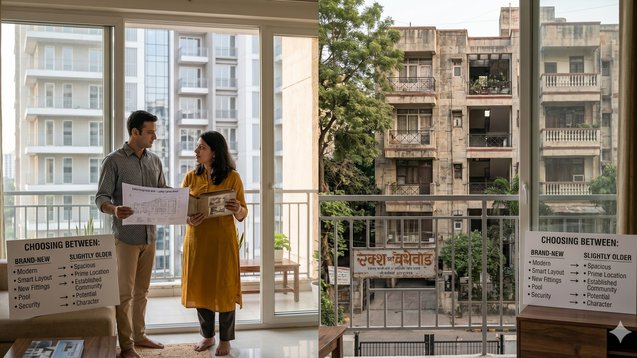
Choosing Between Brand-New vs Slightly Older Property
Introduction
When you start your home-buying journey in India, one question quietly shapes your entire decision: should you go for a brand-new property or consider a slightly older one? The answer appears straightforward after initial examination. New homes come with modern designs, fresh construction, and the excitement of being the first owner. But then reality sets in older properties often offer better locations, larger layouts, and sometimes even better value. The decision-making process becomes more challenging in Mumbai, Bengaluru, and Delhi NCR because of this particular decision. New projects develop in remote areas, while existing homes maintain their presence in developed regions which possess advanced infrastructure. The two options remain accessible to consumers in Tier 2 cities such as Pune and Jaipur and Kochi, but price competition remains less intense. Existing properties maintain their presence in prime locations within Tier 3 towns, while new developments begin to extend their boundaries. The choice between contemporary life and actual worth needs your judgment. The truth is, there’s no one-size-fits-all answer. Your lifestyle, budget, long-term plans, and even your tolerance for maintenance all play a role. Let's simplify the situation into practical components which will enable you to make a decision that you can trust.
What Makes a Property Brand New or A Little Older?
To figure out the difference we need to know what we mean by brand older properties. A brand new property is one that is
still being built or just finished
has designs and things like pools and gyms
meets the latest rules for buildings
has never been used before or has been used very little
A property that is a little older is
around five to fifteen years old
has had people living in it before
is in a neighborhood that has been around for a while
has everything around it already built
In cities like Tier 1 cities older properties are often in the best spots while brand new ones are on the outskirts. In cities like Tier 2 and Tier 3 cities the difference is not as big but it still matters. When you look at properties on Property Aaj (https://www.propertyaaj.com) you will see both brand older properties side by side. Each one is nice, in its own way.
Your Location Advantage functions as your most important decision-making element.
The reality shows that location holds more importance than all other factors. The location of older properties provides them with a strong competitive edge. Established areas provide them with access to:
Better connectivity
Proximity to offices and schools
Mature infrastructure
Social ecosystem already in place
In metros this can mean living closer to your workplace. In Tier 2 cities it could mean being near city centers. In Tier 3 towns residents typically obtain essential services through public transportation. Developers usually build new properties in emerging markets. The new properties bring about immediate challenges which developers must address but they also provide developers with upcoming business prospects. People must decide between experiencing immediate convenience or working toward their future progress.
Price Comparison: Immediate Cost vs Long-Term Value
The analysis of pricing leads to interesting developments from that point onward. New buildings charge higher rates for every square foot because they include modern features and established brand names. Developers provide customers various payment options because they want all customers to receive discounts through pre-purchase offers. Older properties can be more cost-effective. The following benefits you will receive:
Larger carpet area
Better location
Lower price per square foot
The price difference between two markets reaches extreme levels within Tier 1 cities. Tier 2 cities show a more equal distribution of pricing differences. People in Tier 3 towns prefer to buy older properties because they fit their budget requirements. Property Aaj users should use both price and value information to make their property selection at https://www.propertyaaj.com.
Construction Quality: Old Strength vs New Standards
People often think that new construction is always better. That's not always the case. Older buildings those built 10 to 15 years ago often have:
Larger rooms
Thicker walls
construction quality
However they may not have modern features.
New properties have:
Building materials
Modern safety standards
Designs that save energy
In big cities like Tier 1 well-known builders follow high standards. In cities like Tier 2 and Tier 3 the quality can be different so it's very important to choose a builder with a good reputation. The point is not old versus new, it's about how the property is built and construction quality matters. It's all about finding a property that is built well. The construction quality is what matters.
Amenities and Lifestyle Features
This is where new properties clearly stand out. Modern projects offer:
Clubhouses
Gyms
Swimming pools
Security systems
Smart home features
Older properties may lack these, or offer limited amenities. Metro areas consider lifestyle amenities as essential selling points. Tier 2 cities now treat these amenities as standard features. Tier 3 towns still experience development of these amenities. New properties present better options for people who prioritize lifestyle preferences. You need to evaluate your actual use of these amenities before making a decision.
Maintenance and Hidden Costs
Maintenance costs exist for all older properties which must be preserved. You will encounter the following expenses:
Repair costs
Renovation expenses
Higher society maintenance charges
However, these costs are often predictable. New properties usually require minimal maintenance initially. But don’t forget:
Maintenance charges for amenities can be high
Initial costs may include GST (not applicable for resale)
Maintenance expenses in Tier 1 cities show high costs for both alternatives. Maintenance expenses in Tier 2 and Tier 3 cities show lower costs. You must consider both long-term expenses and the initial purchase cost.
Legal and RERA Considerations
The legal system needs better understanding because it requires specific elements to establish complete legal clarity. RERA applies to all new properties because it provides
Building owners must prove their construction work
Developers need to protect buyers through additional security measures.
The verification process of older properties needs to include
The identification of all property owners
The examination of previous ownership information
The verification process of society approvals.
In Tier 1 cities, legal processes are more efficient than Tier 2 and Tier 3 cities which require additional safety measures. The users of Property Aaj (https://www.propertyaaj.com) must complete all legal checks before they proceed to complete any contract.
Rental and Resale Potential
From an investment perspective, both options have advantages. Older properties in prime locations offer two benefits through their:
capacity to attract continuous rental demand
ability to generate rental income from their first day of operation.
New properties provide two advantages through their:
increased value development in emerging markets
ability to attract high-end tenants through their property features.
In metropolitan areas, location serves as the primary factor that determines rental demand. In Tier 2 cities, both factors matter. In Tier 3 towns, appreciation plays a bigger role. Your investment strategy should guide your choice.
Buyer Psychology: Emotional vs Practical Thinking
The emotional aspect of home buying is the main reason people purchase homes. The experience of entering a new home brings excitement because all its components exist in their original state and modern design. The benefits of older homes include practical value and adequate living space and established residential areas. In Tier 1 cities, buyers often lean towards practicality due to high costs. The buying behavior in Tier 2 cities shows both practical and emotional tendencies. In Tier 3 towns, emotional comfort often plays a bigger role. Your decision making process will improve when you understand your own mental state.
When Should You Choose a Brand-New Property?
A new property makes sense when:
You want modern amenities
You’re comfortable waiting (if under construction)
You prefer low initial maintenance
You’re investing for future appreciation
The property suits buyers who seek both lifestyle benefits and long-term growth potential. The property suits buyers who seek both lifestyle benefits and long-term growth potential.
When Should You Choose an Older Property?
An older property is a better choice when you think about it. You should choose a property when the location is the most important thing to you.
You need to move right away.
You want a place to live.
You are looking for a deal on an older property.
This is great for people who buy properties. They just want something that is practical and works for them, like an older property.
Finding the Right Balance
You don’t always have to choose one over the other. The best options available to you include:
Recently completed projects in developing areas
Well-maintained older homes in good societies
New properties in semi-developed locations
The balanced options available on Property Aaj (https://www.propertyaaj.com) enable you to make better decisions.
Conclusion
The choice between selecting a brand-new property or an existing property from a previous construction period depends on your personal requirements. A new property meets your requirements if you need modern living spaces and various amenities and future development possibilities. The better choice for you is an older property because you value its location and existing space and immediate readiness for use. The Indian real estate market supports both property types because of its various market segments. The essential requirement for decision-making lies in matching your selection to your personal lifestyle and financial objectives and future aspirations. People can discover their ideal home through proper research combined with Property Aaj, which offers extensive resources at https://www.propertyaaj.com.
FAQs
1. Is a new property always better than an older one?
The answer is no because new properties bring modern features whereas older buildings provide superior location and value.
2. Do older properties have higher maintenance costs?
The statement is true because older properties need repairs and renovations which require financial resources but these expenses can be controlled through effective management.
3. Are new properties safer for legal protection than existing properties?
The answer is yes because RERA establishes transparent project operations which safeguard buyer rights in new developments.
4. Which option is better for investment?
The answer depends on which properties you choose because new properties will increase in value whereas existing properties will provide you with immediate rental revenue.
5. Can older properties be renovated easily?
The answer is yes however you need to include renovation expenses as part of your financial plan.
6. How do I choose between the two?
The process requires you to assess your essential requirements which include your preferred location, your available funds your daily activities and your future objectives.